

5 Backstage Etiquette Rules Directors Notice: Checklist for Performers

Backstage etiquette demands one thing above all else: be silent, be punctual, be respectful, and do exactly what the stage manager and crew ask, the moment they ask it. Everything else, from where you stand in the wings to how you treat someone else’s costume, flows from that single expectation. This guide breaks it down into the practical rules you can start applying at your very next rehearsal.
TL;DR:
Arrive early and prepare fully to avoid last-minute scrambling that can cause missed cues or safety hazards during a show.
Keep noise levels minimal and follow stage management instructions precisely, including reading back cues to demonstrate understanding.
Never touch or borrow props and costumes without permission, and always check your assigned items before performance to prevent crises.
Maintain a tidy, respectful green room, and keep shared spaces free of clutter, food, and personal belongings to foster a cooperative environment.
Follow backstage safety protocols strictly, including unobstructed fire exits, proper footwear, and immediate compliance with crew instructions during emergencies.
Table of Contents
What is backstage etiquette, and why does it matter so much?
Backstage etiquette is the unwritten (and sometimes written) code of conduct that keeps a production running safely and smoothly once the house lights go down. Some people call it stage discipline, others “performer conduct guidelines” or simply “how to behave backstage.” Whatever label you use, it covers the same territory: noise control, punctuality, respect for other people’s belongings, and instant compliance with stage management.
It matters because a theatre backstage is genuinely a workplace, not a hangout. University drama departments treat backstage areas as spaces requiring the same discipline as a rehearsal room, with strict expectations around silence and tidiness. Break that discipline, even briefly, and you risk a dropped cue, a missed entrance, or worse, someone tripping over a cable in the dark. Performers who consistently observe these standards tend to become the ones directors want back next season, because reliability and courtesy backstage build a reputation that follows you from production to production.
The core backstage rules every performer should know
Most backstage problems trace back to one of a handful of broken rules. Learn these, and you will avoid nearly every awkward moment a green room can throw at you.
Arrive early and be genuinely ready at your call time. “Half hour” means half an hour before curtain, not half an hour before you start doing your make-up.
Keep noise to an absolute minimum in the wings and backstage corridors. Whisper if you must speak at all, and never stand where the audience can catch a glimpse of you.
Follow stage management and crew instructions immediately, and read them back. If you’re told “standby, LX cue 42,” repeat it so the caller knows you’ve heard correctly.
Never touch another performer’s props, costumes, or personal items without asking first. Someone’s headpiece is not communal property, however tempting it looks.
No eating, drinking, or smoking in costume. Keep your things labelled and tidy so nobody else mistakes your kit for theirs.
Pro Tip: Practise your readback out loud during tech week, not just in your head. Saying “copy, standing by” clearly and audibly trains the habit before opening night, when nerves make people mumble.
Preparation and kit: what to pack before performance day
Half the panic that happens backstage on show night comes down to poor preparation, not bad luck. A performer who has packed properly rarely needs to ask anyone for anything.
Spare tights or socks, safety pins, and a small roll of gaffer or spike tape
Basic make-up for touch-ups, plus a clear water bottle (spillable drinks near costumes are a hazard)
Non-staining snacks that won’t leave marks on hired costumes
A clear plastic bag for your kit, so you can find anything in a dark dressing room in seconds
Labelling matters more than people expect. When items are clearly labelled and packed in clear bags, retrieval during a fast costume change becomes second nature rather than a scramble. Before the house opens, walk your props table and costume pre-set yourself; don’t assume the last person left everything where it belongs.
Dressing-room and green-room conduct
Shared spaces reveal character fast. A tidy, considerate green room usually signals a tidy, considerate cast, and the reverse is just as visible to a director watching from the wings.
Clear away rubbish, wrappers, and personal clutter the moment the curtain call ends, not the next morning
Never bring uninvited visitors into dressing rooms without checking first
Respect other performers’ pre-show rituals; some people need silence, others need music, and neither is wrong
Keep food and drink away from shared mirrors, wigs, and hanging costumes
None of this is about being precious. It’s about making a cramped, shared space work for everyone using it, sometimes for eight shows a week.
Staying unseen and cue-ready in the wings
The wings are where backstage etiquette gets tested in real time, because there’s no room for hesitation once the show is running.
Stand behind the legs (the vertical curtains masking the wings) so you’re never visible from the auditorium, and check your sightline from the seats during a technical rehearsal if you’re unsure
Respond to “five minutes” or “beginners” calls with a clear, audible readback such as “thank you, five”
Move through wing space quietly and deliberately; never rush past a stagehand carrying scenery
Keep fire exits and quick-change areas completely clear at all times
Pro Tip: If you’re not sure whether you’re visible from the stalls, ask the deputy stage manager to check during a break rather than guessing. It takes thirty seconds and saves an embarrassing moment mid-show.
Handling props, costumes and equipment responsibly
Props and costumes belong to the production, but responsibility for them belongs to you the moment they’re assigned to your track.
Don’t touch, borrow, or “tidy” another performer’s props or costume pieces unless they’ve explicitly asked you to
Check your own pre-sets and props before every performance; don’t assume yesterday’s placement still holds
If something is missing, damaged, or in the wrong place, tell stage management immediately rather than trying to fix it yourself
A missing prop reported early is a two-minute problem. A missing prop discovered thirty seconds before an entrance is a crisis, and it’s the stage manager’s job to know about it first, not the last thing they hear about.
Safety rules and why the crew’s word is final
Backstage rules exist mostly for safety, even the ones that seem purely about manners.
Keep fire exits, fire extinguishers, and escape routes completely unobstructed, always
Wear closed-toe shoes backstage and in workshop or scene-dock areas; sandals and bare feet near flown scenery or trucks are a genuine hazard
No smoking, and no alcohol while signed in, because being signed in means you’re legally at work, not off duty
Follow the stage manager and department heads (props, wardrobe, sound, lighting) instantly; their calls are timed to the second and built around everyone’s safety
Backstage crew wear predominantly black, often called “blacks,” precisely so they can move invisibly and quickly without becoming a safety distraction themselves. Understanding how crew roles divide responsibility helps you know exactly whose instruction takes priority in any given moment, and why arguing with a stagehand mid-scene-change is never the right call.
Phones, recording and staying performance-ready
Put your phone away, properly away, the moment you arrive. Most companies and drama departments explicitly ban phones from backstage and dressing-room areas, and unauthorised photography or recording during a show is one of the fastest ways to damage trust with a company, quite apart from any copyright issue. If you’re ever unsure whether recording is permitted for a curtain call or rehearsal, check the venue’s own policy rather than assuming.
Keep phones off or stored well away from the wings, not just on silent
Never film or photograph without explicit permission from stage management
Eat small, non-staining snacks and sip water regularly across a long show day
Bring a warm layer for cold get-ins and quick stretches between scenes to avoid muscle strain
Pro Tip: A short breathing routine, four counts in, four counts out, done quietly in the wings, settles pre-entrance nerves far faster than scrolling a phone screen.
Ocean Theatre in practice: how these rules look in a youth production
Call times are typically built around a simple structure: arrival, kit check, vocal and physical warm-up, then costume and props check well before “half hour” is called. Young performers rehearsing productions such as Anastasia or Beauty and the Beast follow the same readback habits as professional companies, repeating calls like “thank you, five” so nothing gets lost in a busy wing space.
Inclusive backstage practice matters just as much. Adjustments for sensory needs, mobility, or communication preferences are built into rehearsal planning wherever possible, reflecting the standards set out in Ocean Theatre’s accessibility statement. The result can be a backstage culture where young performers learn professional habits similar to those seasoned performers rely on, at a pace that suits a first production.
Handling conflicts or disagreements backstage
Tension backstage is almost inevitable eventually, whether it’s a costume dispute, a disagreement over blocking, or simple nerves boiling over during a stressful tech week. How you handle that moment says more about your professionalism than almost anything else on this list.
The first rule is timing: never argue during a scene change, a cue sequence, or anywhere near the wings while a show is running. If something is wrong, flag it quietly to the stage manager or your department head and let them decide when and how to address it. Raising your voice backstage during a live performance doesn’t just look unprofessional, it risks distracting someone mid-cue.
The second rule is chain of command. Performers should not try to resolve disputes with crew members directly if the disagreement is about scheduling, safety, or responsibility, because those calls belong to stage management. If two performers disagree over a shared prop or a blocking change, take it to the director or stage manager rather than settling it between yourselves in the corridor. This isn’t about removing your voice from the process; it’s about keeping decisions consistent and keeping the show safe.
Save the actual conversation for after the show, once everyone has had a chance to calm down. Most disagreements that feel enormous in the heat of a tech run look considerably smaller the next morning, once you can talk them through properly rather than in a rushed five-minute gap between scenes.
Etiquette for working with technical crew and stagehands
Crew members carry enormous responsibility, often invisibly. A stagehand moving scenery in the dark, a follow-spot operator tracking your every step, a wardrobe assistant managing a sixty-second quick change: none of that works if performers treat crew as background staff rather than colleagues.
Basic courtesy goes further than people expect. Learn crew members’ names if you can; being greeted by name rather than “hey, you” changes the whole tone of a backstage relationship. Never move furniture, props, or set pieces yourself unless you’ve been specifically told to; crew track positions precisely, often with spike marks invisible to anyone but them, and an unplanned shift can cause a genuine hazard in blackout.
If a quick change requires a dresser’s help, stand still and follow their lead rather than trying to help by grabbing at your own costume. Dressers work fast, in low light, often against a countdown of seconds, and an “helpful” performer moving unpredictably slows the whole process down.

Give feedback through the right channel too. If a costume piece is uncomfortable or a prop feels unsafe, tell your stage manager or the relevant department head rather than confronting a crew member directly mid-run. They’ll relay it accurately and make sure it’s actually fixed, rather than leaving an awkward exchange hanging over the rest of the run.
Personal hygiene and scent considerations backstage
Dressing rooms are small, warm, and shared, sometimes by a dozen performers changing in and out of costume several times a night. Personal hygiene stops being a private matter the moment you’re sharing that space, because your habits affect everyone around you.
Strong perfume or aftershave is one of the most common, and most avoidable, backstage complaints. Costumes absorb scent quickly, and a heavy fragrance can linger in a shared rack for days, affecting performers who wear that same costume on alternate casting nights. Keep fragrance minimal or skip it entirely on show days.
Freshly laundered practice clothes and clean feet matter more backstage than almost anywhere else, given how often costumes are shared, layered, or handled by dressers working at close range. Deodorant is essential, but go easy on it too; overpowering scent in a confined green room is just as disruptive as none at all.
Hair and make-up removal matter as well. Leaving stage make-up on a shared pillow, headpiece, or costume collar creates cleaning problems that fall on wardrobe staff, not you. A quick clean-up routine at the end of every show, wiping down your area and removing make-up before you leave, keeps shared spaces genuinely usable for the next performer or the next show.
Appropriate behaviour during breaks and downtime
Downtime backstage, whether it’s a costume-change gap, an interval, or a long stretch waiting between scenes in a big ensemble number, still counts as being at work. That doesn’t mean sitting in silence, but it does mean staying alert and considerate.
Keep conversation quiet enough that it doesn’t carry through to the wings or auditorium, particularly during a scene that’s still running elsewhere in the building. Save loud laughter, gossip, or heated discussion for after the show entirely. Use breaks to actually rest: stretch gently, hydrate, run lines quietly, or simply sit still rather than pacing through busy crew areas.
Avoid using downtime to wander into spaces you don’t need to be in, particularly technical areas like the fly floor, sound booth, or lighting box, unless you’ve been specifically invited. Crew are usually working through their own checklists during what looks like a quiet moment to you.
Staying performance-ready matters too. It’s tempting to fully switch off during a long interval, but a performer who’s gone completely cold, physically and mentally, often struggles to snap back into character for act two. A short physical reset, a few lines run under your breath, or a quiet moment of focus works far better than scrolling a phone for twenty minutes straight.
Managing emergencies or unexpected events backstage
Every production, however small, needs a shared understanding of what happens when something goes wrong, because the moment it does, it is not the time to start improvising a plan.
If you hear a fire alarm, stop whatever you’re doing and follow the venue’s evacuation plan exactly, even mid-scene if the stage manager calls it. Never assume an alarm is a test; treat every one as real until told otherwise. Know where your nearest fire exit is before the show starts, not after the alarm sounds, and keep that route mentally mapped throughout the run.
For smaller emergencies, a costume malfunction, a missed cue, a sudden injury, the same principle applies: alert stage management immediately rather than trying to solve it quietly yourself. A wardrobe malfunction reported in the wings can often be fixed in seconds by a dresser standing by; one hidden out of embarrassment can turn into a much bigger problem on stage.
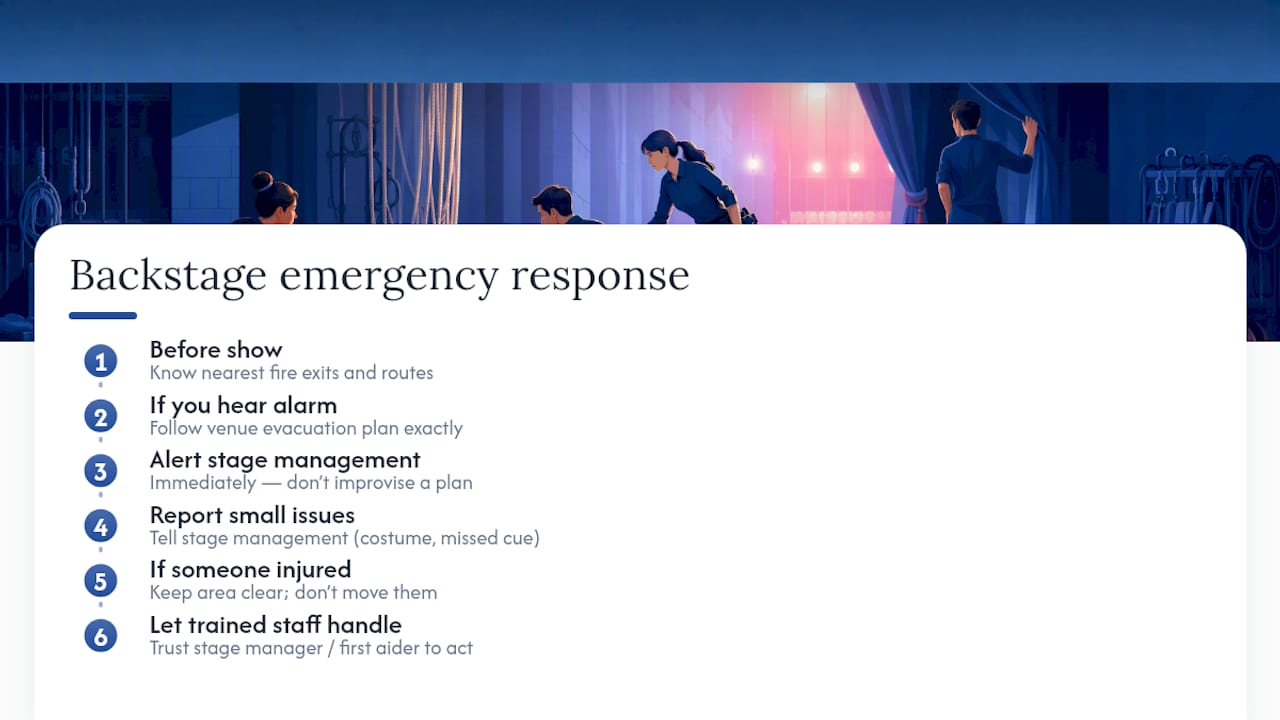
If a fellow performer is injured or unwell, don’t crowd them or try to move them unless there’s immediate danger. Call for the stage manager or first aider by name if you know it, and keep the area around them clear. Panic spreads fast backstage in a confined space, and the calmest person in the room is usually the one who’s simply trusting the process and letting the people trained to handle it, handle it.
Where to find more detailed backstage guidance
For rules specific to a particular venue, always check its own handbook before relying on general advice. Stage-management handbooks such as the UCF Stage Management Handbook and university performer conduct codes cover dress codes, sign-in procedures, and safety rules in far more detail than any single article can. If you’re preparing for auditions in another discipline, the same preparation logic applies well beyond theatre, as shown in this clarinet audition preparation guide. Always confirm a venue’s specific policies on recording, fire safety, and accessibility rather than assuming they match what you learned elsewhere.
An editorial take on getting backstage conduct right
Most backstage etiquette advice online treats every rule as equally important, and that’s where it goes wrong. Silence in the wings and following stage management’s calls sit far above dress codes and snack choices in terms of consequence. Get the small stuff wrong and you’ll feel embarrassed. Get the big stuff wrong, ignoring a standby call, touching someone else’s prop mid-run, wandering into a clear sightline, and you risk derailing the show for everyone else on stage.
The conventional advice also underplays how much of this is learnable through repetition rather than instinct. Nobody is born knowing to whisper “thank you, five” back to a stage manager; it’s a habit built through rehearsal after rehearsal, which is precisely why youth theatre training matters so much. A performer who’s practised these rhythms at fourteen carries them, unthinkingly, into every production that follows.
If there’s one thing to prioritise above all else, it’s this: treat every instruction from stage management as final, immediately, without negotiation, in the moment. Everything else on this list supports that single habit. Get that right, and the rest of backstage etiquette tends to follow naturally.
— Andrew
Ready to build these habits in a genuinely supportive rehearsal room? Explore Ocean Theatre’s upcoming productions, including Guys & Dolls and Les Misérables, or visit Ocean Theatre’s home page to see how young performers aged 14 to 19 across Berkshire learn professional stagecraft from their very first call time.
Sources
Recommended
Comments