

Rescue Flat Scenes: 3 Blocking in Theatre Templates for Youth Casts
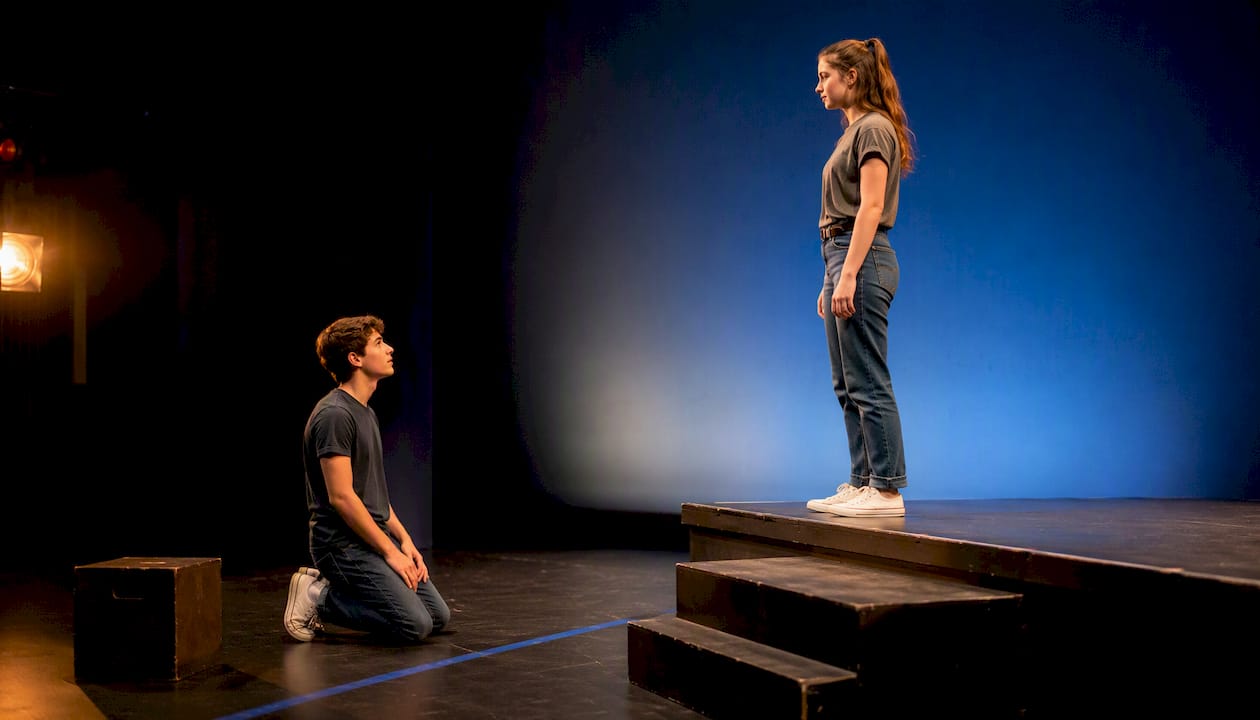
Blocking is the planned positioning and movement of actors during a scene, mapped out so every entrance, cross and pause serves the story rather than confusing it. Done well, it clarifies who matters in a moment, where the audience should look and how a scene breathes. Directors and stage managers set it during rehearsal, then record it so the same clarity happens at every performance.
TL;DR:
Effective blocking manages sightlines and relationships, helping the audience understand scene dynamics before any dialogue occurs.
Using a nine-zone grid and specific terminology like upstage, downstage, and cross simplifies rehearsals and ensures consistent staging.
Motivated movement based on characters’ objectives enhances the scene’s clarity and keeps actors’ movements motivated and purposeful.
Documenting blocking with clear notation and spikes allows understudies and crew to reproduce performances accurately and maintain consistency.
For young performers, simple templates and guided practice build confidence, teamwork, and instinctive staging skills more effectively than complex notation.
Table of Contents
What is blocking in theatre? A working definition
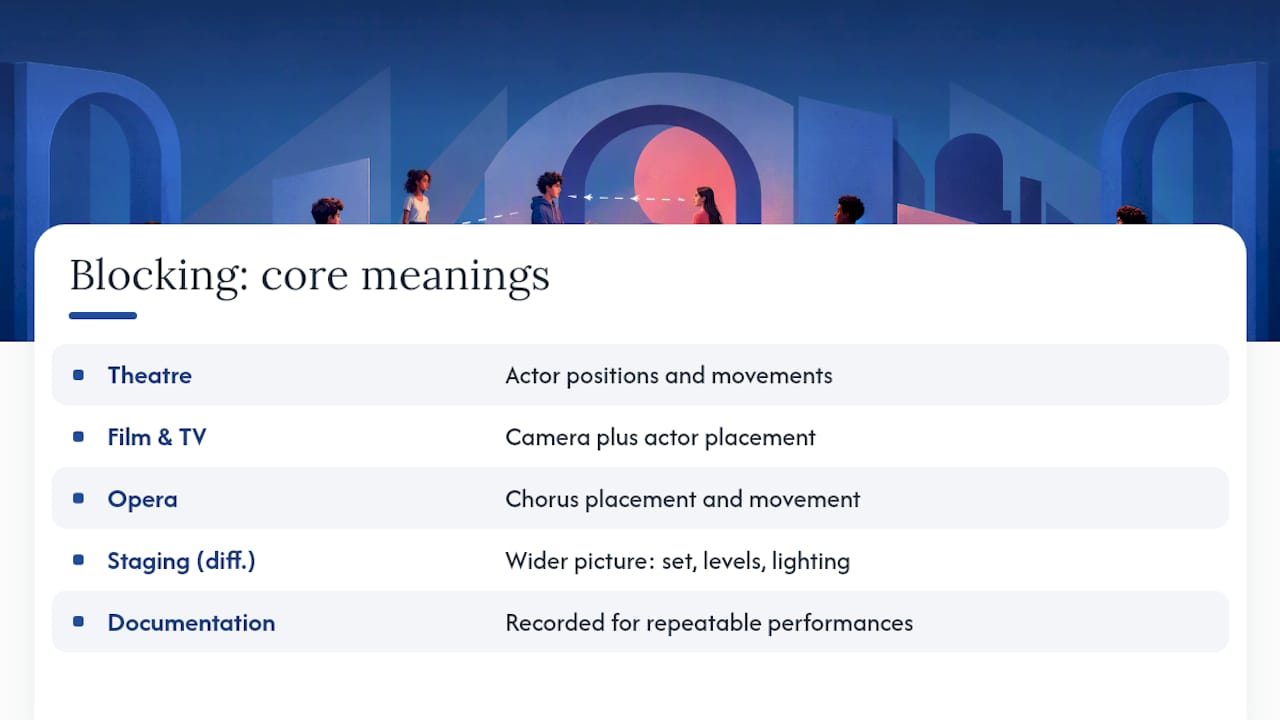
Blocking is the precise positioning and movement of actors on stage, and it is usually documented by the director or stage manager) so the same staging can be reproduced night after night. That is the textbook version, but the term stretches further than most drama students expect. Film and television crews use “blocking” for camera and actor placement too, and opera directors talk about blocking a chorus the same way a straight-play director blocks two people arguing in a kitchen.
You will also hear “staging” used almost interchangeably with blocking, though staging tends to cover the wider picture: set pieces, levels and how movement coordinates with lighting design so actors stay visible rather than accidentally stepping into shadow. Historically, blocking has moved a long way from the static tableaux of Victorian melodrama, where actors froze in meaningful poses, towards the fluid, motivated movement expected in realist and contemporary staging.
Whoever calls the blocking, someone has to write it down. Without a record, a company relearns the show from memory every rehearsal, and understudies have nothing to work from.
Why blocking matters more than traffic control
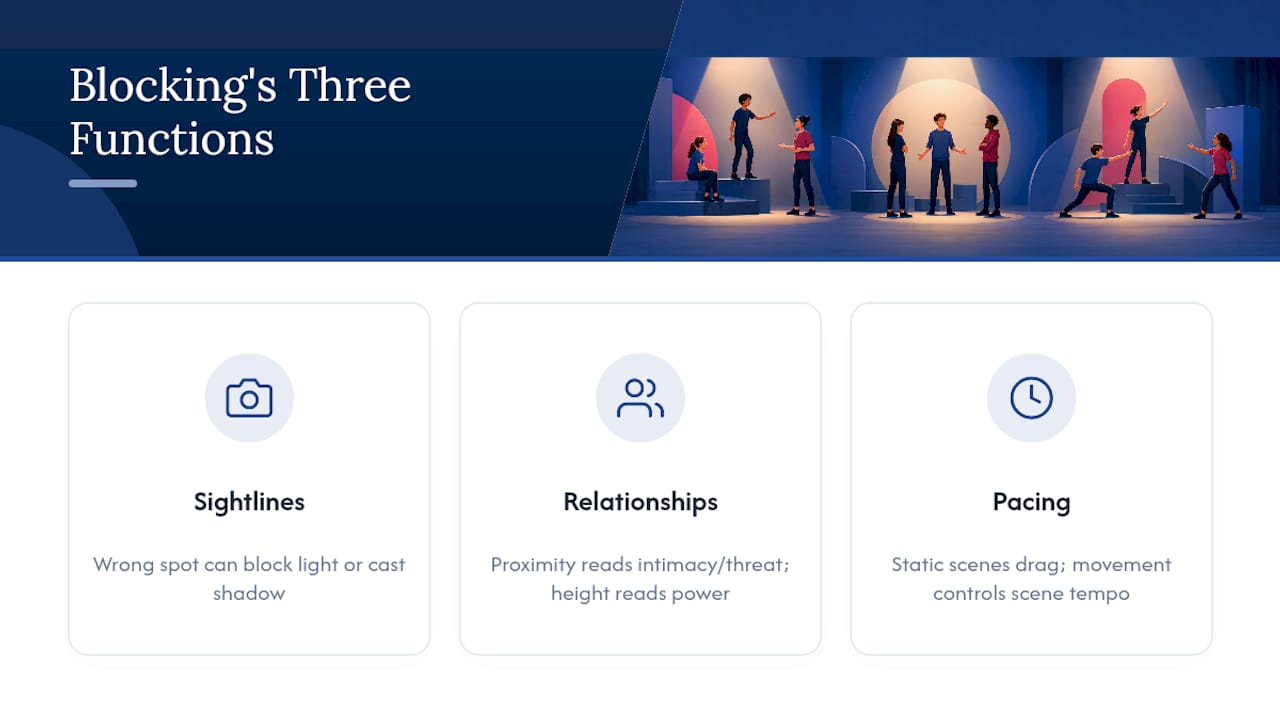
Treat blocking as furniture rearranging and your show will feel flat no matter how good the actors are. Good blocking is a storytelling tool that does at least three jobs simultaneously.
First, it manages sightlines. An actor stood in the wrong spot can block a lighting state or vanish into shadow, which means blocking decisions and lighting design need to happen in conversation, not in isolation. Second, blocking signals relationships through simple physical logic: proximity reads as intimacy or threat, and height reads as power. Put one character on a raised platform and another kneeling below, and the audience understands the dynamic before either speaks a line.
Third, blocking controls pacing. A scene that keeps actors static for too long drags, however sharp the dialogue. A scene where characters cross constantly without reason feels jittery and hard to follow. The movement between scenes, and the transitions in and out of them, often determines whether an audience feels a production moves confidently or limps from beat to beat.
The stage vocabulary every performer needs to know
Blocking has its own shorthand, and learning it early saves enormous rehearsal time. The terms below are all relative to the actor facing the audience, not the audience itself, which trips up beginners constantly.
Upstage and downstage: upstage is away from the audience, downstage is towards them, a legacy of raked stages that sloped upward at the back.
Stage left and stage right: always from the actor’s perspective as they face the audience, never the audience’s own left and right.
House left and house right: the audience’s perspective, used by directors and designers when discussing the auditorium rather than the stage floor.
The nine-square grid: many directors mentally divide the stage into nine zones (upstage left, upstage centre, downstage right, and so on) to plan clean, readable compositions rather than vague drift.
Open and closed positions: an open position shows the actor’s body and face to the audience; a closed position turns away from them, useful for hiding a reaction or building tension before a reveal.
Cheating out: angling the body slightly towards the audience while still appearing to face a scene partner, so faces stay visible without looking unnatural.
Cross and spike: a cross is any move from one stage position to another, and a spike (or mark) is the taped reference point on the floor showing exactly where that cross should end.
Practical blocking methods and rehearsal tests you can use now
Theory only gets you so far. These are rehearsal-tested techniques that experienced directors return to whenever a scene feels static or unclear.
Ask “why” before you fix any move. Motivated movement, where a character crosses the room because they want something from another character, always reads better than movement inserted purely for visual variety.
Run the distance test. Have actors play a scene at three different distances from each other, close, medium and far, and watch how the meaning shifts before locking in a final choice.
Run the levels test. Repeat the same beat with one actor sitting, one standing, then swap, and note which arrangement communicates the power balance the script actually needs.
Walk it yourself. Many directors physically stand in an actor’s spot and move through the blocking themselves, which surfaces awkward crosses and timing problems that are invisible from a director’s table.
Watch for clumping. Groups of actors bunching together in one stage area kill visual interest fast; spreading bodies across different depths and levels keeps a stage picture alive even during a static conversation.
Backstage’s own guidance on blocking reinforces this iterative approach: decide which parts of the stage you actually need, identify the focal point of each beat, and keep experimenting in the room rather than deciding everything on paper beforehand.
Pro Tip: If a scene still feels dead after three attempts at re-blocking, the problem is rarely the positions themselves. Go back to the actors’ objectives first. Blocking almost always fixes itself once the “why” behind each move is clear.
How blocking gets recorded and kept alive through rehearsal
A brilliant blocking idea that only lives in the director’s head disappears the moment memory fails, which is why documentation is not an optional extra. The stage manager’s prompt book functions as the single point of truth for the production, and it needs to be unambiguous enough that an understudy or deputy stage manager can step in and reproduce the blocking without guesswork.
Good rehearsal-room practice tends to follow the same rhythm:
Block scene by scene or unit by unit, rather than trying to stage an entire act in one pass.
Add business (props, small physical actions) and technical cues only once the basic movement is settled.
Check sightlines from several positions in the house, not just the director’s usual seat, because what reads on a rehearsal room floor can genuinely vanish once real seating is in place.
Run at least one technical rehearsal where blocking, lighting and sound cues are tested together rather than in isolation.
Use consistent notation, spikes on the floor, marks in the script, cue numbers cross-referenced to the lighting and sound plots, so the whole team reads the same shorthand.
Digital prompt-book tools have become common alongside the traditional paper script, giving stage managers a searchable, shareable record that travels more easily between rehearsal rooms and performance venues.
Three templates worth rehearsing this week
Rather than starting every scene from a blank stage, these three templates give you a starting shape to adapt.
Two-character intimacy template: place the pair close together, facing slightly open to the audience, and use small shifts in distance to track the emotional temperature of the scene.
Three-person power triangle: give one character control of centre stage and stagger the other two at different depths and levels, so the audience always knows who currently holds authority.
Ensemble entry choreography: stagger entrances rather than flooding the stage at once, and keep enough space between bodies that no single performer blocks another’s sightline to the audience.
Spend some time drilling each template with a short scene before applying it to your actual script. The shapes will start to feel instinctive rather than mechanical within two or three sessions.
How we approach blocking with young performers at Ocean Theatre
Working with performers aged 14 to 19 changes how blocking gets taught, though never how much it matters. Confidence and teamwork sit at the centre of every rehearsal, so blocking becomes a shared problem to solve rather than an instruction handed down from a director’s chair. Simple templates and short, timed drills work better than dense notation for a cast still building technical vocabulary, and it keeps energy high without overwhelming anyone new to the process.
Small stages and community venues bring their own constraints too, tighter wings, limited depth, fewer levels to play with, and those limits often produce the most inventive staging once a young ensemble learns to trust the process.
— Andrew
Where guided blocking practice can take you next
Reading about blocking gets you started, but nothing replaces standing on a stage floor and testing a cross with a real scene partner watching your sightlines. There are organizations that offer hands-on rehearsal experiences for young performers with weekly rehearsals led by professional directors and large-scale musical productions each year giving performers genuine stage time to apply what they learn.
[

Expect ensemble work, structured blocking exercises inside a supportive rehearsal room, and the kind of repeated, guided practice that turns theory into instinct far faster than reading alone ever could. This is a training pathway for young performers rather than a substitute for professional direction on your own production, but if you are looking for somewhere to put blocking principles into practice under experienced guidance, it is a strong place to start. You can see the kind of large-scale staging young performers take on in a production like Our House, and full booking details for upcoming courses and productions sit on the booking information page. If you are ready to find out what is currently open for enrolment, the Ocean Theatre landing page is the place to check availability.
Sources
FAQ
What is an example of blocking in theatre?
A simple example is a director having one character stand while another sits during an argument, using height to show who holds power in that moment, then swapping the arrangement once the balance shifts.
What is another word for blocking in theatre?
“Staging” is the term most often used interchangeably with blocking, though staging can also cover set design and technical elements beyond actor movement alone.
What does blocking mean in musicals?
Blocking in musicals covers the same core idea, planned actor positioning and movement, but it typically integrates closely with choreography and lighting cues since musical numbers demand tighter coordination between dance, staging and sightlines than a straight dialogue scene usually requires.
Who decides blocking during rehearsal?
The director usually sets blocking during rehearsal, working with actors to test movement, while the stage manager records the final decisions in the prompt book for consistency across every performance.
How do I stop actors clumping together on stage?
Vary distance and levels deliberately, spread entrances across different points rather than funnelling everyone through one, and run a quick distance test whenever a group scene starts to feel visually flat.
Recommended
Comments