

2–5 Minute Drills for Teen Communication Skills That Stick
- admin79639
- 11 minutes ago
- 10 min read

Five skills fix most conversation problems teens face: active listening, ‘I’ statements, emotional regulation, non-verbal awareness and empathy. Start right now with a 60-second drill: after a friend speaks, reflect back what you heard in your own words before replying. NCBI research identifies this exact habit as a core listening skill, and it’s one we build deliberately in every Ocean Theatre rehearsal.
TL;DR:
Practicing active listening by paraphrasing and asking follow-up questions reduces misunderstandings and enhances collaboration among teens.
Using “I” statements and practicing assertiveness helps communicate boundaries respectfully without escalating conflicts.
Running through simple drills like reflect-back and boundary role-plays reinforces key skills and builds confidence through repetition.
Applying the five-step conflict method slows reactions, labels emotions, and clarifies requests to prevent escalation.
Tailoring communication style to friends, teachers, and parents improves understanding and fosters respectful, effective interactions.
Table of Contents
Communication skills for teens: the core five and how to practise them
Getting better at talking to people isn’t about being naturally chatty or endlessly confident. It’s about repeatable habits. Below are the five skills that do the most work, each with a drill you can try today.
1. Active listening. This means four things: give full focus (phone down, eyes up), pause before replying, paraphrase what you heard, and ask a follow-up question. Research on active listening identifies these four components as the difference between hearing someone and actually understanding them. Try this with a friend: they talk for two minutes about their day, you say nothing but “mm-hmm” and nod, then you summarise it back in one sentence before asking a question. It feels strange the first time. By the third try, it feels normal.
2. ‘I’ statements. Swap blame-shaped sentences for ownership-shaped ones. “You never listen to me” becomes “I feel unheard when I’m talking and you’re on your phone.” Planned Parenthood’s guidance treats ‘I’ statements as one of the core habits of healthy communication, alongside clarity and a willingness to apologise. Before: “You’re so annoying when you cancel plans.” After: “I feel let down when plans change last minute, can we talk about it?”
3. Assertiveness, not aggression. Assertive language keeps everyone’s respect intact. KidsHealth’s guidance on assertiveness describes it as the balanced middle ground between staying silent and steamrolling someone, and says it’s a skill you build through practice, not a personality trait you’re born with. A quick role-play: practise asking a friend to return something you lent them weeks ago, without apologising three times first.
4. Non-verbal cues. Eye contact, open posture, and a tone that matches your words all carry as much weight as the words themselves. A simple theatre warm-up: stand tall, shoulders back, and hold eye contact with a partner for ten seconds without speaking. Actors use this to build stage presence; it works just as well before a difficult chat with a teacher.
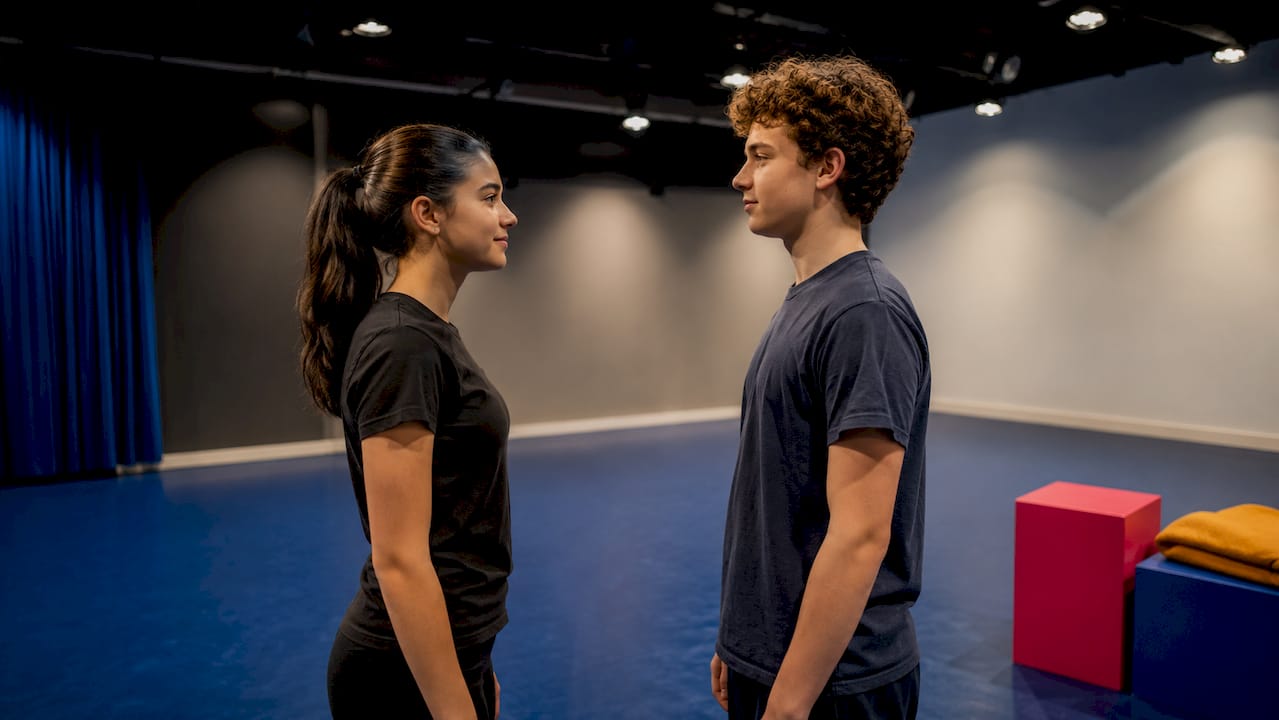
5. Emotional regulation. Two techniques you can use mid-conversation: box breathing (four seconds in, four hold, four out, four hold) or a silent count to five before responding when you feel your temper rise.
6. Empathy. You don’t need to fix someone’s problem to show you understand it. Try: “That sounds really hard” or “I get why you’re upset.” Neither offers advice. Both show you’re listening.
7. Digital etiquette. Before sending anything with emotional weight, check it against a short list:
Would I say this to their face?
Could this be read the wrong way without my tone?
Is this a conversation that actually needs a phone call instead?
8. Conversation starters. “What’s the best thing that happened to you this week?” beats “How was your day?” every time, because it invites a story rather than one word.
9. Apology and repair. A genuine apology names what happened, owns it, and states what you’ll do differently: “I shouldn’t have said that in front of everyone, I was frustrated but that’s not an excuse, and I’ll talk to you privately next time.”
Pro Tip: Pick one skill from this list and practise it for a full week before adding another. Trying to fix everything at once is why most people give up on day three.
Exercises and worksheets to build these skills into habits
Skills stick when you rehearse them, not just read about them. Short, repeatable drills of two to five minutes with immediate feedback make practice realistic enough to actually keep doing.
Try these with a friend, sibling, or parent:
The reflect-back drill: one person talks for 90 seconds about anything, the other listens silently, then repeats the main point back before responding.
The boundary role-play: practise saying no to a request you’re not comfortable with, using one sentence, no over-explaining.
The presence exercise: borrowed from theatre warm-ups, stand and deliver one sentence about your day with deliberate eye contact and a steady voice, then repeat it with your arms crossed and looking at the floor. Notice the difference in how it lands.
The daily journal line: each evening, write one sentence noting a moment you listened well or spoke up clearly, then review the week every Sunday.
Active listening has been linked to fewer misunderstandings and better collaboration among teens who practise it regularly, which is exactly why the drill above rewards repetition over intensity.
Handling conflict: a five-step method that stops escalation
Most arguments spiral because someone reacts before they’ve named what they’re actually feeling. This five-step method slows that down:
Pause. Before responding, take a breath. If you’re too angry to speak calmly, ask for a break: “Can we finish this in ten minutes? I need a second.”
Label the emotion. Say what you’re feeling, even just to yourself: “I’m frustrated,” not “You’re wrong.”
Use an ‘I’ statement. State your side without blame: “I felt embarrassed when that happened in front of everyone.”
Request a change or ask for clarity. “Could you check with me before making plans for both of us?”
Agree on a next step. Even something small, like “Let’s both cool off and talk tonight,” counts as progress.
For a curfew argument with a parent, step three might sound like “I feel like I’m not trusted when the time gets moved without warning.” For a friendship dispute, it might be “I felt left out when the group chat made plans without me.”
Pro Tip: A real apology names the specific thing, not a vague “sorry for whatever.” “I’m sorry I interrupted you three times” repairs far more than “sorry if I upset you.”
Digital communication: tone, timing and privacy
Texts strip out tone of voice and facial expression, which is exactly why so many arguments start over a message that “sounded rude” but wasn’t meant that way.
Before sending anything with any emotional charge, run it through this checklist:
Read it aloud. If it sounds harsh spoken, it’ll read harsh too.
Wait ten minutes before sending anything written while angry.
Ask whether this is really a voice-call or in-person conversation instead of a text thread.
Never share a photo or add someone to a group chat without asking first.
A message like “why didn’t you answer me?!” rephrases easily into “hey, I texted earlier, everything okay?” Same question, completely different tone.
Building a 4-week practice plan that actually sticks
Reading about these skills changes nothing on its own. Planning conversations, practising calm, and reflecting afterwards is what turns knowledge into habit.
Week 1: Focus only on active listening. One reflect-back drill daily.
Week 2: Add ‘I’ statements. Try rewriting one blame-sentence per day before you say it out loud.
Week 3: Practise assertiveness with one small request or boundary daily.
Week 4: Combine all three in a real conversation, then journal what worked.
Week | Focus skill | Simple measure of progress |
1 | Active listening | Number of reflect-backs attempted |
2 | ‘I’ statements | Times used instead of blame language |
3 | Assertiveness | Boundaries stated without over-apologising |
4 | Combined practice | One real conversation reviewed in journal |
Ask a friend or parent for honest feedback each week, and note it in a few lines. Small rewards, like your favourite takeaway after a full week of practice, keep motivation from fading before habits form.
Building self-confidence in communication
Confidence in conversation isn’t a personality trait some people have and others don’t. It’s built the same way stage presence is built: through repetition until the nervous feeling shrinks.
Start small. Confidence grows from stacking tiny wins, not from one big leap. Speaking up once in a small group meeting is a win. Asking a question in class instead of staying silent is a win. Each one makes the next slightly easier.
Voice matters more than most people realise. A steady, clear tone signals confidence even when your hands are shaking under the table. Actors learn to project their voice not because they feel fearless, but because the technique itself creates the impression of calm, and often the calm follows.
Posture does similar work. Standing or sitting with your shoulders back and your chin level changes how you’re perceived, and research on body language consistently links open posture to how confident and trustworthy a speaker appears.
The fastest way to build confidence is through low-stakes repetition: ordering your own food, asking a shop assistant a question, introducing yourself first at a club meeting. None of these carry real risk, but each one trains the same muscle you’ll need for harder conversations later. Confidence isn’t the absence of nerves. It’s having done the thing enough times that the nerves stop being the main event.
Handling peer pressure and bullying in communication
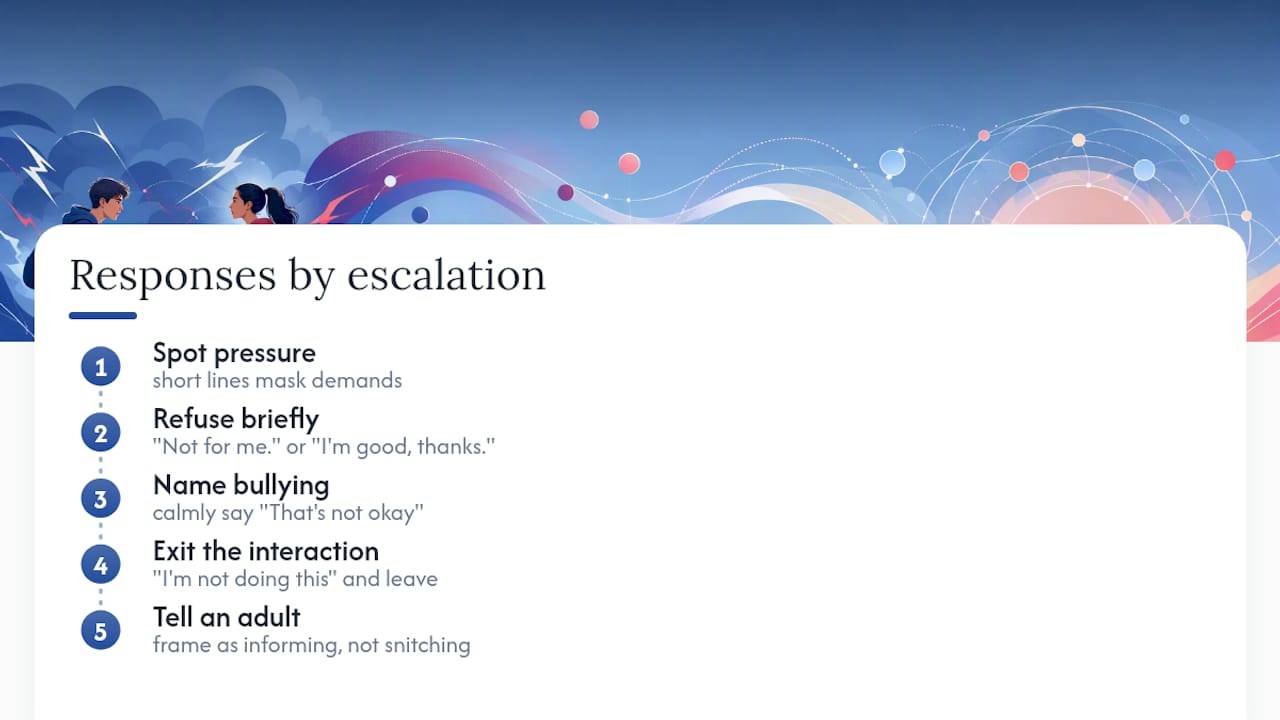
Peer pressure rarely announces itself as pressure. It usually sounds like “everyone’s doing it” or a joke that isn’t really a joke. The clearest response is a short, assertive line that doesn’t require justification: “Not for me,” or “I’m good, thanks.” You don’t owe anyone a paragraph explaining why.
If pressure turns into bullying, whether that’s exclusion, mockery, or something online, the communication approach shifts. Naming what’s happening plainly, without escalating, often works better than either silence or a matched insult: “That’s not okay” said calmly carries more weight than a shouted comeback, because it doesn’t hand the other person the reaction they’re fishing for.
Walking away is a communication skill, not a failure. Ending a conversation with “I’m not doing this” and leaving is sometimes the strongest, clearest thing you can say.
Telling a trusted adult isn’t the same as losing control of the situation. Framing it as reporting information rather than “snitching” changes how it feels: “I wanted you to know what’s been happening so you’re aware,” said to a teacher or parent, is a communication skill in its own right, one that protects you and often others too.
The friends worth keeping are the ones who respect a clear “no” the first time it’s said. If someone keeps pushing after that, the problem sits with them, not with your wording.
Adapting your communication style for friends, teachers and parents
The same joke that lands perfectly with your mates will fall flat, or backfire, with a teacher. That’s not you being fake. It’s you reading the room correctly.
With friends, communication tends to be looser: shorthand, sarcasm, interruptions that aren’t rude because everyone’s doing it. That register works because the relationship carries context your words don’t have to.
With teachers, directness paired with respect works best. “I didn’t understand the homework, could you explain the third question again?” gets a far better response than a vague “I don’t get it” mumbled at your desk. Eye contact and a calm tone matter more here than with friends, because teachers are reading your non-verbal cues for whether you’re genuinely asking or just complaining.
With parents, timing often matters as much as wording. Advice on talking with teenagers points out that adults who focus on listening without lecturing get further with teens than those who jump straight to correction, and the same logic works in reverse. Choosing a calm moment, rather than mid-argument, to raise something serious with a parent dramatically improves how it lands.
None of this means changing who you are. It means recognising that the same message needs different packaging depending on who’s receiving it.
Why open-ended questions unlock better conversations
“Did you have a good day?” gets you “yeah.” “What was the best part of your day?” gets you an actual story. That’s the entire case for open-ended questions in one comparison.
Closed questions, the ones with a yes or no answer, shut a conversation down almost as fast as they open it. Open-ended questions, the ones starting with what, how, or why, hand the other person room to actually say something.
This matters most in conversations that feel stuck. If a friend seems off and “are you okay?” gets a flat “fine,” try “what’s been on your mind lately?” instead. It’s harder to answer in one word, which is exactly the point.
The same trick works with adults. Asking a teacher “how did you get into this subject?” instead of just answering their questions turns a one-way interaction into an actual exchange. It signals genuine interest, which is most of what makes someone want to keep talking to you.
Ocean Theatre’s perspective: how performance training accelerates communication growth
Every rehearsal we run doubles as communication practice, whether the cast realises it or not. Ensemble scenes demand active listening, because missing a cue means missing your line. Voice projection work builds the same steady, confident tone we’ve described throughout this piece. Improvisation and role-play push assertiveness without ever using that word.
Theatre training supports confidence and teamwork through exactly this kind of repeated, low-stakes practice, which is why so many parents tell us their teen’s communication changes noticeably after a term of rehearsals, not because we teach communication directly, but because performing demands it.
— Andrew
Ready to practise these skills in a real cast?
Reading a list of drills only gets you so far. Ocean Theatre gives Berkshire teens aged 14 to 19 the thing worksheets can’t: a room full of people who need you to listen, respond, and hold eye contact under real pressure, every single week.
[

Our weekly rehearsals build the exact skills covered above, active listening through ensemble work, voice and presence through performance, assertiveness through character choices, inside a genuinely supportive group rather than a classroom exercise. Whether your teen is naturally quiet or already loud and confident, two full-scale musical productions a year give them a structured place to grow both. If this sounds like the next step, visit Ocean Theatre Co. to see upcoming productions and find out how to join, or take a look at a past production like Guys & Dolls to see what a term of rehearsal actually builds towards.
Sources
Recommended
Comments