

Parents of teens: Spot evidence backed cross training for dancers
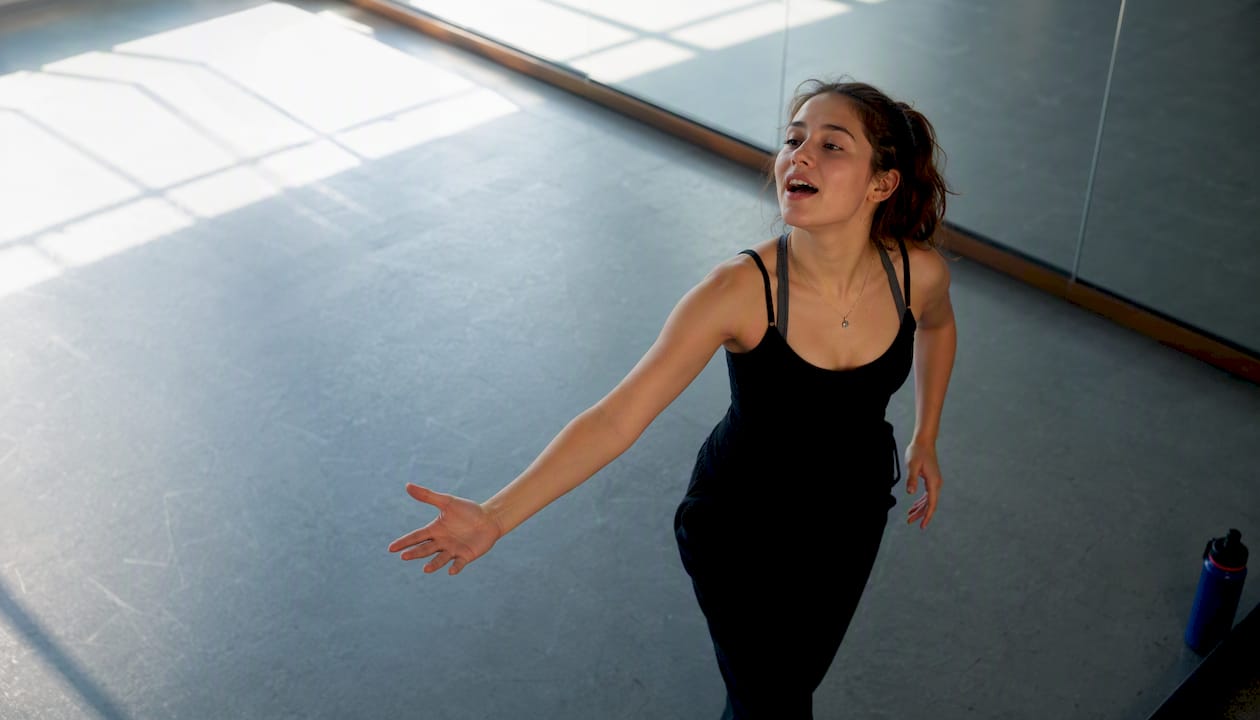
Cross training for dancers, in the musical theatre world, means training acting, singing and dance together rather than in isolated silos, so a teenager builds one connected performance skill instead of three disconnected ones. The benefit is real: better storytelling, stronger ensemble instincts and genuine stage readiness. If you’re weighing up programmes for your 14 to 19 year old, the first thing to check is whether classes are actually integrated, or just three separate subjects taught under one roof.
TL;DR:
Integrated cross training builds sessions where acting, singing, and dance are developed simultaneously, allowing skills to transfer quickly into real performance.
Effective programmes include song throughs, mixed sectionals, scene-to-song bridges, and full company runs, ensuring disciplines feed each other in practice.
Performance improvements include enhanced storytelling stamina, ensemble skills, confidence under pressure, and habits like discipline and collaboration.
Look for staff who teach across disciplines, observe rehearsals, and verify assessment focuses primarily on live performance to confirm true integration.
Weekly schedules should include light rehearsal loads for teenagers, with clear progression as shows approach, and programs should prevent overload through proper pacing and recovery.
Table of Contents
What integrated cross training looks like in practice
A genuinely integrated programme doesn’t teach singing on Monday, acting on Wednesday and dance on Friday and hope they collide somewhere on stage. It builds sessions where all three feed each other from the start. Practitioners in musical theatre education favour an iterative rehearsal loop: a sectional to fix a technical problem, followed immediately by a song through where that fix gets tested in character. This sequencing, documented in integrative performance training research, accelerates how quickly a young performer transfers a skill from drill into real performance.
Recognisable session formats include:
Song throughs where a number is run in full, in character, immediately after vocal or choreography notes
Mixed sectionals that pair small-group vocal coaching with blocking and character work in the same hour
Scene-to-song bridges, where actors carry dialogue straight into the number it leads towards
Full company runs that stitch individual scenes into the shape of an actual show
Curricula built this way show measurably better engagement and skill integration than programmes that keep disciplines apart.
What outcomes should you actually expect for a teenager?
Parents often ask what changes, beyond a confident bow at the end of term. The honest answer is that the gains are both technical and personal, and a decent programme will be able to show you evidence of both.
Statistic callout: Research into musical theatre curriculum design has found that integrated training that fuses acting, singing and dance produces significantly better performance outcomes than teaching the disciplines separately. That is the entire case for choosing an integrated programme over a dance class here and a drama club there.
What that translates to for a 14 to 19 year old:
Storytelling stamina: singing a number while sustaining a character arc, rather than switching off acting the moment the music starts
Ensemble skill: reading other performers, holding formation, supporting rather than competing
Confidence under pressure: performing in front of an audience regularly, not just once a year
Transferable habits: discipline, punctuality and collaborative problem-solving that outlast the show itself
Musical theatre training built around project-based, ensemble rehearsal has been shown to strengthen collaboration and communication skills that many parents value just as highly as the performance polish. Ask any prospective programme how they measure progress across a term. If the answer is vague, that’s worth noting.
How can you tell a programme actually delivers integration?
Plenty of programmes claim to be “triple threat” training. Fewer actually run their timetable that way. Here’s what to look for when you’re assessing prospectuses or attending an open day:
Check the teaching team. Look for staff who teach across disciplines, or who work as a coordinated team rather than three specialists who never speak to each other.
Ask to see a real class, not a showcase. A rehearsal in progress tells you more than a polished five-minute demo ever will.
Look for song throughs and mixed sectionals on the timetable. These are the clearest sign that singing, acting and movement are being taught as one skill.
Ask who’s at the piano. A committed musical director or accompanist in the room, rather than a backing track, usually signals a more serious production standard.
Ask how progress is assessed. A useful benchmark from curriculum design research puts roughly 60% of assessment on live performance, 25% on technical checks and small-group feedback, and 15% on written reflection, which keeps the focus on the stage without losing technical rigour.
Ask about safeguarding. Any programme working with teenagers should have clear, visible policies and named safeguarding leads.
Pro Tip: Watch how staff respond when a young performer gets something wrong in front of the group. The tone of that correction tells you more about the programme’s culture than anything in the brochure.
What does a realistic training week actually look like?
A committed term of integrated training has to sit alongside GCSEs, A Levels, part-time jobs and, frankly, teenage life. A sensible weekly pattern for a 14 to 19 year old in a serious programme might look like this:
One evening session (2 to 3 hours): combined vocal, acting and movement work, including a song through
One rehearsal block (2 to 4 hours), increasing in frequency closer to a production
Occasional weekend workshop or intensive, particularly ahead of a show
At least one full rest day with no formal training commitment
Across a term, expect rehearsal intensity to build gradually rather than stay flat, with technical sectionals dominating early weeks and full company runs taking over as a production approaches. Cross training that’s chosen thoughtfully improves resilience and technique. The wrong mix, layered on top of a full school timetable, risks fatigue rather than progress, so a programme that never lets up between shows is worth questioning rather than admiring.
What should you ask a provider before enrolling?
A short conversation with a provider, or a few pointed questions at an open day, will tell you more than any prospectus. Ask:
“Can I see how you structure an integrated class?” A confident, specific answer beats a general one about “triple threat training” every time.
“How many productions do students take part in each year, and at what scale?” This tells you whether performance opportunity is frequent or occasional.
“What’s the staff-to-student ratio in rehearsal?” Smaller cohorts generally mean more individual feedback.
“What do fees actually cover?” Ask specifically whether costume, venue hire and production costs are included or billed separately later. Vague answers here are a red flag.
“Can I speak to a current parent?” Genuine testimonials should be easy to verify, not just quotes on a webpage.
“What’s your safeguarding policy?” A programme that can’t answer this clearly and immediately isn’t ready for your teenager.
How Ocean Theatre approaches integrated training for 14 to 19s
Ocean Theatre Company builds its programme in Berkshire around exactly this model of integrated, professional-led training, rather than treating singing, acting and dance as separate subjects bolted together.
Participants train intensively across all three disciplines and put that training into practice in two large-scale productions each year, performing classic musical repertoire with the kind of high-energy staging that gives teenagers a genuine sense of what it means to hold a stage. Past productions have included large ensemble shows such as Singin’ in the Rain and Anastasia, alongside earlier company favourites like The Addams Family.
What families can expect:
Weekly rehearsals building towards two major productions per year
Professional direction across acting, singing and dance rather than isolated coaching
A supportive, ensemble-first atmosphere designed to build confidence alongside skill
Parents describe watching their teenager grow in confidence and stage presence over the course of training, a transformation the company points to as central to what the programme is built to achieve.
Ocean Theatre also maintains a published accessibility statement, a detail worth checking against any programme you’re considering.
Which cross training exercises actually belong in this mix?
Within an integrated programme, the useful cross training isn’t a gym circuit. It’s deliberately varied practice across vocal styles, acting techniques and movement genres, so a young performer doesn’t become brilliant at one thing and stuck when a show demands something different.
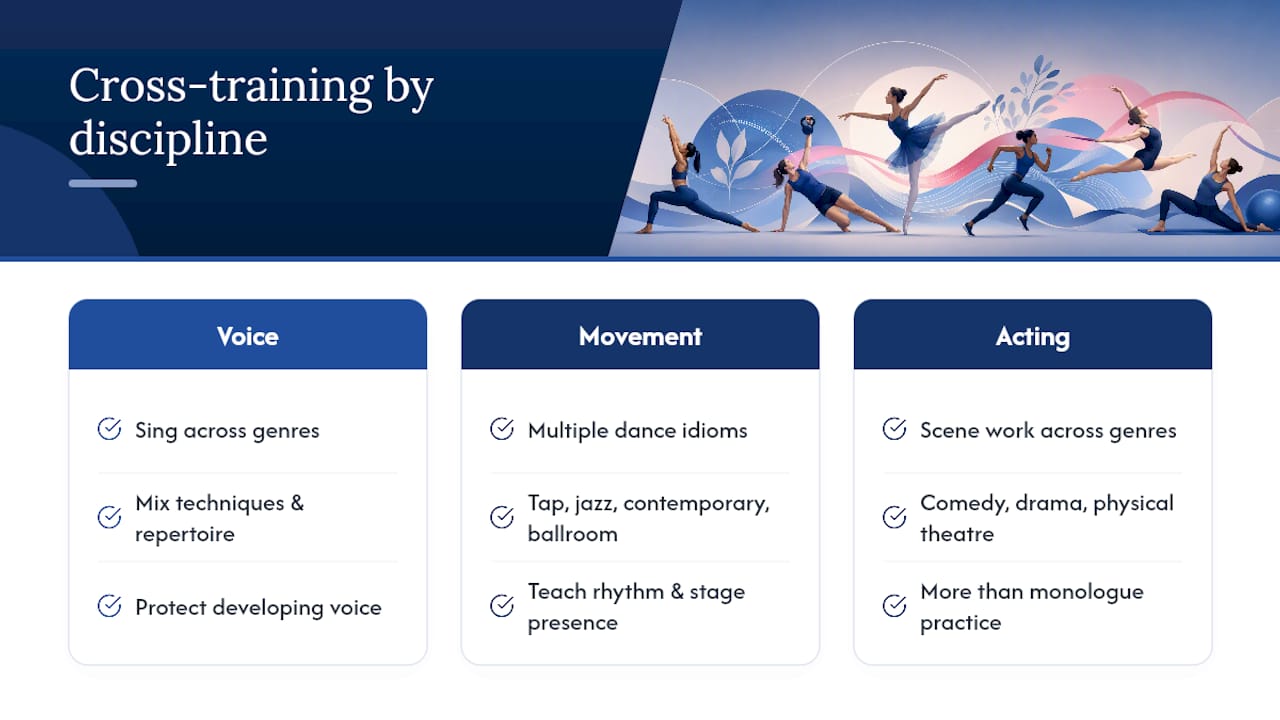
For voice, that means singing across genres rather than drilling one style relentlessly. Vocal cross training that mixes techniques and repertoire, in the way described by cross training research for singers, builds a more flexible instrument and helps protect a developing voice from the strain of repeating the same vocal patterns show after show. A teenager who only ever sings ballads will struggle the moment a show demands belting, patter or comic timing.
For movement, that means exposure to more than one dance idiom. Tap, jazz, contemporary and basic ballroom partner work each teach different things about rhythm, weight and stage presence, and a programme that only ever drills one style leaves a gap the moment a different show comes along.
For acting, cross training looks like scene work across comedy, drama and physical theatre, not just monologue practice. The point of mixing all three disciplines isn’t variety for its own sake. It’s building a performer who can adapt to whatever a director or a role asks of them, which is precisely what makes the “triple threat” label meaningful rather than decorative.
Does this kind of training actually improve performance and cut injury risk?
Yes, though the mechanism is different from what most people assume. The performance gain comes from synthesis: a young performer who has practised singing and moving and acting as one connected skill, rather than three separate ones, tells a story with far more stamina and consistency across a full number. Research into musical theatre training backs this directly, showing that students who master disciplines individually and then fuse them in performance develop noticeably more versatility and adaptability than those trained in silos.
The injury and strain angle matters too, particularly for voice. A teenager who only ever trains one vocal style and one dance genre repeats the same physical and vocal patterns constantly, which is exactly the kind of repetitive load that leads to fatigue and strain. Varying technique and repertoire, the way vocal cross training recommends, spreads that load more evenly and builds resilience rather than wearing down one narrow set of muscles or vocal habits.
None of this replaces proper physical warm-ups, vocal rest or basic injury prevention around dance and singing. What it does is reduce the risk that comes from doing the same narrow thing, in the same narrow way, week after week, term after term, without variation.
What’s age appropriate for a 14 year old versus a 19 year old?
A 14 year old and a 19 year old shouldn’t be training identically, even inside the same programme, and a well-run one will structure sessions to reflect that.
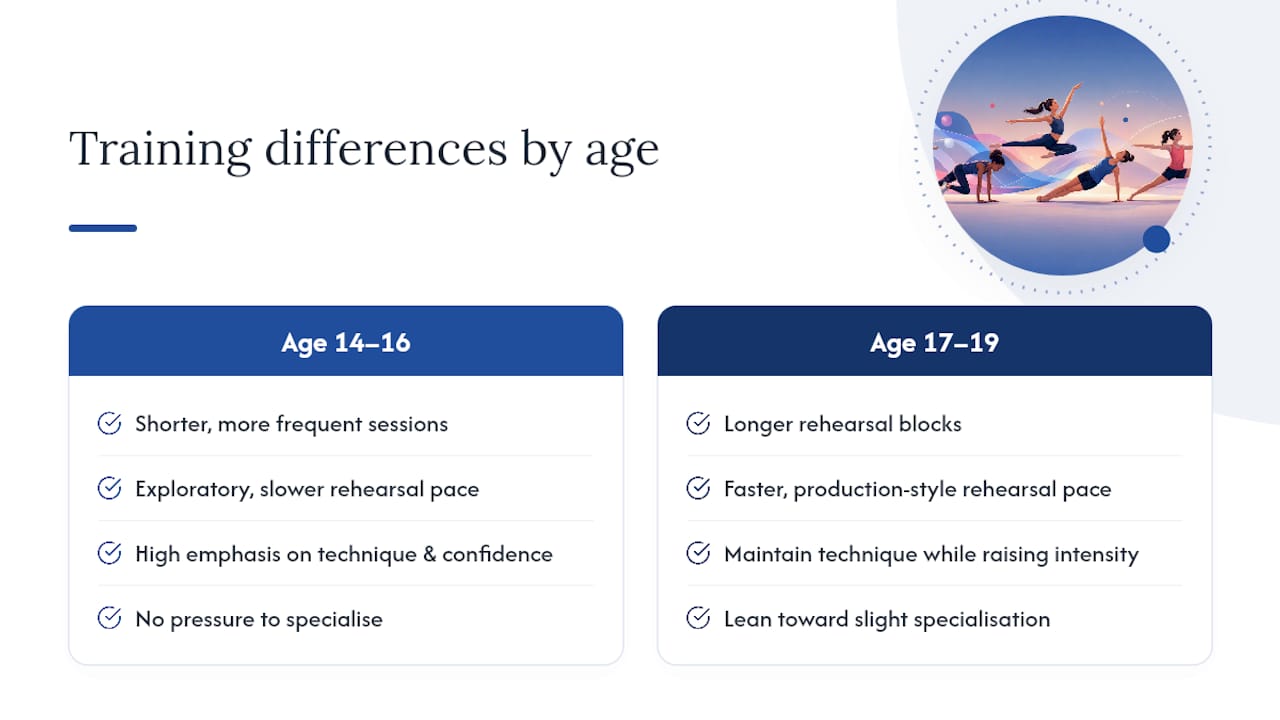
Younger teenagers, roughly 14 to 16, benefit from shorter, more frequent sessions with a heavier weighting towards technique and confidence building. The pace should feel exploratory: trying different vocal styles and dance genres without pressure to specialise, and with rehearsal loads that leave plenty of room around school commitments.
Older teenagers, 17 to 19, can generally sustain longer rehearsal blocks and a faster pace, closer to the demands of a genuine production schedule. This is also the age where specialising slightly, leaning into a stronger discipline while maintaining the other two, starts to make sense, particularly for anyone considering drama school or conservatoire auditions afterwards.
Across both age bands, the same principle from curriculum design research holds: assessment and rehearsal intensity should scale with age and experience, not just be a flat, one-size timetable applied to every year group. A 14 year old handed a 19 year old’s rehearsal load is a common, avoidable mistake, and it’s worth asking any provider directly how their approach differs across the age range they teach.
How do you stop cross training tipping into overtraining?
The line between committed and overcommitted is easy to miss, especially with a teenager who loves the work and never wants to say no to more of it.
Watch for the practical warning signs: rehearsal load creeping up without a corresponding rest day, vocal strain appearing (hoarseness, fatigue after single sessions), or grades starting to slip. Cross training genuinely helps when it’s varied and well-paced. It does the opposite when it’s simply more volume stacked onto an already full school week, which is precisely the risk that thoughtful programme design is meant to guard against.
The fix is rarely to cut training altogether. It’s to check the balance: is there at least one full rest day a week? Does rehearsal intensity actually ease off outside production periods, or does it stay permanently at full pace? Does the programme build in recovery around exams? A programme that answers all three well is doing right by your teenager. One that treats every week as show week, regardless of the school calendar, is setting up for burnout rather than growth.
Talk to your teenager regularly about how the load feels, not just how the performances go. Enthusiasm can mask fatigue for longer than you’d expect at this age, and a five-minute honest conversation after rehearsal catches problems long before a report card or a doctor’s note does.
What I’d tell any parent weighing this decision
The mistake I see most often isn’t parents picking a bad programme. It’s parents assuming that any programme offering “singing, acting and dance” is automatically integrated, when in reality plenty of them just timetable three separate subjects and call it triple threat training. The difference only shows up once you’re inside a real rehearsal, watching whether a vocal note actually changes how a scene is played, or whether the three disciplines stay politely separate all term.
If there’s one genuinely underrated piece of advice in all of this, it’s to watch a rehearsal in progress before you commit, not just a polished showcase. A showcase shows you the result. A rehearsal shows you the method, and the method is what your teenager will actually live inside for the next several months. Ask to sit in, ask what a typical Tuesday looks like, and trust what you see over what any brochure claims.
— Andrew
Ready to see integrated training in action? Here’s how to start
Reading about integrated training only gets you so far. The genuinely useful next step is watching it happen, which is exactly what an open rehearsal, a taster session or a live production at Ocean Theatre lets you do.
[

Ocean Theatre runs a programme with two full-scale productions a year, offering 14 to 19 year olds regular, professional-led stage experience rather than a single end-of-term showcase. Recent shows like Our House and Anastasia give a real sense of the scale and repertoire your teenager could be working towards, and the company’s past shows archive is worth a browse if you want a fuller picture of the range on offer.
If your teenager is curious, the simplest way to find out whether this fits is to enquire about upcoming auditions or taster sessions directly through the Ocean Theatre website, where current production dates and enrolment details are listed.
Sources
Comments