

5–10 Minute Daily Ear Training for Singers That Transfers to the Stage

Ear training builds relative pitch, the skill that lets you hear a note in your head, feel where it sits against the key, and correct your voice before an audience notices a wobble. It works through repetition, not talent. The single most effective habit is short, daily practice, just a few minutes daily, rather than one long weekly session. Start today: pick a note on a piano or app, sing it back, then check it. That one minute tells you where your ear already is.
TL;DR:
Short, daily ear training, focusing on simple exercises like note matching and interval drills, significantly improves pitch accuracy and functional listening skills.
Practicing with structured routines and rotation of exercises helps develop the ability to identify scale degrees, follow chord changes, and lock into pitch within a key.
Using technology like apps for guided drills and real-time feedback can aid training but should not replace relying on your ear over visual cues and technique correction.
Rehearsals and live singing environments naturally reinforce ear training by demanding real-time pitch adjustment in group settings.
Consistent, incremental practice over just a few minutes each day yields better results than infrequent, lengthy sessions and prepares singers for performances.
Table of Contents
What is ear training for singers?
Ear training for singers means developing the ability to recognise and reproduce musical relationships by ear, not just by luck or muscle memory. At the centre of it sits relative pitch: the skill of hearing how one note relates to another, rather than identifying a note in isolation the way someone with perfect pitch might. For working singers, relative pitch is the far more useful skill, because it lets you find your part in a duet, follow a key change, or recover instantly when a band drifts flat.
A few terms are worth pinning down before you start practising. An interval is the distance between two pitches, measured in steps, such as a major third or a perfect fifth. A scale degree describes a note’s position within a key: the first note of a scale is degree one (the tonic), the fifth is degree five (the dominant), and so on. Functional hearing is the ability to sense how a note behaves within that key, whether it feels stable and resolved or unstable and pulling towards resolution. Musicians who develop functional hearing don’t just identify notes; they feel where a melody wants to go next.
There’s a distinction that trips up a lot of singers early on: hearing a pitch accurately is not the same as being able to sing it. You can have a sharp inner ear and still miss the note, because singing adds a layer of physical coordination between your ear and your larynx that instrumentalists never have to manage. Ear training for singers has to address both halves: the listening skill and the vocal feedback loop that turns what you hear into what you produce. This is why ear training for singers primarily targets relative pitch rather than absolute pitch recognition. It’s the intervals, scale degrees, and real-time correction that get you through a live performance, not the ability to name a stray note in a passing car horn.
Pitch discrimination itself is a trainable skill, not a fixed trait you’re born with or without, and structured listening practice measurably improves it over time, according to research on auditory perception. That’s the encouraging part. Nobody is locked out of good intonation. It’s a matter of the right repetitions.
Core ear-training exercises every singer should practise
Every exercise below targets a different layer of aural skill, from raw pitch matching through to functional hearing within a key. Work through them roughly in order if you’re starting out, though a seasoned singer will want to keep circling back to the earlier ones as a warm-up.
Single-note matching. This is where everyone begins, and it never stops being useful. Play a reference pitch on a piano, keyboard app, or pitch pipe, then sing it back on a neutral vowel like “ah” or “oo”. Check yourself with a tuner or by playing the note again straight after. Start in the comfortable middle of your range, then gradually work towards the edges. The goal isn’t perfection on day one; it’s building the habit of checking, every single time, rather than assuming you’ve landed the note.
Interval drills. Once single notes feel secure, move to intervals, the gaps between two pitches. Play a starting note, then sing up or down a specific interval, such as a major third or perfect fourth, before checking against the instrument. Many singers find it easier to internalise intervals through mnemonic songs: the opening of “Here Comes the Bride” is a perfect fourth, the start of “Somewhere Over the Rainbow” is a full octave, and the first two notes of “Happy Birthday” outline a major second. Practise both melodically (one note after another) and harmonically (two notes together), since singers usually meet intervals melodically in a solo line and harmonically when singing backing vocals or in a choir.
Scale-degree and functional ear training. This is where relative pitch turns genuinely useful on stage. The cadence-and-note method works like this: play a simple chord cadence in a key, such as I, IV, V, I, to establish the tonal centre in your ear. Then play or sing a single note and try to identify its scale degree, is it the tonic, the third, the leading tone? This method builds functional hearing that mirrors real ensemble situations far more closely than isolated interval drills, because it trains you to hear notes in context rather than as abstract distances.
Drone singing. Set a sustained single note, the tonic of whatever key you’re working in, using a drone app, a sustained piano note, or even a held note from an accompanist. Sing scale degrees or short melodic phrases against that drone and listen for when your voice locks into tune with it and when it clashes. This is one of the most underused ear-training exercises among singers, because it isolates pitch stability from everything else, no lyrics, no rhythm complexity, just you and the key centre. A useful variation is singing the tonic and the fifth against the drone to feel resolution and tension directly, which SingMeter’s guide to drone practice recommends as a way to build genuine scale-degree stability rather than guesswork.
Call-and-response and phrase echoing. Have a friend, teacher, or app play or sing a short phrase, four or five notes, and echo it back immediately without checking an instrument first. This trains short-term aural memory alongside pitch accuracy, and it’s close to what happens in a real rehearsal when a musical director teaches you a harmony line by ear.
A solid set of core exercises typically includes:
Single-note matching against a tuner or piano
Melodic and harmonic interval identification
Scale-degree recognition using cadence-and-note drills
Sustained drone work for key-centre stability
Call-and-response phrase echoing
Short melodic transcription of two to four bar phrases
That combination reflects the essential exercise categories most vocal coaches recommend, and it scales from complete beginner through to advanced sight-singer without needing to change approach, only difficulty.
Using technology sensibly. Apps like EarMaster offer guided interval, chord, and melody drills with built-in call-and-response modes, which is genuinely useful for structured, repeatable practice when you don’t have a teacher or accompanist to hand. A basic pitch detector app or tuner is equally valuable for the checking step in single-note matching. The trap is leaning on visual feedback so heavily that you’re training your eyes instead of your ears, more on that shortly.
A 5 to 10 minute daily ear-training routine
You don’t need an hour. You need consistency. Short daily sessions of a few minutes build pitch accuracy more reliably than occasional long practice blocks, partly because your ear is genuinely learning something new each day rather than cramming, and partly because short sessions don’t fatigue your voice the way an hour of sustained singing can.
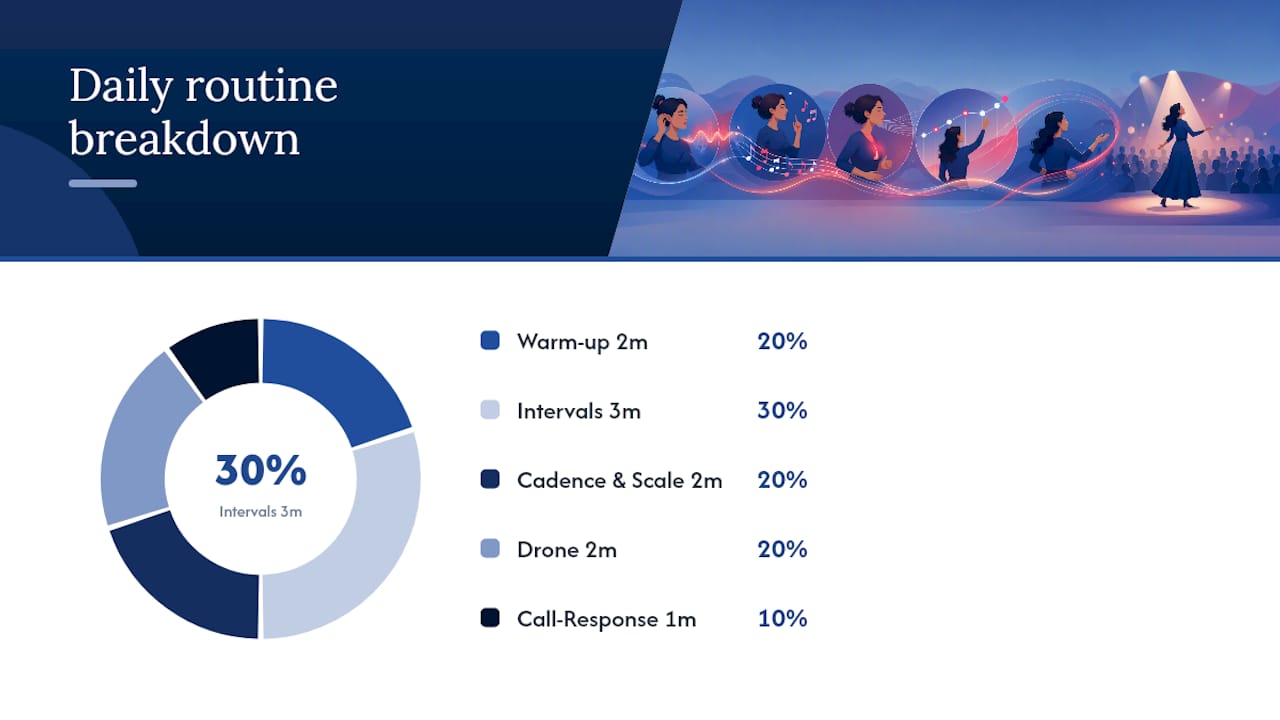
Here’s a routine that fits comfortably into ten minutes:
Minutes 1 to 2: warm-up matching. Play three or four notes in your comfortable range and sing each one back, checking with the instrument.
Minutes 3 to 5: interval drill. Pick two intervals to focus on for the week (start with major thirds and perfect fifths) and drill them melodically, both ascending and descending.
Minutes 6 to 7: cadence and scale degree. Play a I, IV, V, I cadence, then test yourself on identifying random scale degrees within that key.
Minutes 8 to 9: drone work. Hold a drone note and sing the tonic, third, and fifth against it, listening for lock-in.
Minute 10: call-and-response. Use an app or a recorded phrase and echo it back once, cold, without checking first.
Rotate your focus across the week so you’re not drilling the same interval into monotony. Mondays and Thursdays might target thirds and fourths, Tuesdays and Fridays might shift to fifths and sixths, and you could dedicate one day purely to drone and scale-degree work, since that’s the exercise most singers neglect. This kind of rotation keeps the routine interesting and makes sure your weaker intervals get equal attention rather than being quietly avoided.
Track progress with three simple markers: accuracy (are you landing the note first try, or needing two or three attempts), speed (how quickly you can identify or reproduce an interval), and confidence (can you do it without hesitating or second-guessing). When all three improve on an exercise for a week or two running, that’s your cue to raise the difficulty, wider intervals, faster tempo, or a new key centre. Progress in ear training is genuinely incremental, and the plateau you hit in week three is normal, not a sign you’re doing something wrong.
Turning ear training into real song performance
Drills only matter if they transfer to the songs you actually sing. The bridge between the two is deliberate, structured practice on real material, not just hoping the skills carry over.
Start by picking one troublesome phrase from a song you’re learning, ideally four to eight bars where you keep losing pitch or fumbling an entry. Find the starting note using a keyboard or app, and identify what interval or scale degree it sits on relative to the key. That single piece of information often explains why you keep missing it, perhaps it’s a leap of a sixth you’ve never drilled, or an entry on the leading tone that wants to pull upward.
Practise the phrase on a neutral vowel first, stripping away the lyrics entirely so you can focus purely on pitch and shape. Check yourself against a recording or an instrument, isolate whichever specific note or interval keeps slipping, and drill just that fragment on its own for thirty seconds before rejoining it to the full phrase. Only once the vowel version is solid should you bring the actual lyrics back in, since consonants and vowel shapes can distract your pitch focus if you reintroduce them too early.
In ensemble or band settings, ear training earns its keep in a different way: finding the key centre the moment a song starts, tracking chord changes as they happen so your harmony line stays anchored, and blending your tone and pitch with the singers around you rather than cutting through them. A singer with strong functional hearing can often sense a chord change coming before it’s announced, simply because the underlying scale degrees start to feel unstable, exactly the sensation drone practice is designed to build.
Common ear-training mistakes and how to avoid them
The biggest mistake is leaning on a visual tuner for every single check, indefinitely. Tuners are excellent training wheels early on, but if you never phase them out, you’re training your eyes to confirm pitch rather than training your ear to sense it. Use the tuner to verify, then increasingly trust your ear first and check second, only reaching for the visual confirmation once or twice per session rather than after every note.
Tension is another quiet saboteur. A surprising number of pitch problems that feel like “ear” issues are actually vocal technique issues, tightness in the jaw or throat pulling notes sharp or flat regardless of what your inner ear is telling you. If a note consistently comes out wrong despite confident aural recognition, check your posture and breath support before assuming the problem is your hearing.
Don’t skip fundamentals to chase advanced material. Jumping straight to wide, awkward intervals before major seconds and thirds feel automatic just builds frustration and slows real progress. Build methodically, interval by interval, scale degree by scale degree.
Pro Tip: Clap or tap the pulse of a phrase while you sing it back during interval drills. Rhythm and pitch are processed together in performance, and separating them in practice, all pitch, no time feel, can leave you accurate in a quiet room but unstable the moment a band’s tempo pushes you around.
How ensemble rehearsal reinforces ear training
Nothing sharpens relative pitch quite like singing in a group where everyone else can hear you drift. Rehearsal rooms are, in effect, one long ear-training session disguised as putting a show together, and it’s a big part of what happens week to week at youth theatre companies.
Echo warm-ups open most sessions: a musical director sings a short phrase, and the ensemble sings it straight back, the call-and-response exercise from earlier in this guide, just done live with twenty other voices around you. Drone work happens naturally too, often with an accompanist holding a sustained chord while a vocal section finds and locks into their harmony line above it. Phrase copying carries on through blocking rehearsals, when a section leader teaches a harmony part by ear, line by line, exactly mirroring the phrase-isolation practice described earlier.
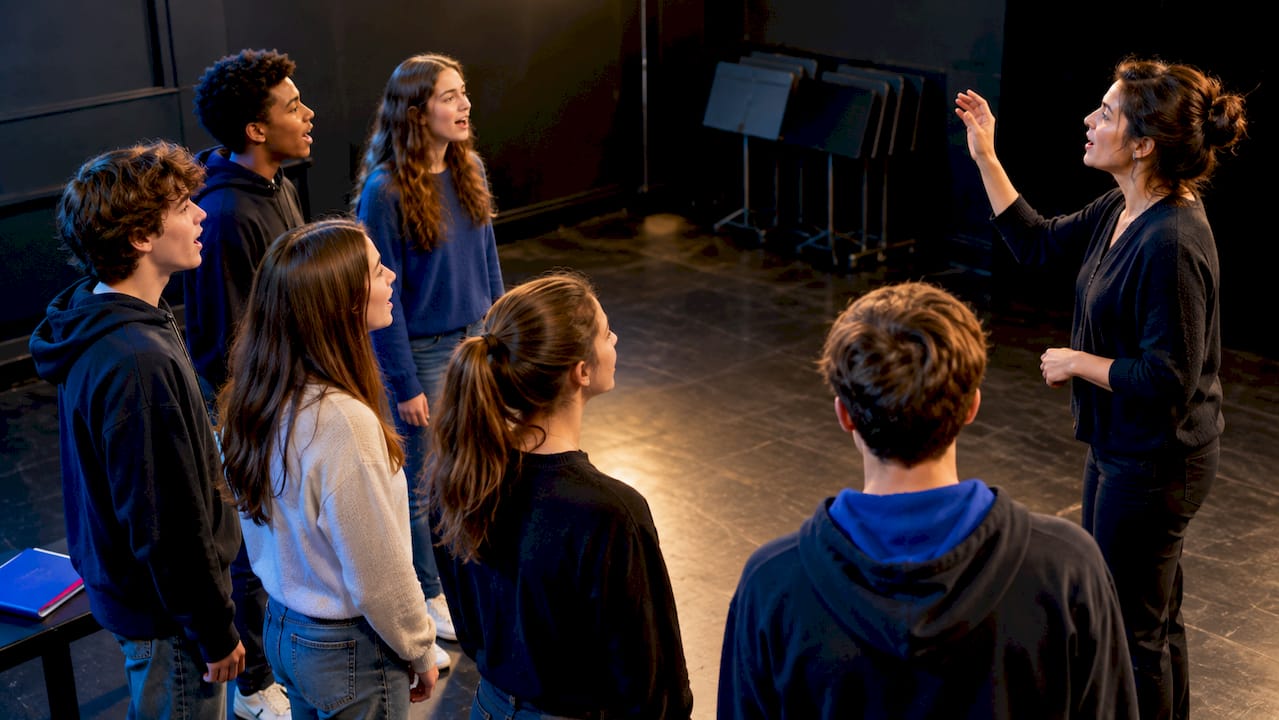
Young performers training in this kind of structured, high-energy ensemble environment consistently describe sharper pitch confidence and faster harmony pickup within a single term, the practical payoff of ear skills built through repetition, not theory.
What actually moves the needle in ear training
Most advice on ear training for singers overcomplicates the early stages. You don’t need music theory fluency before you start, and you don’t need to master absolute pitch, an ability most professional singers never have and don’t need. What the research and the practical exercises above both point to is simpler: relative pitch, built through short, consistent daily sessions, beats occasional intensive study every time.
Where conventional advice falls down is in treating ear training as separate from singing technique. It isn’t. A note sung flat because of throat tension will keep sounding flat no matter how many interval drills you do, because the problem was never your ear. The reader’s priority should be this order: fix obvious technique issues first, then drill single notes and intervals daily, then move to functional and drone work once basic matching feels automatic.
The other underrated point is application speed. Don’t wait until drills feel perfect before testing them on a real song phrase. Waiting for polish before application is how most home practice stalls, drilling in a vacuum with nothing to show for it beyond marginally better scores on an app.
— Andrew
Practise these skills where they matter: on stage
Apps and solo drills build the foundation, but nothing tests relative pitch quite like singing a live harmony line against a full band with an audience watching. That’s the gap Oceantheatre fills for young singers aged 14 to 19 in Berkshire: performance-centred training where ear skills get practised in real rehearsals, not just quiet bedroom sessions.
[

Weekly rehearsals with professional direction put every exercise in this guide into practice, echo warm-ups, drone work with a live accompanist, and harmony lines taught by ear during blocking, all building towards two large-scale musical productions each year. It’s ear training with real stakes and a genuinely supportive cast around you, rather than a solo grind against an app. If you want to see the kind of repertoire and rehearsal work involved, take a look at a recent production like Guys & Dolls, or visit the Oceantheatre landing page to find out about joining a term and getting your ear trained the way working performers actually train it, in a room with other singers.
Where to go deeper
For structured, exam-style benchmarks, ABRSM’s graded aural tests map a clear progression of listening skills. Singers wanting proper coursework should look at Berklee’s music theory and sight-singing programme for vocalists, which links interval fluency directly to sight-singing. For daily guided drills, EarMaster and SingMeter both offer structured, practice-focused exercises worth building into your routine.
Sources
FAQ
Does ear training actually work for singers?
Yes. Structured listening practice measurably improves pitch discrimination, and it’s a trainable skill rather than a fixed trait, according to research on auditory perception. Consistency matters more than intensity: short daily sessions build accuracy more reliably than occasional long ones.
What is the best app for ear training for singers?
EarMaster is widely used for its guided interval, chord, and melody drills with call-and-response modes, while SingMeter offers a more vocalist-specific approach with drone and pitch-matching exercises built around real singing rather than general musicianship. Both work well alongside live rehearsal or lesson time rather than replacing it.
What is ear training in music?
Ear training is the practice of developing your ability to recognise, reproduce, and understand musical sounds by ear, including pitch, intervals, scale degrees, and rhythm. For singers specifically, it centres on relative pitch, the skill of hearing how notes relate to each other within a key rather than identifying them in isolation.
What are some good songs to use for ear training?
Familiar tunes make excellent interval mnemonics: “Here Comes the Bride” outlines a perfect fourth, “Somewhere Over the Rainbow” opens on an octave leap, and “Happy Birthday” begins with a major second. Beyond mnemonics, pick phrases from songs you’re actively learning and isolate the specific interval or scale degree that keeps tripping you up.
How much ear training practice do singers need daily?
Around 5 to 10 minutes daily is enough to see steady improvement, and it’s more effective than occasional longer sessions because it avoids vocal fatigue and builds a genuine daily habit. Rotate your focus across the week between intervals, scale degrees, and drone work to keep progress balanced.
Recommended
Comments