

Six Week Musical Theatre Plan to Boost Callbacks for Students

Preparation wins auditions more often than raw talent does. A performer who chooses the right cut, rehearses with discipline for six weeks, and walks in with a confident slate will consistently beat someone with a bigger voice and no plan. Start now: pick your sixty-second cut, block out six weeks (or two, if that’s all you have), and build your first five seconds before you touch anything else.
TL;DR:
Mastering the material in six weeks requires focusing on selection, technical fundamentals, acting integration, and stress testing under pressure.
Recording mock auditions and reviewing them exposes issues in acting, timing, and physical habits that performers cannot feel themselves.
Proper preparation of sheet music, punctual arrival, and tailored warm-ups are crucial for maintaining vocal health and confidence on the day.
Adjusting performance style for panel versus single-director auditions involves varying energy, projection, and subtlety based on the interview setting.
Consistent professionalism and industry engagement over time build relationships and reputation, influencing future casting decisions beyond a single audition.
Table of Contents
Musical theatre audition tips: your checklist and timeline
Bookmark this. It’s the skeleton the rest of the article fills in.
Six-week milestones:
Week 1, choose your material. Pick a song that fits the show and your type, and settle on your cut.
Week 2, build technical foundations. Nail pitch, rhythm, and breath before you add any acting layer.
Weeks 3 to 4, integrate acting. Attach an objective to every phrase and start running the cut on its feet.
Week 5, run mock auditions. Record yourself, invite feedback, and rehearse under mild stress.
Week 6, taper and rest. Lighten the vocal load, sharpen the slate, and protect your voice.
Two-week compressed plan: merge weeks 1 to 2 into three days of song selection and technical drilling, spend a week on acting integration and one mock audition, then rest for the final two days. It’s tighter, but the sequence, material first, then technique, then acting, then testing under pressure, stays the same regardless of your timeline.
Day-of checklist: arrive at least thirty minutes early, run a short physical and vocal warm-up, check your binder is in order, and rehearse your slate once under your breath before you’re called in.
Choosing material and building a 60 to 90 second cut
Match the song to the show, not to your favourite showstopper. A pop-rock musical wants a pop-rock cut; a Golden Age show wants Golden Age phrasing and diction. Casting directors are asking what the show needs today, not who can hit the biggest note, so the closer your material sits to the world of the production, the faster you register as castable.
Respect your type and age honestly. A sixteen-year-old singing a forty-year-old’s torch song reads as miscast within the first line, however well it’s sung.
Build your cut around a dramatic turn rather than a vocal peak. The moment where the character’s thinking changes is worth more to a panel than a held high note with no story behind it.
Practical cutting rules:
Mark clear start and stop points so nobody’s guessing where you’ll come in.
Choose a cut that survives a bad vocal day, not one that only works when you’re at your best.
If two contrasting songs are requested, make sure they genuinely contrast in tempo, era, or emotional register, not just key.
Keep it inside the sixty-to-ninety-second range unless the audition notice says otherwise, since 16 bars or a 60-second monologue is the standard ask.
Pro Tip: Rehearse your cut standing still with your arms at your sides before you ever add movement. If the acting choices survive with nothing to hide behind, they’re strong enough for the room.
Vocal and acting preparation: the six-week schedule
A six-week runway lets vocal technique, acting, and physical stamina reinforce each other instead of competing for your attention the night before.
Week by week:
Selection. Finalise your cut and confirm the key works for your voice on a tired day, not just a fresh one.
Technical foundations. Drill pitch accuracy, breath support, and diction. Save the acting layer for later; trying to do both at once slows everyone down.
Acting integration. Assign one clear objective to each phrase of the cut. If you can’t state a phrase’s purpose in a single sentence, you don’t know it well enough yet.
Stamina and pressure testing. Run the cut from standing rest, then again after raising your heart rate, then cold with no warm-up. These conditions expose exactly where breath and tempo collapse under pressure, which tells you what to fix.
Mock auditions. Perform for a small audience, ideally with a pianist and camera running, and treat it as the real thing.
Taper. Cut rehearsal volume, protect your voice, and rehearse the slate and walk-in more than the song itself.
Vocal load management matters more than most performers realise. Schedule long, thorough warm-ups earlier in the day when your voice has room to work through range and register shifts. As the audition approaches, keep sessions lighter and shorter; over-rehearsing in the final 48 hours tires the voice exactly when you need it fresh.
Rehearsing cold and fatigued isn’t punishment, it’s diagnosis. If your breath support holds up when you’re tired and under-warmed, it will almost certainly hold up in the waiting room too.
Rehearsal practice: mock auditions, recording, and using feedback
Set up mocks that mimic the real thing as closely as possible: a pianist sight-reading your music, a camera running, and two or three people sitting as a panel would. Anything less comfortable than the actual room will only make the real audition feel easier by comparison.
Watch the recording back and look for:
Physical tics, fidgeting hands, shifting weight, a jaw that clenches under pressure.
Tempo drift, especially in the last third of the cut when nerves tend to speed everyone up.
Breath habits that show strain rather than support.
Where your gaze goes when you’re thinking; wandering eyes read as disconnection to a panel.
Mock auditions and video review reliably surface problems performers can’t feel from the inside. Prioritise fixing acting choices over polishing small vocal details until the cut itself is secure; a technically perfect phrase sung with no intention behind it still won’t land.
Pro Tip: Watch your mock audition with the sound off first. If the story is still clear from movement and face alone, your acting choices are doing real work.
Accompanist etiquette and preparing your music
Small, avoidable mistakes with your sheet music cost more auditions than bad singing does. The accompanist is on your side, but only if you make their job easy.
Use a binder that opens flat and stays open without you holding it.
Mark your start and stop points clearly, ideally with a highlighter or a bold circle.
Bring your music in the correct key. Pianists sight-read your copy in real time, so a transposed or handwritten mess slows the whole room down.
Tell the pianist your tempo and give a clear count-off before you begin.
Thank them briefly and move on; don’t linger over instructions.
If the audition uses backing tracks instead, download and test the file in advance on the device that will actually play it, and carry a backup copy.
Day-of logistics and warm-up routine
Arrive at least thirty minutes before your slot. Warming up in a corridor two minutes before you’re called is rarely enough time for your voice or nerves to settle.
Check in as soon as you arrive, then find a quiet spot to run your full warm-up.
Do your longer physical and vocal warm-up early, then keep a short, five-minute version ready for right before you’re called.
Drink water steadily through the morning rather than gulping it right beforehand.
Sleep matters more than any last-minute run-through; a tired voice is a stiff voice.
If dairy affects your voice or throat, skip it on audition day, milkshakes and cheese sandwiches can wait.
Use waiting time to run lines silently in your head or visualise the room rather than chatting loudly or humming at full volume, which tires the voice before you’ve even walked in.
Dance and movement basics for the audition call
If you’re not primarily a dancer, your job is simple: learn the combination cleanly and perform it with full commitment. Panels notice clean, confident execution far more than flashy tricks done half-heartedly.
If movement is a strength, layer in character and intention once the steps are secure. A well-danced combination with a clear point of view will always beat technically identical steps performed blankly.
Build basic stamina beforehand so you’re not visibly gasping by the second run-through.
Practise the combination multiple times in a row to simulate being asked to repeat it.
Wear clothes you can move freely in and shoes appropriate to the style being taught.
Watch the choreographer closely during teaching; picking up corrections quickly is itself part of what’s being assessed.
Taking direction, callbacks, and what casting is really judging
When a director gives you a note, make the change big and commit fully, rather than adjusting by a fraction and hoping it reads. Tiny, cautious tweaks often look like no change at all from behind the table.
Casting is weighing more than your voice: professionalism, how well you fit the role’s type, how readily you take a note, and whether you can tell a story in under two minutes. The ‘moment before’ and getting off-book quickly both feed directly into that judgement, since a performer still thinking about the page can’t fully react in the room.
For callbacks, learn the sides off-book wherever possible, even if it means a late night. A coach or teacher can help you make quick, specific adjustments between the first audition and the callback, which often matters more than further polishing what already worked.
Pro Tip: If a director gives you the same note twice, you didn’t commit hard enough the first time. Go bigger than feels comfortable.
Common audition mistakes and quick fixes
Learning the song from a recording, not the score. Fix: buy or borrow the sheet music and learn rhythms exactly as written.
A messy, disorganised binder. Fix: mark cuts clearly and test that it opens flat before audition day.
The wrong cut for the show. Fix: revisit casting notices and pick material that matches the style being cast.
A weak or mumbled slate. Fix: rehearse your name and song title out loud, at volume, daily.
Collapsing energy at the end of the cut. Fix: rehearse the final phrase first in some sessions so it never gets the least attention.
Over-singing to prove range. Fix: choose material that sits comfortably, then let the story carry the moment instead of volume.
These mirror the practical, student-focused advice most experienced coaches repeat for good reason: they’re the mistakes that show up again and again.
How Ocean Theatre Company prepares young performers for auditions
Everything above works best inside a structure that reinforces it over time, not just in a single frantic week. Oceantheatre’s model, weekly rehearsals, professional-led direction, and two large-scale productions each year, gives young performers exactly the repeated, staged practice this article recommends: material work, technical drilling, acting integration, and performance under real pressure, on a cycle rather than a one-off scramble.
Productions such as The Addams Family and Singin’ in the Rain give participants the kind of varied repertoire experience, comedic, dramatic, dance-heavy, that builds exactly the range casting panels look for… A structured programme like this is one genuinely effective route into stronger, steadier auditions.
Mental preparation and managing audition nerves
Nerves aren’t a sign you’re unprepared, they’re a sign the moment matters to you. The goal isn’t to eliminate them, it’s to stop them running the show.
Give yourself a fixed pre-audition routine and repeat it every single time you rehearse a mock audition, so your body recognises it as familiar rather than threatening by the time it matters. A short breathing sequence, a physical shake-out, and a single reminder phrase (“tell the story”) work better than trying to think your way calm in the moment.
Reframe the audition itself. You’re not being judged as a person, you’re being assessed for fit against a specific role on a specific day. That distinction sounds small, but it takes the pressure off proving your overall worth and puts it back on the much smaller, more doable task of telling one story well for ninety seconds.
Visualise the room in advance, walking in, slating, starting the song, so none of it feels unfamiliar when you’re actually standing there. Performers who rehearse the nerves themselves, not just the material, tend to recover faster from a shaky first line instead of spiralling through the rest of the cut.
Finally, accept that one imperfect audition isn’t a verdict on your talent. Casting decisions turn on type, timing, and what a show needs that particular day, factors entirely outside your control. Focus on what you can control: preparation, choices, and how you carry yourself walking through the door.
Effective vocal warm-ups for musical theatre auditions
A generic scale-based warm-up isn’t enough for musical theatre, where you need range, diction, and stylistic flexibility all working within minutes of walking into the room.
Start with breath before pitch: a few minutes of slow, low breathing settles both the diaphragm and the nerves before a single note is sung. Move into gentle humming through your full range to wake up resonance without straining, then add simple five-note scales on vowel sounds relevant to your cut’s style, legato for a ballad, crisper and more rhythmic for an up-tempo number.
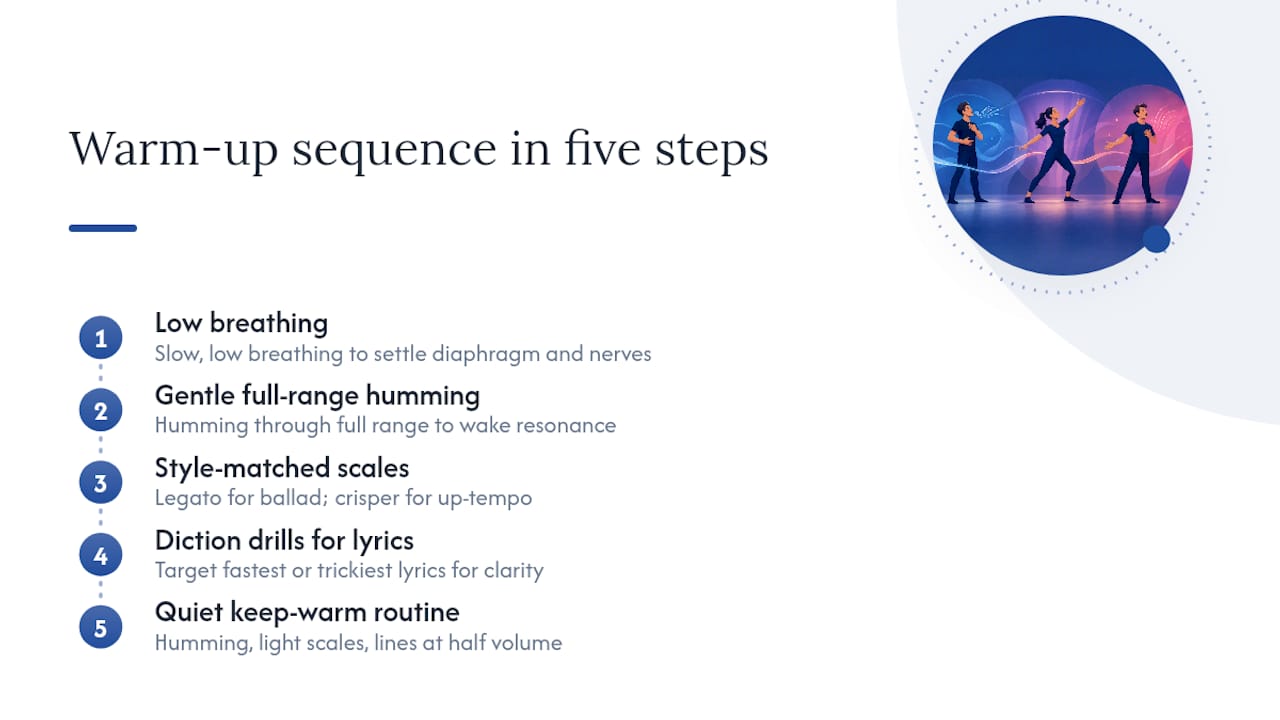
Include diction drills specific to your cut’s fastest or trickiest lyrics. Musical theatre often demands rapid, clear text delivery, and a warm-up that ignores this leaves your mouth unprepared even if your voice is ready.
Save any big, loud belting or high-note work for earlier in the day rather than right before you’re called. A short, quiet keep-warm version nearer the room, gentle humming, light scales, a few lines of the cut at half volume, protects your voice without exhausting it before you’ve even started.
Tailor the warm-up to the show. A pop-rock score benefits from a slightly more chest-forward, contemporary warm-up; a classic Golden Age piece rewards a rounder, more legato approach. Matching your warm-up style to your material means your voice arrives already thinking in the right idiom.
Tailoring your performance to panel or single-director auditions
A full panel and a lone director in a small room call for genuinely different choices, even with the same cut.
For a panel, project your energy and eye contact across the group rather than fixing on one person, and keep your physicality slightly bigger so it reads clearly from further back or across a wider table. Panels also move faster between performers, so a strong, clear slate and an immediate connection to the first line matter even more; you have less time to win them over gradually.
In a room with a single director, often much closer to you, pull the scale in. Big, presentational choices that work for a panel can feel overblown at close range. Use more subtlety in the face and voice, and treat it more like a genuine conversation or scene than a performance being broadcast outward.
In both settings, read the energy in the room during your slate. A brisk, businesslike panel wants efficiency; a warmer, more relaxed single director may respond well to a touch more personality before you begin. Adjust your pacing, not your preparation, your material and choices stay the same, but how broadly you deliver them should flex to the space and the audience in front of you.
Headshots and resumes that support your audition
Your headshot should look like you on an ordinary day, not a heavily edited version of you. Casting compares the photo to the person walking through the door within seconds, and a mismatch creates an immediate, if unfair, doubt before you’ve sung a note.
Keep the resume clean, one page, easy to scan in the few seconds a panel typically has between performers. List your most relevant and recent credits first, group training and special skills clearly, and cut anything irrelevant to the show being cast. A resume padded with unrelated details slows a panel down exactly when speed and clarity work in your favour.
Staple your resume to the back of your headshot, photo facing out, so nothing falls loose or gets separated in a stack of dozens of others. Update both regularly; a resume listing a show from three years ago as your most recent credit signals you haven’t been active, even if that’s not true.
Building relationships with casting professionals
Auditions are rarely a single, isolated event. The same casting directors, choreographers, and music directors turn up again across regional and youth theatre circuits, and how you behave in one room follows you into the next.
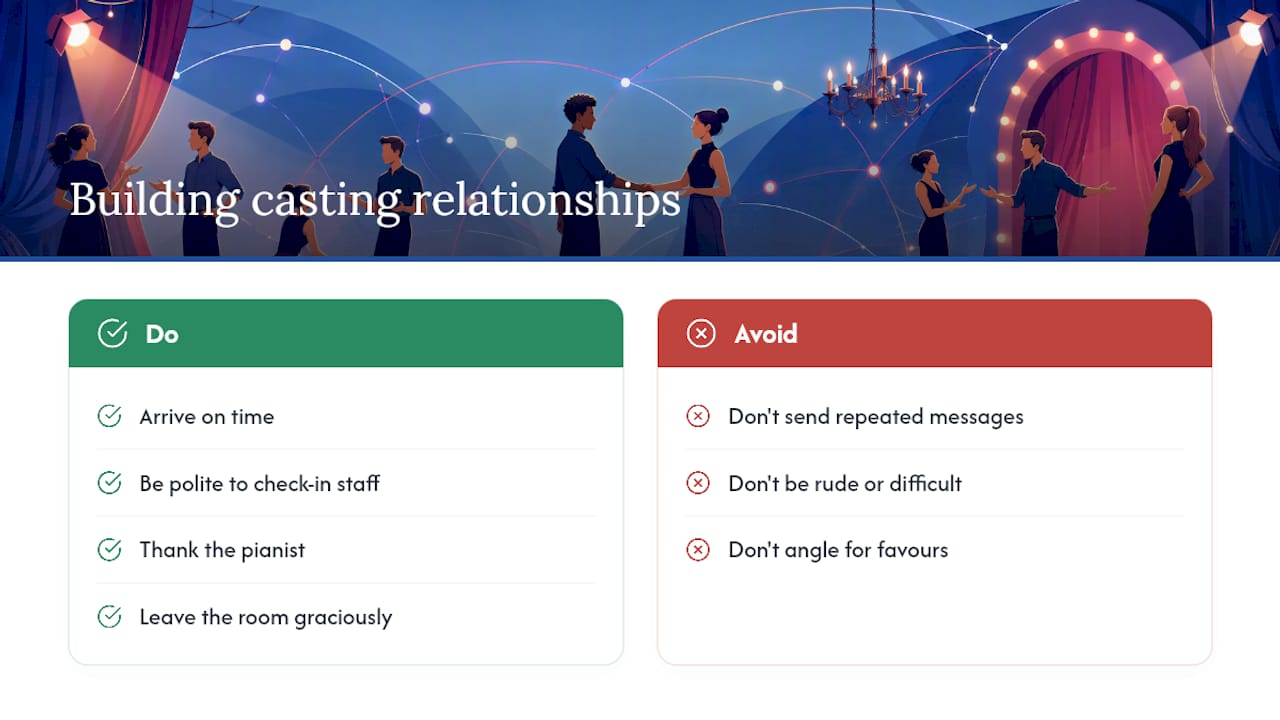
Professionalism outside the actual performance counts for more than most young performers assume: arriving on time, being polite to the person checking you in, thanking the pianist, and leaving the room graciously whether it went well or not. Panels remember performers who were easy and pleasant to work with almost as clearly as they remember a strong cut.
Where possible, take workshops, classes, or intensives led by people who work in casting or direction regularly. It’s not about angling for favours, it’s about becoming a known, reliable quantity in a room before you ever audition for them formally. A structured, professionally led training environment gives you exactly this kind of repeated, low-stakes exposure to industry professionals over time, rather than meeting them for the first time under audition pressure.
Follow up briefly and appropriately after a callback if invited to, a short thank-you note rather than repeated messages. The relationship matters more over years than any single audition result does.
Ready to build these habits inside a genuine rehearsal schedule rather than alone in your bedroom? Ocean Theatre Company trains performers aged 14 to 19 across Berkshire through weekly, professional-led rehearsals and two full-scale productions a year, including recent shows like Anastasia and Legally Blonde. It’s exactly the kind of sustained, structured practice this article has been describing throughout.
A coach’s note on persistence and realistic expectations
Auditions reward performers who’ve done the unglamorous work, the cold run-throughs, the messy first mock, the note you didn’t want to hear, far more than they reward talent alone. Expect some auditions to go badly even when you’re prepared; that’s the job, not a sign you’re on the wrong path. If you take one thing from this article, make it this: run your cut cold tonight and record it. What you see will tell you more than another hour of singing in the mirror ever could.
— Andrew
Sources
Recommended
Comments