

Open Auditions Explained: Practical Prep and Youth Theatre Steps
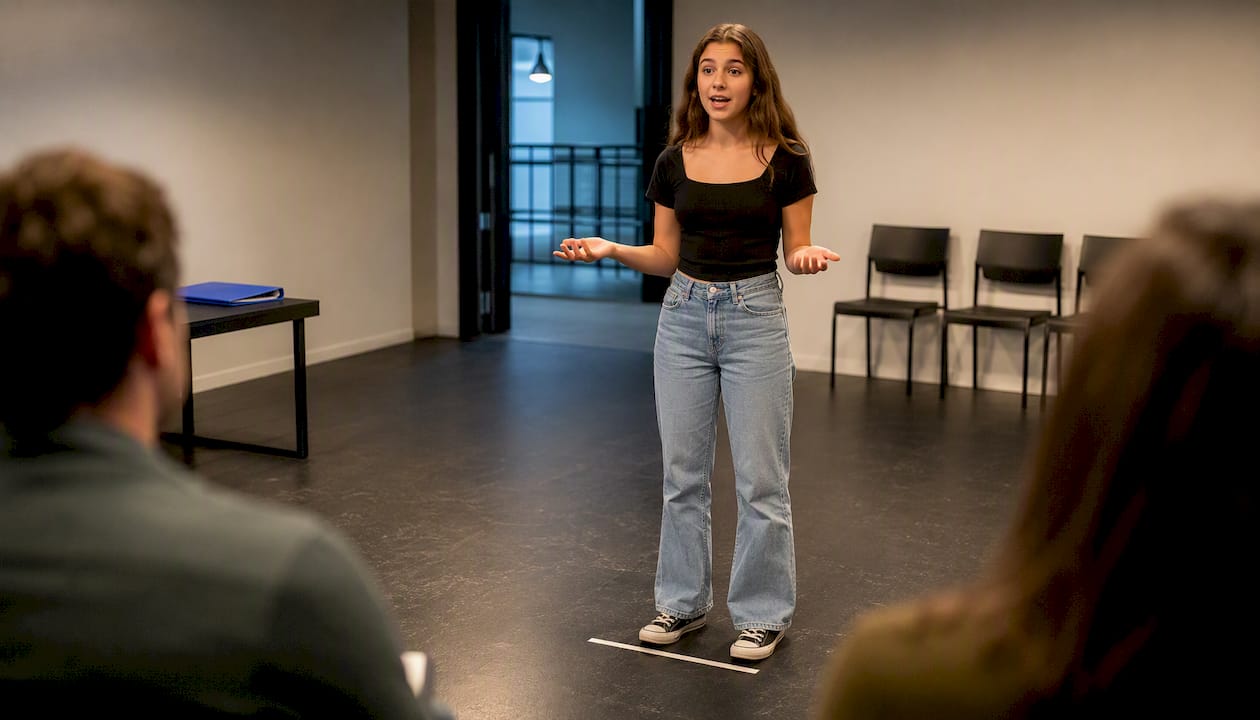
An open audition is a publicly advertised casting call that anyone meeting the stated criteria, such as an age range, can attend without an agent. It usually runs as an in-person queue-and-perform session, a live virtual call, or a self-tape submission. For beginners, it’s genuinely worth attending: it’s one of the few doors into performing arts that doesn’t require an industry connection to walk through.
TL;DR:
Open auditions are highly competitive with short performance windows, but they provide a genuine entry point for beginners without industry connections.
Preparation should focus on arriving early with necessary materials, memorizing brief material, and ensuring technical quality for virtual or self-tape formats.
Punctuality, professionalism, and following instructions are crucial, as casting teams see many hopefuls and small mistakes can count.
Practice over time, especially in youth theatre, builds the skills and confidence needed to succeed in open auditions, beyond just performing well on the day.
Attending when properly prepared and matching the role breakdown offers the best chance of success, rather than just turning up for experience.
Table of Contents
What is an open audition and what are the three main formats?
Open auditions exist wherever a production needs to see a wide pool of people quickly, whether that’s a community show, a student production, or a professional casting search building an ensemble. The core idea is access: no agent, no invitation, just a published notice and a set of requirements you either meet or don’t.
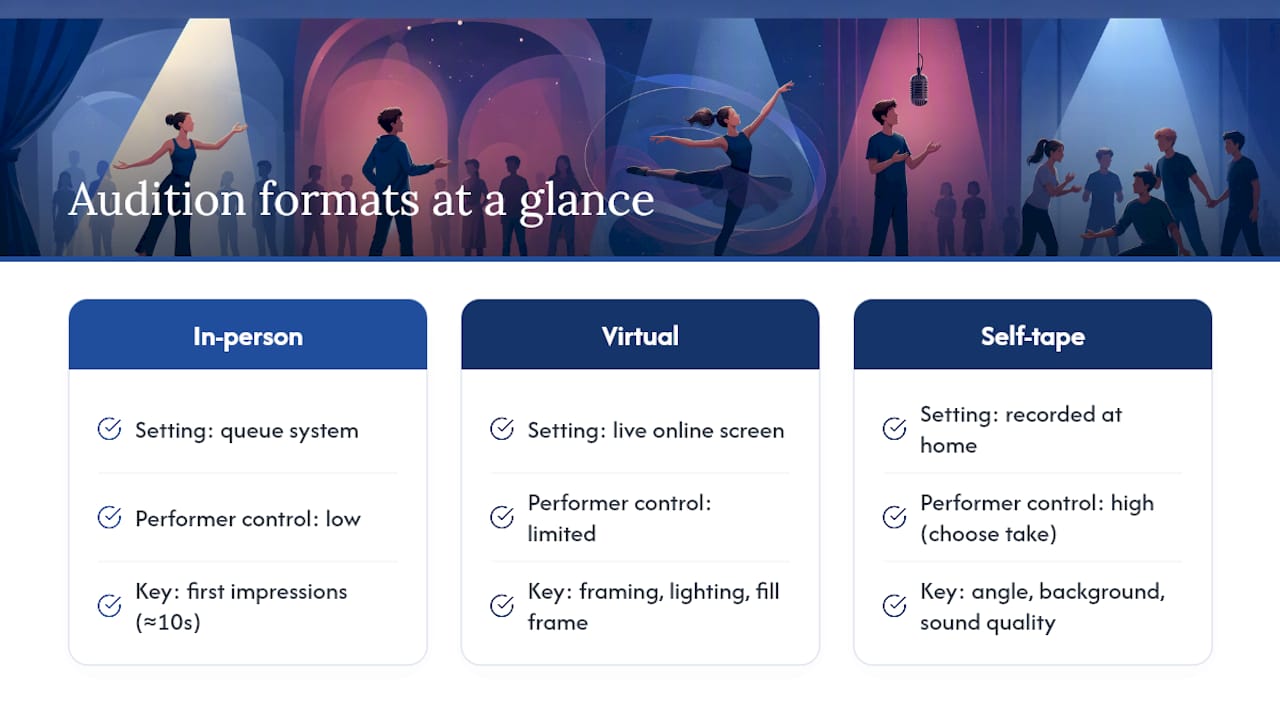
In-person auditions work on a queue system. You sign in, wait your turn, deliver a short slate and performance, and leave. First impressions land fast here, often within the first ten seconds of walking into the room.
Virtual or live online auditions put the same pressure through a screen. Casting still reads energy and presence, but now it depends on your framing, lighting, and how well you fill the frame without a live room to react to you.
Self-tape auditions hand you the most control. You choose the take, the angle, the background. Equity’s self-tape auditions guidance sets out why sound quality and steady framing matter as much as the performance itself; a great take undone by muffled audio rarely gets a second look.
Open versus closed auditions: what’s the real difference?
The two formats sit at opposite ends of accessibility. An open audition is publicly advertised and available to anyone who fits the brief. A closed audition is invite-only, typically reached through an agent, a casting director’s shortlist, or a direct relationship with the production.
Who can attend: open calls welcome the public; closed calls restrict entry to pre-vetted or represented performers.
Purpose and scale: open calls are often about discovery or filling ensemble and understudy roles across a large pool; closed calls tend to cast principal or specialist roles from a narrower, already-known field.
What it means for beginners: open auditions are your realistic entry point. They’re more competitive per slot, but they’re the ones you can actually walk into.
What happens at an open audition, step by step?
Knowing the sequence in advance takes a surprising amount of nervous energy off the table.
Arrival and sign-in. You’ll usually register on a list or sign-up sheet and then wait, sometimes for a while. Use that time to warm up quietly and run your material one last time rather than watching everyone else’s nerves.
The slate. Before you perform, you’ll state your name and the role you’re reading for, clearly and briefly. Equity’s code of best practice for self-tape auditions treats the slate as a professional standard, not a throwaway moment, and fumbling it is one of the most avoidable first impressions to get wrong.
The performance. Expect a tight window, often 30 to 90 seconds. Casting decisions form quickly, and preparation and presence tend to matter more than raw talent alone, according to BroadwayWorld’s breakdown of open-call auditions.
After you leave the room. Some auditions end there; others lead to callbacks days or weeks later. No callback doesn’t mean no talent. It usually means you weren’t right for that particular breakdown on that particular day.
How do you prepare for an open audition?
Preparation is what separates a wasted trip from a real shot, whatever format you’re facing.
Bring the essentials: a current headshot, an up-to-date CV or resume, and spare printed copies if the notice doesn’t confirm digital submission.
Have material ready: 30 to 60 seconds, fully memorised, suited to the age and tone of the role advertised. Don’t guess. Read the breakdown twice.
Check your tech for virtual and self-tape calls: steady framing, eyes roughly at camera height, clear audio, and a plain, uncluttered background.
Sort logistics the night before: arrive early, bring water, and dress in a way that hints at the character without turning into a costume.
Pro Tip: Record your self-tape on your phone, then watch it back with the sound off first. If your energy and expression still read clearly with no audio, your performance is doing the work rather than relying on the words alone.
Backstage’s tips for acing an open call make the same point from the casting side: arriving prepared is what actually gets remembered, not luck.
What audition etiquette should beginners follow?
Punctuality and a clean, concise slate signal professionalism before you’ve said a single line of your piece. Casting teams see dozens, sometimes hundreds, of hopefuls in a single day, so anything that slows the room down works against you.
Avoid monopolising the waiting area with chatter or nerves that spread to everyone around you, and follow directions exactly when a casting assistant gives them. The most common mistakes are painfully avoidable: a rushed or mumbled slate, poor audio on a self-tape, or turning up without having read the character breakdown properly.
If you’re not selected, treat it as information, not rejection. Casting is about fit for one specific role on one specific day, and that changes constantly.
Are open auditions worth attending? The pros and cons
Weighing this honestly helps you decide where to spend your limited audition time.
The upsides:
Genuine public access with no agent required.
Real discovery potential. Backstage notes open calls have produced professional hires for ensemble and understudy roles.
Valuable experience simply from doing the reps, regardless of the outcome.
The downsides:
High competition per available slot.
A short window, often under a minute, to make your case.
Variable odds of even being properly seen if numbers are very high.
The verdict: attend when you genuinely match the breakdown and you’re prepared, not just to “get experience” by turning up unready.
How does youth theatre training prepare you for auditions?
Weekly rehearsal under professional direction builds exactly the skills an open audition tests in miniature: a tight time window, a clear first impression, and the ability to perform under pressure. At Oceantheatre, members aged 14 to 19 across Berkshire rehearse toward two large-scale musical productions a year, which means slating, taking direction quickly, and holding focus in an ensemble become second nature rather than a one-off ordeal. Newcomers gain confidence and genuine stagecraft, not just theory, in a group that’s designed to feel supportive rather than cut-throat, with entry routes set out in the accessibility statement.
Why the standard audition advice misses the point
Most beginner guides to open auditions focus almost entirely on the moment itself: nail the slate, hit your marks, don’t ramble. That’s not wrong, but it treats the audition as an isolated event rather than a skill built over months of repetition. The research bears this out. Casting professionals consistently say preparation and presence, not raw talent or luck, decide who gets remembered in a room full of strangers.
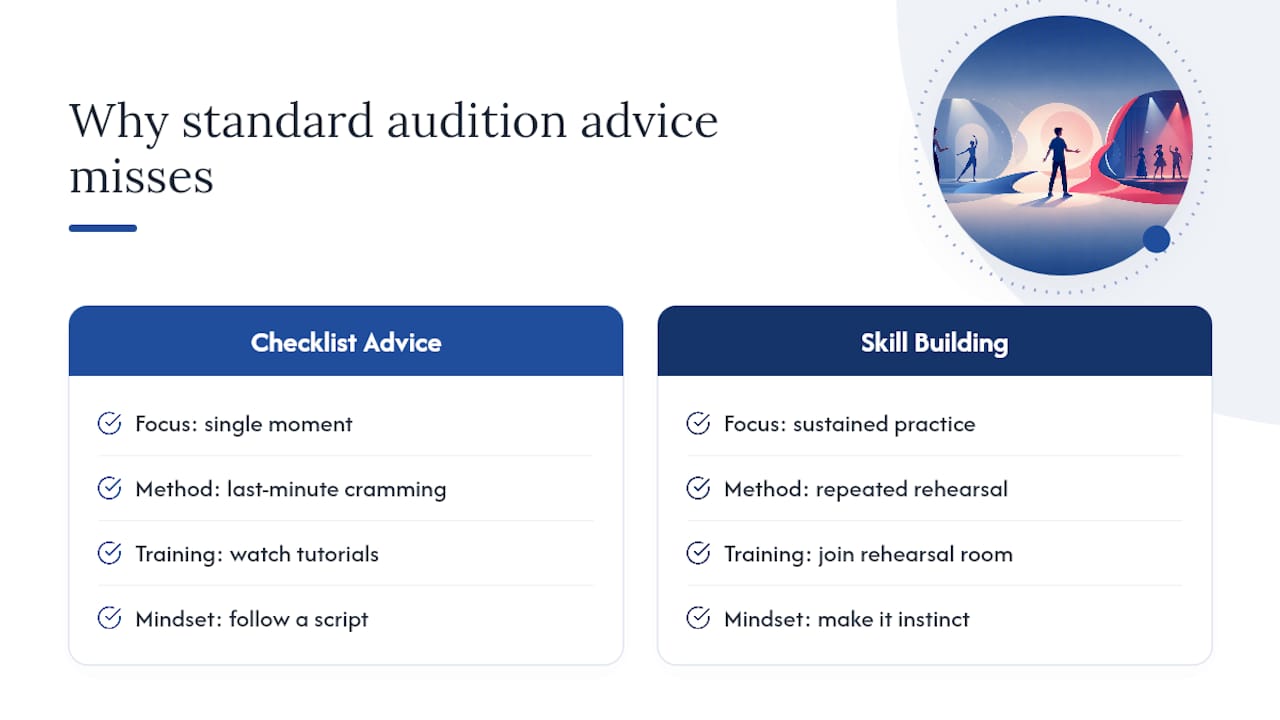
Where conventional advice falls short is in assuming a beginner can simply read a checklist the night before and perform confidently the next day. Presence under pressure is a muscle. It’s trained through repeated rehearsal, not through a single YouTube tutorial on how to slate correctly.
If you’re new to this, prioritise sustained practice over audition-specific cramming. Join a rehearsal room, get comfortable being watched, and let the technical checklist become instinct rather than a script you’re anxiously running through your head. The open audition itself is just the moment you finally get to show it.
— Andrew
Ready to build real audition confidence?
Reading about open auditions gets you halfway there; regular rehearsal under proper direction gets you the rest of the way. Youth theatre companies train young people aged 14 to 19 through weekly sessions and large-scale musical productions each year, giving members stagecraft, ensemble experience, and calm-under-pressure skills that no single audition-day checklist can teach on its own.
[

Joining a youth theatre doesn’t necessarily mean starting on a stage. It often means starting with a supportive group where slating, taking direction, and performing under a clock become familiar well before attending auditions. Past productions like Guys & Dolls and Les Misérables show the scale members work at once they’re in. If you’re ready to see what that could look like for your son or daughter, visit Oceantheatre to check upcoming productions and enquire about joining.
Where can you find further guidance on open auditions?
For official standards, Equity’s casting and auditions advice covers professional conduct expectations. Backstage’s open call tips offer casting-side perspective, while BroadwayWorld’s overview explains the modern format landscape. The Cambridge Dictionary offers the plainest definition of the term itself.
Sources
Recommended
Comments