

Musical theatre builds public speaking for 14–19s, evidence for parents
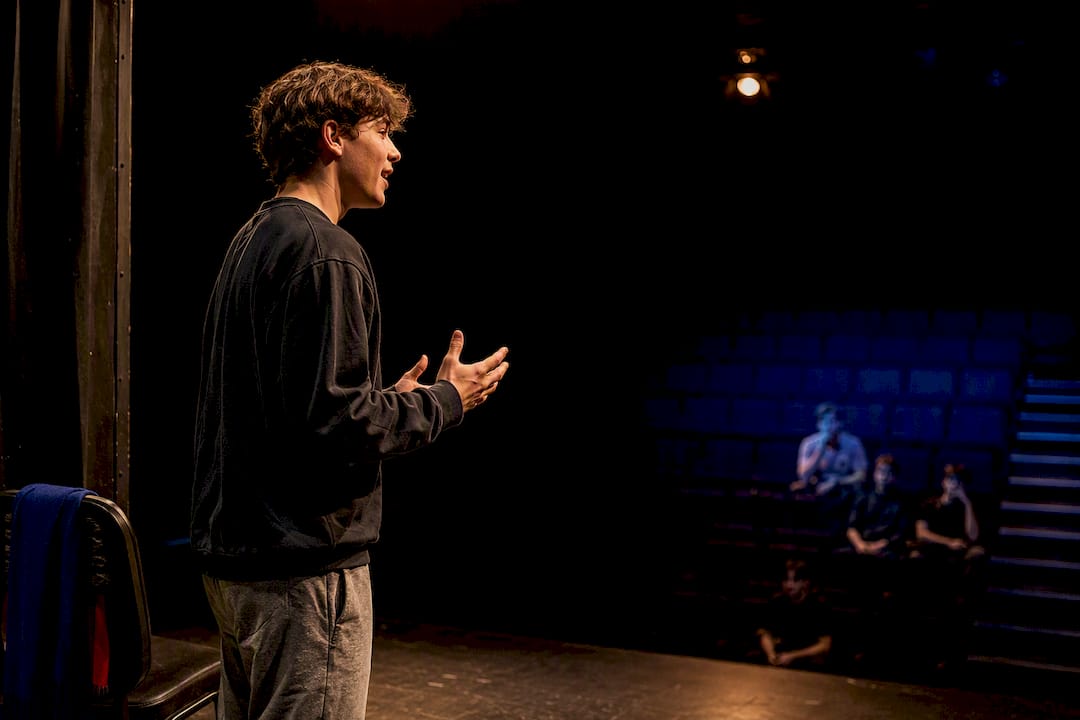
Musical-theatre training builds public speaking for teens more reliably than most standalone courses, because it drills the same skills under real pressure: projection, structure, eye contact, composure. Longitudinal research backs this up with durable gains in confidence and communication. Ocean Theatre Company puts that theory into weekly rehearsal rooms across Berkshire, and parents consistently see it in their teenagers by opening night.
TL;DR:
Musical-theatre training provides durable improvements in confidence, communication, and teamwork, especially when involving full musicals with real performance stakes.
Rehearsal experiences develop vital public speaking skills such as projection, diction, body language, and structuring speech, which transfer directly to classroom and social settings.
Intensive programs with regular rehearsals, staged performances, and progression tracking yield stronger outcomes in leadership, resilience, and social belonging than casual drama clubs.
Feedback from directors and peers during rehearsals is crucial for technical progress, teaching teenagers how to accept correction and build resilience in public speaking.
Participating in regular performances and ensemble roles, along with structured exercises like impromptu speaking and video review, significantly reduce stage fright and improve speaking confidence.
Table of Contents
What musical-theatre training improves: confidence, communication and teamwork
What public speaking skills does theatre training actually teach?
What are the most common public speaking struggles for teens?
Practical next steps: how to trial a programme and support your teen
Ocean Theatre Company: join a trial and see stage confidence build
What musical-theatre training improves: confidence, communication and teamwork
Rehearsal rooms are laboratories for exactly the skills a nervous teenager needs at the front of a classroom. A mixed-methods longitudinal study found that students’ 21st-century skills, including creativity, collaboration and communication, rose with every semester of enrolment, not just after a single term. That matters for parents weighing up a short workshop against something more intensive: the gains compound.
The transfer from stage to speech is direct rather than metaphorical. Projection and breath control are the mechanics of being heard in a hall, which is precisely what a teenager needs when addressing forty classmates. Articulation work sharpens diction under nerves. Active listening, drilled constantly in scene work, becomes the skill of reading a room mid-speech and adjusting tone accordingly.
Character work adds something a public speaking course rarely touches: character-based exercises push teenagers into empathy and perspective-taking, which shows up later as spontaneity when they have to think on their feet in front of an audience.
A large sector review of youth theatre members found:
Confidence, teamwork and communication were the three outcomes members named most consistently when asked what participation had given them.
Beyond the technical skills, the social architecture of a company does real work too:
Peer support networks that outlast any single production, giving teenagers a stable group through exam years and school upheaval.
Resilience built through repeated performance in front of others, which normalises the physical stress response public speaking triggers.
Leadership opportunities, from ensemble captain roles to solo numbers, that hand teenagers real responsibility rather than token praise.
A sense of belonging that specifically supports teenagers who find traditional classroom participation daunting.
How do you choose the right performing-arts programme?
Not every youth theatre delivers the same outcomes, and the gap between a casual drama club and an intensive training company is wider than most parents expect. Look for programmes structured around genuine performance stakes, not just craft exercises.
Curriculum and repertoire. A programme built around full musicals, with proper ensemble choreography, role work, singing technique and movement, gives teenagers far more stage time than scattered drama games.
Staff and safeguarding. Ask directly about professional-led direction, DBS-checked staff, a published child-protection policy and first-aid provision on site. Sector guidance recommends parents treat these as non-negotiable checklist items, not assumptions.
Rehearsal and performance model. Weekly sessions build technique, but tech week and public performance are where nerves get tested and rebuilt into confidence. A programme without a real audience at the end is missing the point.
Progression and assessment. The strongest companies track growth rather than relying on parents to take their word for it. Published progression pathways let you see whether a teenager who joins at 14 is still being stretched at 18, and leadership or solo casting gives you evidence of that stretch in action.
Accessibility and cost. Transparent fee structures, concession policies where they exist, and clarity on what counts as an “extra” (costumes, travel, production levies) all separate a well-run company from one that surprises parents mid-term.
Pro Tip: Ask to sit in on the last twenty minutes of a rehearsal before you enrol. You will learn more about tone, discipline and how staff handle mistakes in that short window than from any prospectus.
Ensemble and leadership roles are worth weighting heavily in your decision. Research synthesising Centre Stage and related youth theatre projects finds that active participation in ensemble work correlates strongly with stronger teamworking and leadership outcomes, so a programme that rotates responsibility rather than always casting the same faces in lead roles is doing something right.
What time and cost commitment should parents expect?
Intensive musical-theatre training requires a significant commitment beyond a casual hobby, so it is beneficial to understand the time needed before enrolling. Typically, term-time schedules include weekly rehearsal sessions of a few hours, with increasing frequency and duration as production dates approach. Show week often involves a much more demanding schedule.
Evening tech runs become nightly rather than weekly, often stretching later than a normal school evening allows.
Dress rehearsals add full-day sessions, particularly at weekends, and teenagers should expect to lose most of a Saturday or Sunday.
Performance weekends can mean two or three shows across a few days, on top of the rehearsals leading into them.
On cost, expect a term fee covering weekly training, plus a separate production fee tied to each show a teenager takes part in. Costume contributions and travel to performance venues are common additions worth asking about upfront. Before enrolling, ask specifically what happens if a teenager has to drop out mid-production, whether fees are refundable, and what counts as compulsory versus optional spending. A programme confident in its value will answer these plainly.
Ocean Theatre Company: putting the theory into practice
Ocean Theatre Company was built around exactly this model. Training is aimed squarely at 14 to 19 year olds, led by professional directors, and structured around two large-scale musical productions each year rather than one-off workshops with no real audience at the end.
The repertoire leans into classic musical theatre performed at a high-energy standard, from The Addams Family to more recent stagings like Our House. Weekly rehearsals build technique across singing, acting and dance, while the production calendar gives every member genuine stage time, not just the strongest performers.
Parents consistently describe watching their teenager arrive quiet and leave the programme willing to hold a room, whether that room is a school assembly or a job interview.
What public speaking skills does theatre training actually teach?
Voice control is the first thing a director works on with a new teenager, and it maps directly onto public speaking. Projecting to fill a room without shouting, varying pace to hold attention, and pausing deliberately rather than rushing through nerves are all rehearsed weekly, not taught once and forgotten.
Body language gets the same treatment. Standing with weight evenly distributed, keeping hands purposeful rather than fidgeting, and holding eye contact across an audience rather than fixing on one friendly face are all corrected in real time during blocking rehearsals, where a director can see exactly what a script cannot fix.
Structuring a speech borrows directly from how a musical scene is built: a clear opening that sets the stakes, a middle that develops tension or argument, and a close that lands with intention rather than trailing off. Teenagers who have learned to shape a monologue for maximum impact tend to apply the same instinct to a school presentation without needing to be told the theory of “beginning, middle, end” separately.
The habit of rehearsing aloud, repeatedly, in front of other people, is arguably the single most transferable skill theatre offers. Most public speaking anxiety comes from unfamiliarity with hearing your own voice fill a space, and repetition solves that faster than any technique.
What are the most common public speaking struggles for teens?
Freezing under sudden attention is the challenge that comes up most often, and it usually stems from a lack of rehearsal under real conditions rather than a lack of ability. Teenagers who have only ever practised a speech alone in their bedroom have never trained the specific skill of continuing to speak while people are watching.
Monotone delivery is another frequent struggle. Nerves flatten vocal variety, and a script read at one pace, one volume, becomes hard to listen to even when the content is strong. Theatre training tackles this directly through table-read exercises where a director stops a teenager mid-line and asks them to try the same phrase three different ways.
Filler words and rushed pacing tend to appear together, both driven by a teenager’s urge to get through the discomfort as quickly as possible. The fix is counterintuitive: slowing down feels riskier in the moment but reads as more confident to an audience.
Comparison anxiety, worrying about how a performance measures up against a sibling, a classmate or a social media version of confidence, undermines plenty of teenagers before they even open their mouths. Ensemble work helps here because success is shared across a group rather than resting on one performer alone.
The common thread across all of these struggles is exposure. Teenagers who rehearse in front of people regularly stop treating an audience as a threat, largely because the response becomes automatic rather than something they have to consciously manage each time.
Which exercises actually build public speaking confidence?
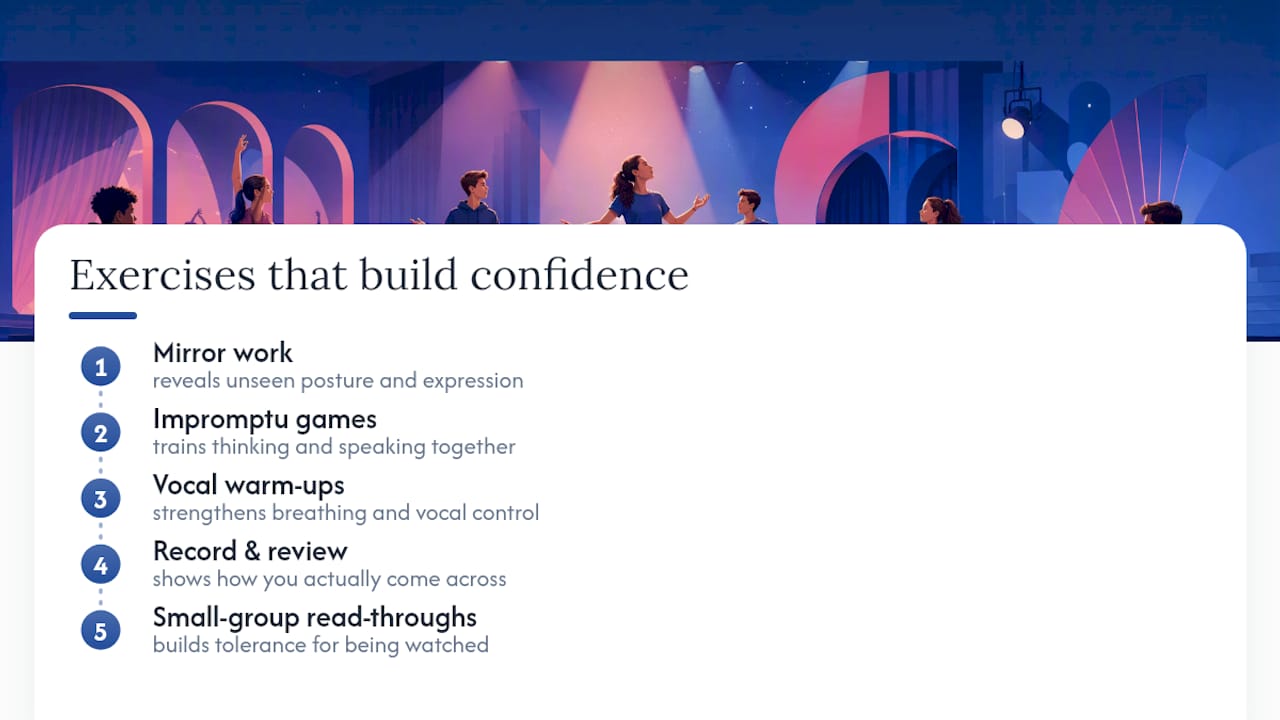
Mirror work, standing in front of a mirror and delivering a short passage while watching posture and facial expression, sounds basic but catches habits a teenager cannot feel from the inside, like a clenched jaw or a fixed stare.
Impromptu speaking games, where a teenager has thirty seconds to talk on a random topic with no preparation, build the specific muscle of thinking and speaking simultaneously without the safety net of a script.
Vocal warm-ups borrowed straight from theatre training, humming scales, tongue twisters, breathing exercises that extend the length of a single exhale, all strengthen the physical apparatus a nervous teenager relies on most under pressure.
Recording and reviewing speeches on a phone feels uncomfortable the first few times, but it closes the gap between how a teenager thinks they sound and how they actually come across, which is often the single biggest confidence blocker.
Small-group read-throughs, performing a short piece for two or three trusted peers before attempting a full audience, build tolerance for being watched in manageable steps rather than all at once. Ensemble scenes in rehearsal do exactly this naturally, week after week, which is one reason regular theatre attendance tends to outperform occasional public speaking practice.
How can parents help a teen manage stage fright?
Stage fright is a physical response before it is a confidence problem, and treating it that way changes what actually helps. Racing heart, shallow breathing and a dry mouth are the body preparing for a threat that is not real, and slow, deliberate breathing exercises before a speech interrupt that response more effectively than reassurance alone.
Reframing the audience helps too. Teenagers who think of a room as judges tend to freeze; those coached to think of an audience as simply listening, rather than scoring, tend to relax into delivery. This is precisely why repeated performance experience works better than isolated pep talks: the reframe becomes automatic rather than something a teenager has to remember to do under pressure.
Practitioner observations from long-term impact research describe a distinctive calm that develops with sustained performance experience, the kind that shows up later in exam halls and job interviews as much as on stage. That composure is not innate. It is trained through repeated exposure to exactly the stress a speech provokes, in a setting where the consequences of a wobble are low.
Parents can support this at home simply by asking a teenager to run through a speech or scene aloud rather than silently, since silent rehearsal skips the exact discomfort that needs practising.
Where else can teens practise public speaking?
Theatre training builds the foundation, but plenty of everyday settings let a teenager keep exercising the same muscle between rehearsals. School presentations are the most obvious, and teenagers who treat every classroom talk as low-stakes practice rather than a chore tend to notice faster improvement than those who avoid volunteering.
Debate clubs offer something theatre does not: structured argument under time pressure, with a genuine opposing view to respond to in real time. Combining the two, stage presence from theatre and argument structure from debate, produces a notably well-rounded speaker.
Teen speech competitions, whether run through schools, youth organisations or local community groups, give teenagers a defined goal and a deadline, both of which sharpen preparation in a way that open-ended practice rarely does.
Student council roles, part-time jobs involving customer interaction, and even volunteering to read at a family event all count as legitimate practice. The through-line across every one of these opportunities is repetition in front of real people, which is exactly what makes intensive theatre training such an effective public speaking course in the first place, just delivered through a medium teenagers are more likely to actually enjoy showing up for.
Why does feedback matter so much for improvement?
Feedback is where technical improvement actually happens, more than rehearsal hours alone. A teenager can repeat a speech twenty times and reinforce the same flaws twenty times over if nobody tells them what to change.
Specific, immediate feedback works far better than generic praise. “That was great” teaches a teenager nothing about what to repeat next time. “Your pace picked up in the second half and it landed better, try starting there” gives them something concrete to act on.
Constructive criticism delivered inside a supportive rehearsal culture also teaches teenagers something that matters well beyond the stage: how to receive correction without treating it as a personal attack. Directors who frame notes as tools rather than judgments model exactly the resilience parents want their teenagers to carry into school, exams and eventually the workplace.
Peer feedback adds a layer that adult direction cannot always reach. Hearing from a fellow ensemble member that a scene felt more convincing this run carries a different kind of weight, partly because teenagers often trust peer honesty more readily than adult reassurance, and partly because it reinforces the sense of shared investment that makes ensemble work so effective for building confidence in the first place.

Practical next steps: how to trial a programme and support your teen
Most reputable companies will let you watch a rehearsal or arrange a taster session before committing to a term. Ask for this directly, and ask to speak with a current parent if a reference is not offered upfront.
Bring six questions to any open day: who is running sessions and what are their credentials, what safeguarding policy is in place, how is progress assessed, what is included in the fees, what performance opportunities exist beyond the annual show, and who handles pastoral concerns if a teenager struggles.
At home, your role is smaller than you might think but still matters. Offer specific feedback rather than blanket praise, help maintain a simple rehearsal routine around homework and rest, and turn up to performances consistently. Teenagers gauge how seriously to take something largely by whether the adults around them show up for it.
— Andrew
Ocean Theatre Company: join a trial and see stage confidence build
If your teenager needs more than a weekend workshop to find their voice, Oceantheatre offers something most public speaking courses cannot: two full-scale musical productions a year, built on weekly rehearsals with professional direction, in a company designed specifically for 14 to 19 year olds across Berkshire.
[

Every session is structured around the same skills covered here: projection, structure, composure under real audience pressure, built gradually rather than crammed into a single course. Repertoire ranges from high-energy contemporary shows to classic musicals, giving every teenager genuine stage time rather than a supporting role in someone else’s spotlight.
Get in touch through the Ocean Theatre Company website to ask about a trial session or upcoming intake dates, and browse a recent production like Our House to see what the training builds towards. Enquire now and find out when the next open rehearsal is happening near you.
Sources
Evidencing the long-term impact of participation in youth theatre (YTAS report)
Developing creativity and 21st‑century skills through theatre classes (AEP report / study)
Centre Stage +20: outcomes of participation in youth theatre (chapter 7)
Stimulating social engagement of adolescents through theatre (MDPI article)
Recommended
Comments