

Ten Minutes a Day Builds Choir Ready Sight Reading for Singers

Sight reading for singers means turning notation on a page into accurate pitch and rhythm the first time you see it, without hearing it played first. The fastest way to build this skill is a short daily practice, rhythm first, then pitch, using movable-do solfège to anchor your ear to the key. Expect real progress within weeks, and confident ensemble reading within a few months of consistent effort.
TL;DR:
Consistent daily practice focused on rhythm and solfège significantly accelerates sight reading progress within weeks.
Using structured drills like scale runs, thirds, and arpeggios helps develop pattern recognition and interval awareness efficiently.
Separating rhythm from pitch by speaking or clapping reduces cognitive load and improves overall reading accuracy.
Apps with graded exercises and real-time feedback enhance training, but recordings and short sessions are essential for steady improvement.
In choir settings, scanning parts, anchoring on the ensemble, and marking entries help maintain confidence during rehearsals.
Table of Contents
What is a good starter plan for sight reading?
You don’t need a lesson plan or a pile of theory before you start. You need a page of music and a repeatable sequence that stops guesswork before it begins.
Follow this order every time you open a new piece:
Scan the score first. Check the key signature, time signature, and the highest and lowest notes so you know the range before you sing a single pitch.
Speak the rhythm. Say the note values aloud or clap them while tapping a steady pulse, entirely separate from pitch.
Find your tonic. Sing Do, then anchor Do to Mi and Sol before you attempt the actual melody, so your ear has a harmonic home to return to.
Choose stepwise material. Simple folk tunes with mostly step-by-step movement are ideal first pieces, and specimen exam banks are a reliable source of graded sight reading material.
Keep going through mistakes. Stopping to correct a wrong note breaks the one habit sight reading depends on: continuous forward motion.
One rule matters more than any other here: don’t let anyone play the full melody for you before you attempt it. A quick reference tonic is fine, but hearing the tune first turns the exercise into memory recall rather than genuine reading.
Core techniques: solfège, interval anchors and rhythm-first practice
Five techniques do most of the heavy lifting in sight singing: identifying the key and time signature, establishing the tonic, separating rhythm from pitch, using a consistent solmisation system, and practising in short daily bursts.
Movable-do solfège is worth adopting early. Because the syllables shift relative to the key rather than staying fixed to absolute pitches, it trains your ear to hear scale-degree relationships in any key, and the vowel-heavy syllables (Do, Re, Mi) are simply easier to sing under pressure than letter names.
Five intervals cover most of the melodic movement you’ll meet as a beginner:
Major 2nd — the small step at the start of most scales
Major 3rd — the sound of a bright, open major triad
Perfect 4th — heard in countless folk tune openings
Perfect 5th — the backbone of most harmony
Octave — your safety net for checking overall pitch accuracy
Drill these from random starting notes, not just from Do, so your ear learns the interval itself rather than memorising one melody.
Separating rhythm and pitch isn’t a beginner’s crutch. Speaking or clapping the rhythm before adding pitch reduces the cognitive load of reading two dimensions of information at once, which is why even experienced sight readers still run a silent rhythm pass on tricky passages.
Pro Tip: Conduct or tap the pulse with your free hand while you sing. Externalising the beat stops you from rushing through easy bars and dragging through hard ones, and it gives your body something steady to hold onto when a leap catches you off guard.
Which exercises actually build sight reading fastest?
Random practice wastes time. Structured drills, repeated in the same order every session, build the pattern recognition that makes reading feel automatic.
Work through this sequence with any new piece:
Scale runs. Sing five-note and full octave scales in solfège, ascending and descending, until Do to Sol feels instinctive.
Thirds and arpeggios. Practise Do-Mi-Sol-Mi-Do patterns from different starting pitches to internalise the shape of a major triad by ear.
Rhythm-only pass. Speak the rhythm of the full melody on a neutral syllable, tapping the pulse, before you think about pitch at all.
Pitch-only pass. Sing the solfège syllables slowly, ignoring rhythm entirely, to lock in the interval pattern.
Combined pass at tempo. Put both together at a steady, unhurried speed, looking two or three notes ahead of where you’re actually singing.
Beginners progress fastest on stepwise folk songs and short hymns, since these avoid wide leaps and awkward rhythms until the fundamentals are secure. As confidence builds, move to melodies with occasional leaps of a third or fourth, then introduce syncopation and simple accidentals. Graded practice banks modelled on specimen exam material give you a natural ladder to climb, one grade at a time, without the guesswork of picking your own material.
Keep tempo constant rather than slowing down at hard bars. A steady, slower tempo throughout beats a fast tempo that collapses the moment a rhythm gets tricky.
How can apps and tools improve your sight reading?
Browser-based and app-based trainers now listen to your voice through a microphone and score your pitch and rhythm accuracy in real time, which is far more useful than practising blind.
Look for tonic playback, so you get a reference note without hearing the melody itself.
Prefer tools with graded exercise banks, so difficulty increases as your accuracy improves.
Check microphone accuracy before trusting the feedback, since a poor mic can flag correct pitches as wrong.
Use free browser tools first. Several web-based sight-singing trainers offer free tiers that cover the basics without a subscription.
Record yourself regardless of the app. Comparing a recording against a tuner or trainer afterwards catches errors your ear misses in the moment.
Keep sessions short, ten to fifteen minutes, and treat the app as a feedback loop rather than a substitute for reading real scores.
How do you sight read confidently in choir rehearsals?
Ensemble reading has its own pressures. You’re not just reading; you’re reading while other parts move around you, and a wrong note feels louder in a room full of listeners than it does alone.
Scan your entire part before rehearsal starts, marking entries after long rests, wide leaps, and breath points in pencil.
Use the ensemble sound to re-anchor your pitch. Leaning briefly on a strong section nearby is a legitimate strategy, not cheating, while you rebuild independent accuracy.
If you miss an entry, don’t chase it. Rejoin cleanly at the next clear cadence or tonic rather than fumbling through the bars in between.
Mark your breaths in advance, especially in long phrases, so breathing decisions never compete with pitch decisions mid-line.
These habits reduce the panic that derails otherwise capable readers the moment a rehearsal starts moving at tempo.
What does a realistic weekly practice schedule look like?
Consistency beats intensity here. A frequent, consistent short practice sessions outperform occasional long sessions, because sight reading is a physical pattern-recognition skill that needs frequent, small repetitions to stick.
Week 1: Ten minutes daily on rhythm-only drills and the five anchor intervals from a fixed starting note.
Week 2: Introduce stepwise folk melodies, running the full five-step sequence from the exercises section.
Week 3: Add melodies with occasional thirds and fourths, and start recording each session for comparison.
Week 4: Attempt one unfamiliar piece cold each day, timing how long it takes before your accuracy stabilises.
Ten minutes a day is the benchmark most vocal pedagogy sources point to for steady skill retention, and consistency in short sessions matters more than occasional long practices. Track progress with recordings and a simple interval checklist. If you’re sailing through every exercise without a single stumble, it’s time to move up a grade rather than stay comfortable.
How does Ocean Theatre build sight-reading skills into training?
Sight reading isn’t taught in isolation at Oceantheatre. It’s built into the warm-ups and sectional rehearsals that prepare young performers for large-scale musical productions, where a confident ensemble sound depends on every voice reading its part accurately from the first read-through. A typical sectional might run a rhythm-only pass on a new chorus number before adding pitch, the exact sequence outlined above, scaled to a room full of teenage voices finding their place in the harmony.

Where to find further sight reading resources
For deeper technique, Open Music Theory’s guide to sight-singing covers pulse and repetition in more academic detail. Sightsinging explains why hearing the melody first undermines genuine reading practice, and remains a useful check on bad habits.
Why immediate practice beats theory every time
Most guides on this topic spend far too long explaining music theory before they ever ask the reader to sing a note. That’s backwards. Sight reading is a motor skill dressed up as an intellectual one, and motor skills improve through repetition under mild pressure, not through understanding key signatures more thoroughly.
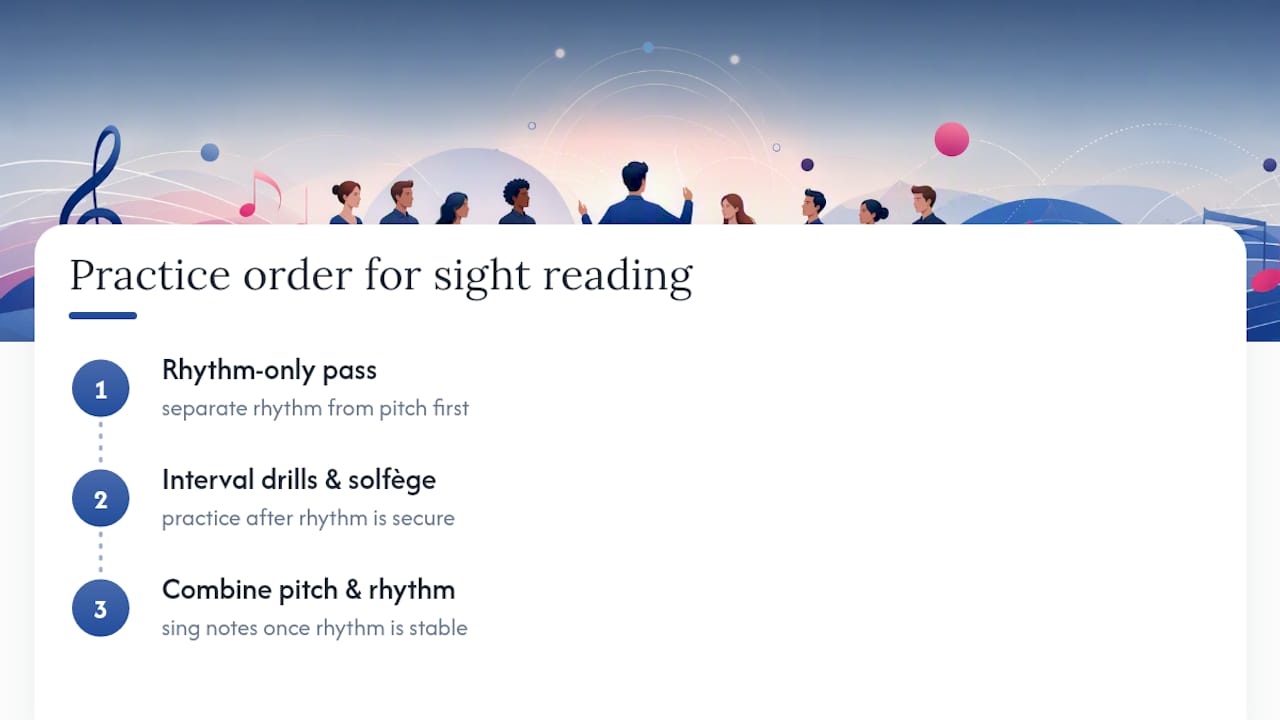
The conventional advice to “practise sight reading” without specifying rhythm-first separation is where most singers stall. They try to solve pitch and rhythm simultaneously, panic on the first leap, and conclude they’re simply bad readers. They aren’t. They’re doing two jobs at once that should be done separately.
If you take one thing from this guide, prioritise the rhythm-only pass over everything else. It feels like an unnecessary extra step when you’re eager to sing the actual notes, but it’s the step that stops rehearsals unravelling under pressure. Interval drills and solfège matter enormously too, but they build on a rhythmic foundation that has to be secure first. Skip that order and you’re building on sand.
— Andrew
Sources
Comments