

Actors: 5 Rehearsal Steps to Read Stage Directions and Hit Your Marks
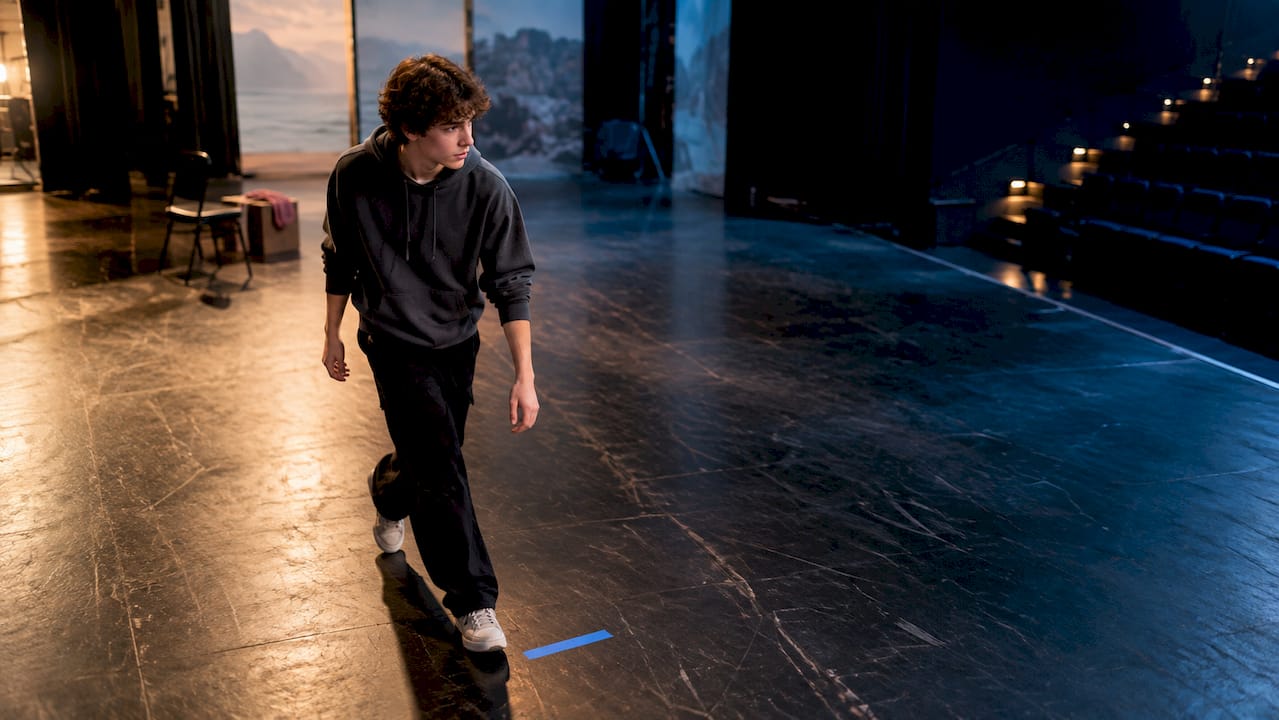
Stage directions are the non-spoken instructions written into a script that tell actors, directors, and designers where to move, how to deliver a line, or when a technical cue should fire. They’re written from the actor’s point of view facing the audience, not the audience’s view looking back. Treat them as rehearsal guides you interpret with your director, not commands carved in stone.
TL;DR:
Actors and crew interpret stage directions differently, with actors focusing on movement and emotional tone, while technical staff handle cues and equipment.
The nine-stage grid offers a standardized framework, with precise directions from the actor’s perspective, making spatial awareness essential for correct blocking.
Reading a script requires understanding the distinct categories of instructions, such as movement, parentheticals, and technical cues, to avoid confusion during rehearsal.
Digital scripts and automation technology have streamlined stage directions, allowing real-time annotation and precise execution of lighting and sound cues.
Practicing stage directions through physical walk-throughs and rehearsals greatly improves instinctive understanding beyond theoretical knowledge.
Table of Contents
Understanding stage directions: who reads them and why
A stage direction is a description or instruction in the text of a play that explains how the play should be performed, and that definition covers a surprising amount of ground. Some directions tell you where furniture sits on the set. Others tell an actor to cross to a window, pause before a line, or exit sobbing. Still others tell a lighting operator to fade to black or a sound technician to cue a thunderclap. All of it counts as a stage direction, even though a lighting cue and a piece of blocking feel like completely different jobs.
It helps to separate two sources of these instructions. The playwright writes some directions straight into the script when drafting the play, embedding their vision of tone and movement directly into the text. Others get added later, during a specific production, when a director or stage manager notes what worked in rehearsal. A script you buy off the shelf often blends both, and part of reading it well is learning to tell which is which.
Different people in the room lean on different parts of the text:
Actors focus on movement and parenthetical directions, the cues that shape blocking and delivery.
Directors use the full set to plan pacing, stage business, and where the audience’s eye should land at a key moment, since stage directions shape blocking and pacing and help establish dramatic emphasis.
Set and costume designers pull practical details from directions describing props, furniture, or a character’s dress.
Lighting and sound technicians work from technical cues embedded in the script or added to a production’s marked-up copy.
Stage managers compile all of the above into the “book,” the master script used to run the show night after night.
Clear, well-written directions make every one of those jobs easier, and Study. Muddled ones create the kind of confusion that eats up a rehearsal evening.
Upstage, downstage, and the nine-area grid explained
Every stage direction referring to movement is written from the actor’s perspective while facing the audience, and getting this the right way round is the single most important thing to learn early. Downstage means nearest the audience, upstage means furthest away, stage left is the actor’s own left hand, and stage right is the actor’s own right hand. Confuse your left with the audience’s left just once during a blocking rehearsal and you’ll understand why this convention exists.
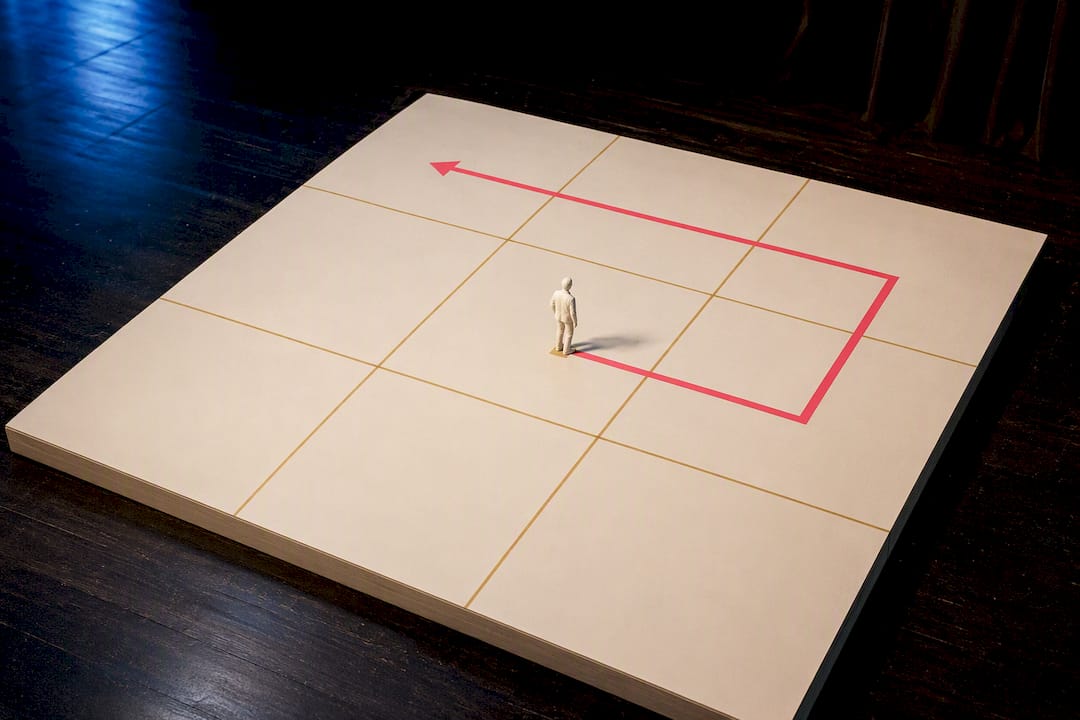
Combine those four directions with centre and you get the standard nine-area grid used across most Western theatre traditions:
Upstage left, upstage centre, upstage right — the back third of the stage, furthest from the audience.
Centre left, centre stage, centre right — the middle third, where most dialogue-heavy scenes anchor themselves.
Downstage left, downstage centre, downstage right — the front third, closest to the audience and often the strongest position for a solo moment.
The terminology has a practical, slightly unglamorous origin. Older stages were raked, meaning they sloped upward at the back so audiences seated on a flat floor could still see the rear of the stage. Walking towards the back of the stage genuinely meant walking “up” a slope, and walking towards the audience meant walking “down.” The stages we use now are mostly flat, but the language stuck.
Pro Tip: Stand centre stage, face the audience, and physically walk to each of the nine areas while saying its name aloud. Muscle memory beats memorising a diagram every time.
Types of stage directions and what each one asks of you
Scripts mix several distinct kinds of instruction, and recognising which type you’re reading tells you instantly who’s meant to act on it.
Movement and blocking directions. These tell an actor where to go: “crosses to the door,” “sits on the sofa,” “exits stage right.” They’re the directions most closely tied to hitting your marks, the exact spots on the floor where blocking places you for a scene to read correctly from every seat in the house.
Parenthetical directions. Short bracketed notes tucked next to a character’s name or mid-line, such as “(whispering)” or “(to Maria).” These shape how a line lands rather than where a body moves, and they’re where a lot of an actor’s interpretive freedom actually lives.
Technical directions. Lighting fades, sound cues, prop handoffs, and costume changes fall here. A lighting operator triggers the fade, a stage manager calls the cue, a dresser handles the costume swap. Actors need to know these exist, but they don’t execute them.
Knowing the category before you try to act on it saves confusion. A parenthetical direction is a suggestion about tone; a technical direction is someone else’s job entirely.
How to read and follow stage directions in rehearsal
Reading a script cold and reading it the way a working actor should are two different skills. The second one takes practice, but the process is learnable in a handful of rehearsals.
Read the whole script before you block anything. Directions that seem odd in isolation usually make sense once you understand the scene’s arc, and rehearsal best practice starts with a full read before physical blocking begins.
Annotate as you go. Underline movement directions, circle technical cues, and bracket parentheticals so the three types are visually distinct on your page.
Map the nine-area grid with tape on the rehearsal floor. Mark centre stage, then walk out the remaining eight areas so the geography is physical, not theoretical.
Practise hitting your marks while connecting each move to intention. A cross to downstage right should feel motivated, not just choreographed. Ask yourself what your character wants at that exact moment.
Know what to do when a direction doesn’t work. If a mark is impractical for your set, or a scene partner misses their cue, stop and flag it rather than improvising silently. Directors would rather solve it in rehearsal than discover it on opening night.
Two exercises make this stick faster than reading alone ever will. First, tape out the grid and perform a scene moving only between two labelled areas, then add a prop handoff or a lighting cue partway through to practise coordinating your movement with a technical trigger, a method Backstage recommends for building actor and crew coordination. Second, run a scene twice: once hitting every stage direction literally, then once with your director allowed to adjust anything that felt stiff. Comparing the two versions teaches you more about flexibility than any amount of reading.
Pro Tip: Rehearse your blocking with the script closed once you’ve learned the moves. If you can still find your marks without reading the direction, it’s in your body, not just your head.
Quick-reference guide to script abbreviations
Printed scripts and stage managers’ books rely on shorthand to keep margin notes tidy, and common abbreviations include C, D, DR, DC, DL, U, UR, UC, and UL among others.
C = Centre
D = Downstage
DR / DC / DL = Downstage Right / Downstage Centre / Downstage Left
U = Upstage
UR / UC / UL = Upstage Right / Upstage Centre / Upstage Left
Each abbreviation maps directly onto one of the nine grid areas, so once you’ve learned the full names, the shorthand is just faster writing. When annotating your own script, use a consistent colour or symbol for each category, movement, parenthetical, technical, so a glance down the page tells you what kind of instruction you’re looking at before you’ve even read the words.
Worked examples: from script line to staged moment
Seeing a direction on the page and knowing what to actually do with it are different skills, so here are three short, paraphrased examples.
Movement example: A direction reading “crosses downstage centre, sits” becomes a staging note: walk deliberately, don’t rush the cross, and use the seated position to anchor the audience’s focus for the monologue that follows.
Parenthetical example: A line marked “(bitterly)” isn’t an instruction to shout. Try dropping your volume and slowing your pace instead. Bitterness often reads stronger as restraint than as anger.
Technical example: “Lights fade to black” is triggered by the lighting operator on a stage manager’s cue call, not by anything the actor does on stage. Your job is simply to hold your final position until the blackout completes.
Productions at Ocean Theatre work through exactly this kind of page-to-stage translation during blocking rehearsals, turning a flat script line into a moment that reads clearly from the back row.
Following the director’s vision without losing the playwright’s intent
Not every direction on the page carries equal weight, and learning to spot the difference is a skill worth developing early. Distinguishing playwright-authored directions from later production annotations matters because the former reflects the author’s original intent, while the latter often just records what one previous production happened to do.
Most theatre professionals treat stage directions as collaborative guides rather than orders, aiming to fulfil the playwright’s intent while serving the practical realities of their own space and cast.
Directors adapt directions for reasons that have nothing to do with disrespecting the script: a stage might be smaller than the playwright imagined, a prop might be unsafe as written, or an actor’s particular strengths might suit a different blocking choice entirely. None of that is a failure to follow instructions properly. It’s the normal, expected work of staging a text.
Pro Tip: If you want to propose a change to a stage direction, bring it to your director rather than the whole cast, and once it’s agreed, write the new blocking straight into your script in pen so it’s locked in before the next run-through.
Historical development and evolution of stage directions
Stage directions weren’t always the detailed instructions modern scripts contain. Ancient Greek and Roman playtexts carried almost none, relying on oral tradition and a chorus to convey context the audience already understood. Shakespeare’s printed texts included sparse directions too, often just “exit” or “enter,” leaving blocking almost entirely to the acting company’s own judgement.
The shift towards detailed, prescriptive directions accelerated in the nineteenth century, as realism took hold on stage. Playwrights like Henrik Ibsen and Anton Chekhov began writing elaborate descriptions of rooms, furniture, and even a character’s emotional state at a given moment, treating the page as closer to a novel than a bare performance script. George Bernard Shaw took this further still, writing stage directions so extensive that some read almost like short stories woven between the dialogue.
Twentieth-century playwrights split in two directions. Some, like Samuel Beckett, wrote directions with obsessive, almost mathematical precision, specifying exact positions and timings. Others stripped things back deliberately, trusting directors and actors to build the physical world themselves. That tension between prescriptive and minimal direction still shapes how contemporary scripts are written, and it’s worth knowing which tradition a script you’re working from belongs to before assuming every instruction is meant literally.
How stage directions differ across theatre traditions
A script’s country and context change how its directions get treated once a company sits down to stage it. West End and Broadway productions of the same commercial musical frequently follow published stage directions closely, since these shows are often licensed with detailed blocking notation designed to reproduce a proven staging across multiple productions worldwide.
Regional and community theatre, by contrast, tends to treat published directions more loosely out of necessity. A smaller stage, a different cast size, or a limited budget for set pieces often forces adaptation, and that’s entirely normal practice rather than a compromise. Fringe and experimental theatre traditions go further still, sometimes treating a playwright’s stage directions as raw material to be reinterpreted entirely, staging a scene set on a single site as it might unfold with actors scattered through the audience instead.
Devised and physical theatre traditions flip the whole model. Rather than starting from a script with directions already written, the movement and staging often get built in the rehearsal room first, with directions recorded afterwards as documentation of choices the company already made. If you’re used to working from a traditionally scripted play, that reversal takes some adjustment. The direction serves the movement, not the other way round.
Why stage directions matter differently for actors and crew
Actors and stage crew read the same script, but they’re extracting almost entirely different information from it. For an actor, a stage direction is primarily about intention and relationship: where you stand relative to another character, what your posture communicates, how a parenthetical shapes your delivery. Get the meaning right and the exact inch of floor matters less than what the position expresses to the audience.
For stage crew, directions function closer to a technical manual. A lighting cue needs a precise timing, a prop needs to be in a specific place before a scene begins, a costume change needs enough time in the wings to actually happen. There’s far less room for creative interpretation here, because a missed cue doesn’t just weaken a moment emotionally, it can stop the show functioning at all.
That difference explains why the stage manager’s copy of a script often looks nothing like an actor’s. It’s covered in cue numbers, timing notes, and technical shorthand rather than character motivation. Both readings are valid responses to the same words on the page. They’re simply solving different problems, and a production runs smoothly only when both readings stay in sync with each other.
How technology has changed the way stage directions get written and run
Digital scripts have quietly changed how actors and crews interact with stage directions over the past decade or so. Rehearsal software now lets companies annotate a shared digital script in real time, meaning a blocking change made in one rehearsal updates everyone’s copy instantly rather than relying on someone photocopying a marked-up page.
Lighting and sound automation has arguably changed things even more. Where a technical direction once meant a human operator manually triggering a fade or a cue on a cue-light signal, modern lighting boards can run pre-programmed sequences triggered by a single cue call, executing dozens of precise changes that would have taken several crew members working simultaneously in earlier decades. That precision has, in turn, encouraged playwrights and directors to write more detailed technical directions into scripts, since the technology can now actually deliver the complexity being asked for.
None of this changes the fundamental job a stage direction does. It still exists to communicate intent from the person who imagined a moment to the people responsible for making it happen live. The tools have simply got faster and more exact, not fundamentally different in purpose.
A rehearsal room is where stage directions actually make sense
Reading about upstage and downstage on a page only gets you so far. The concept clicks properly the first time you physically walk the nine-area grid with a director watching and correcting you. Rehearsal is where a printed instruction turns into a decision you understand in your body, not just your memory.
I’ve seen young performers spend a whole term dutifully underlining stage directions before one blocking rehearsal did more for their confidence than weeks of script analysis ever could. Watching a professional-led rehearsal, or better still joining one, remains the fastest way to turn theory into instinct.
— Andrew
Learn stage directions properly through weekly stagecraft training
Reading about blocking and technical cues gets you started, but nothing replaces practising them under a director’s eye, week after week, in front of a cast that depends on you knowing your marks. That’s precisely what Ocean Theatre builds into its programme for young performers aged 14 to 19 across Berkshire: weekly rehearsals with direction, working through blocking, parenthetical delivery, and technical cues across two musical productions each year.
[

This isn’t a substitute for reading scripts closely yourself. It’s the practical half of the equation, the part where an abstract direction on a page becomes a move you’ve rehearsed, adjusted, and performed in front of a live audience. If you’d rather see what that looks like in practice than take our word for it, browse a recent production such as Our House or get in touch about joining a term of training.
Sources
FAQ
What are the five stage directions?
The five most commonly taught positions are centre, upstage, downstage, stage left, and stage right, which combine to form the nine-area grid used across most Western staging.
What do stage directions explain?
They explain where actors move, how lines should be delivered, and when technical elements like lighting, sound, or props should be used, all written from the actor’s perspective facing the audience.
Can you give an example of a stage direction?
A movement direction might read “crosses downstage right,” a parenthetical might read “(quietly),” and a technical direction might read “lights fade to black,” each instructing a different person in the production.
What exactly are stage directions?
Stage directions are the non-spoken instructions embedded in a script that guide performance and staging rather than being spoken aloud by actors.
What’s the difference between upstage and downstage?
Downstage is the area nearest the audience, and upstage is furthest away, a convention that dates back to the days of raked stages sloping upward towards the rear.
Comments