

Five Evidence-Backed Ways Parents and Teens Can Beat Stage Fright

Most teenage stage fright eases with three things: naming the feeling out loud, one simple breathing technique, and a run-through in front of a safe, familiar audience. Nerves before a performance are normal and usually short-lived. If the fear leads to avoidance, panic, or won’t budge after weeks of gentle practice, that’s the moment to bring in a GP, school pastoral team, or child mental-health service.
TL;DR:
Most teenage stage fright responds well to consistent practice, with gradual exposure and breathing techniques; avoidance can worsen anxiety over time.
Physical signs such as rapid heartbeat, shallow breathing, and shaking often cluster with negative thoughts and behavioral avoidance, signaling deeper performance anxiety.
Teen brains are more sensitive to social judgment and perfectionism, making adolescence a critical period for developing coping skills through supportive rehearsal routines.
Professional help from GPs or mental health services may be necessary if avoidance worsens, panic is severe, or symptoms last over six months despite repeated practice.
Structured youth theatre and low-stakes rehearsals build confidence by making performance feel routine and help transfer anxiety management skills to other areas.
Table of Contents
How stage fright shows up in teens
Stage fright rarely announces itself with a single symptom. It tends to arrive as a mix of physical, mental, and behavioural signals, and recognising the pattern helps you respond with the right tool rather than guessing.
The physical signs are the body’s fight-or-flight response doing exactly what it evolved to do, just at the wrong moment:
Symptoms such as a racing heart, shallow or fast breathing, and a dry mouth
Symptoms such as shaking hands, wobbly legs, or a churning stomach
Symptoms such as sweating, flushing, or sudden nausea before walking on
Cognitively, you’ll often see your teen blank on lines they knew perfectly at home, spiral into self-critical thoughts (“I’m going to mess this up”), or fixate on being judged by the audience. Behaviourally, watch for skipped rehearsals, sudden excuses not to attend, or a full refusal to go on when the moment arrives.
One performance of nerves is not a red flag. A clinical practice review of performance anxiety notes that these somatic, cognitive, and behavioural symptoms cluster together in genuine performance anxiety, and it’s the frequency and avoidance pattern, not the presence of nerves itself, that signals something needing closer attention.
Why adolescence turns up the volume on performance anxiety
Teenagers aren’t just smaller adults with stage fright. Adolescence itself raises the stakes, and understanding why helps you respond with patience instead of frustration.
The teenage brain is still wiring up its threat-detection and social-reasoning systems, which makes peer judgement feel more urgent and more permanent than it actually is
Perfectionism often intensifies in the teenage years, turning “I might slip up” into “everyone will think I’m hopeless”
School pressure compounds performance stress; a 2021 Netherlands study found 47% of secondary pupils aged 12 to 16 cited schoolwork pressure as a major stress contributor, and that load doesn’t switch off when they step on stage
Puberty itself disrupts performance skills directly: a changing voice or shifting coordination can make a once-reliable singer or dancer suddenly unpredictable, which feeds the fear
Avoidance feels protective in the moment, but it quietly reinforces the fear rather than resolving it. Every skipped rehearsal teaches the brain that the stage really is dangerous.
A toolbox of practical techniques for teens and parents
Stage fright responds best to steady practice, not a single pep talk before curtain-up. Build these into a routine and they compound over weeks.
Set a daily rehearsal rhythm by following detailed strategies from how to prep for clarinet auditions: a practical guide, which offers instrument-specific rehearsal advice that can support your teen’s steady practice routine. Ten minutes of lines or lyrics, once a day, beats one long cram session. Include at least one weekly run in front of a safe audience, a parent, sibling, or friend, so performing in front of eyes becomes ordinary rather than rare.
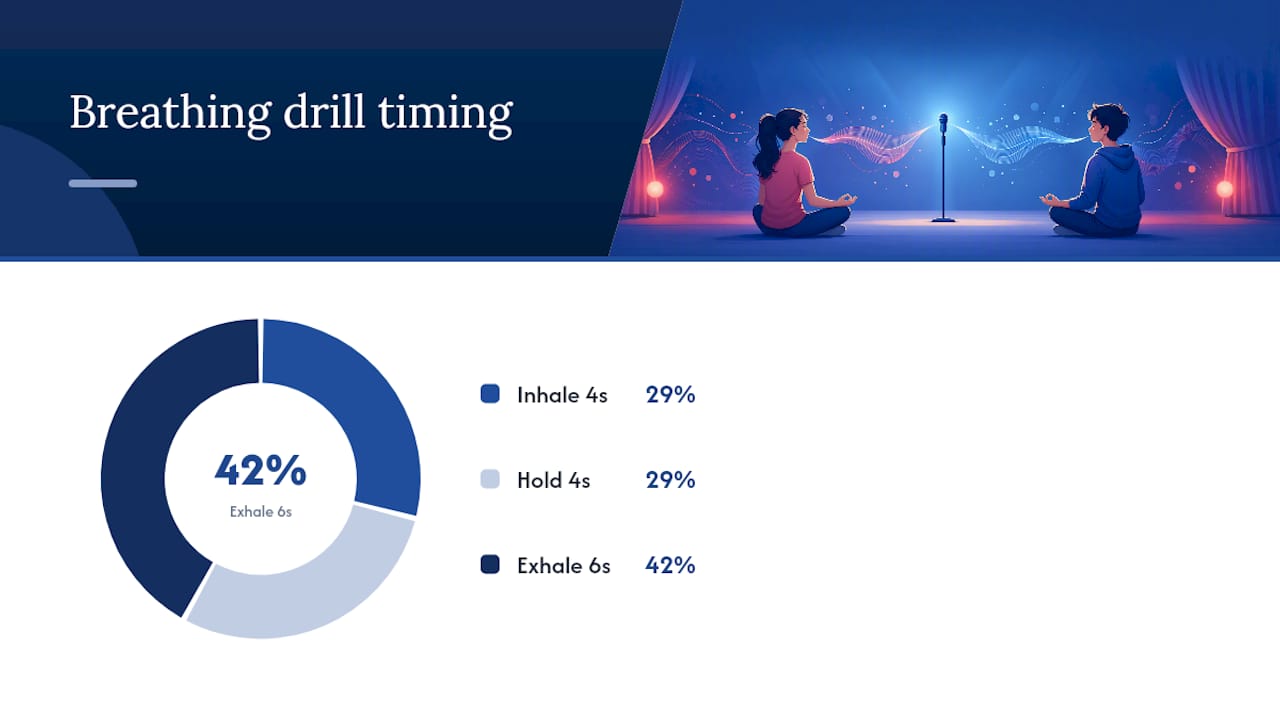
Teach controlled breathing. Diaphragmatic breathing (in for four counts through the nose, hold for four, out for six through the mouth) genuinely calms the body’s stress response. Harvard Health confirms breath control quells the errant stress reaction that drives a racing heart and shaky hands.
Practise visualisation. A short mental script, walking on stage, hearing the first note, feeling steady, works best rehearsed daily rather than pulled out in a panic five minutes before curtain.
Use graded exposure. Start by recording a run-through alone, then perform for one parent, then a small family audience, then a class or peer group, then the full stage. Each step should feel only slightly uncomfortable, never overwhelming.
Reframe the goal. Swap “I must be perfect” for “I want to tell this story” or “I want to support my cast”. The ADAA recommends tackling the underlying fear of judgement directly rather than relying on rehearsal alone to fix it, and coaching that shifts focus from flawless execution to personal values has been shown to help adolescent performers stay engaged through the pressure of puberty, according to a study on acceptance-based coaching for young singers.
For parents, the balance is coaching without pressuring. Ask what your teen needs rather than telling them how to fix it, and if a school production is the source of the anxiety, a quiet word with the drama teacher about a gradual exposure plan often achieves more than pushing harder at home. Our guide on succeeding under performance pressure covers more of these techniques in practice.
Pro Tip: Rehearse the recovery, not just the performance. Teach your teen one line to say if they fluff a word (“and… moving on”) so a stumble doesn’t spiral into a full freeze.
A quick breathing drill and rehearsal checklist
Keep this simple enough to run in a dressing room or a bedroom five minutes before showtime.
The 3 minute breathing drill: Sit or stand tall. Breathe in through the nose for four counts, hold for four, exhale through the mouth for six. Repeat for six full cycles, roughly three minutes, then add one silent affirmation on the final exhale: “I know this.”
Two-line visualisation: “I walk on, I find my mark, my voice is steady.” Repeat it twice, picturing the actual stage they’ll be performing on.
The week-before checklist:
Book one 10 to 15 minute safe-audience rehearsal at home with a parent or sibling watching
Pack water and avoid heavy caffeine on performance day
Arrive early enough to walk the stage and find a “safe face” in the crowd, according to guidance from Nationwide Children’s on performance-day preparation
Run the breathing drill once backstage, ideally with a parent nearby, not hovering
When stage fright needs a professional’s help
Most performance anxiety responds to practice and time. Some cases don’t, and knowing the difference matters.
Speak to a GP, your teen’s school pastoral team, or a child mental-health service if you notice:
Avoidance that escalates, dropping out of activities entirely rather than just feeling nervous beforehand
Panic symptoms so severe they disrupt breathing, cause fainting, or trigger repeated meltdowns
Symptoms persisting for six months or more and clearly limiting school, social life, or hobbies
No improvement despite consistent rehearsal and breathing practice over several weeks
Clinical reviews identify cognitive behavioural therapy (CBT) as the leading evidence-based treatment for performance anxiety in young people, often working by directly challenging the catastrophic thoughts that fuel avoidance. In rarer, more severe cases, a doctor might discuss beta-blockers or other medication, but this always requires medical oversight and is never a first-line step for a nervous teenager. The first, simplest move is usually a conversation with a GP or the school’s pastoral lead.
How structured youth theatre builds stage confidence
Ensemble rehearsal does something a bedroom mirror can’t: it makes performing in front of others feel routine rather than exceptional. At Ocean Theatre, teenagers aged 14 to 19 build confidence through repeated, low-stakes exposure long before a single ticket is sold.
On-your-feet warm-up games, peer feedback circles, and short scene runs in front of the full cast all do the same quiet work as the graded exposure described above, just with the camaraderie of a group who’s nervous too. A read-through in week one looks nothing like the polish parents see on opening night of a production like Kiss Me, Kate, and that gap is the whole point. Parents consistently report that the teen who dreaded the first rehearsal is often the one leading warm-ups by the final week, not because the fear vanished, but because it got smaller with every rehearsal.
Why stage fright spills into the classroom and friendships
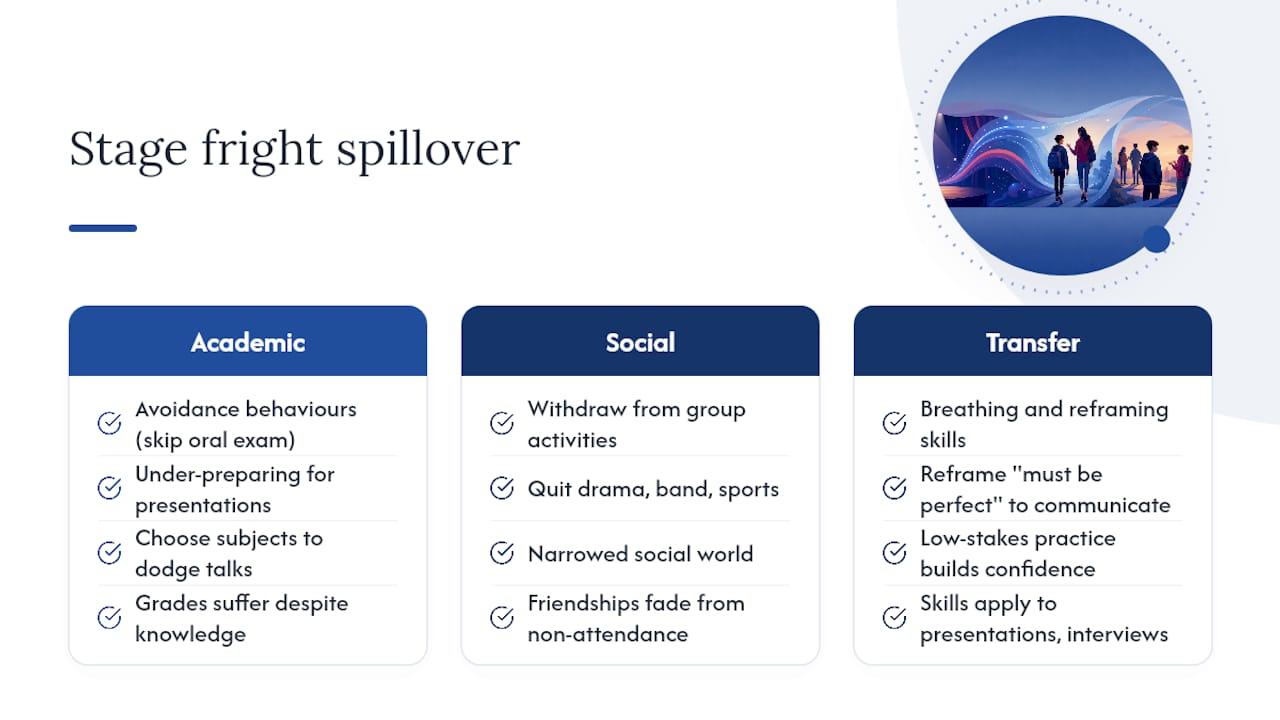
Performance anxiety rarely stays confined to the stage. A teenager who dreads a drama assessment often carries the same dread into a class presentation, a group project pitch, or even reading aloud in English lessons.
Academically, the impact shows up as avoidance behaviours: skipping the day of an oral exam, under-preparing for anything requiring public speaking, or choosing subjects and options specifically to dodge presentations. Grades can suffer not because the teen lacks knowledge, but because the format of assessment triggers the same fight-or-flight response as a stage.
Socially, the cost is often quieter but just as real. Teens with unmanaged performance anxiety sometimes withdraw from group activities, drama clubs, or sports teams where visibility is unavoidable, narrowing their social world at precisely the age when peer connection matters most. Friendships built around shared activities, a school play, a band, a football team, can fade simply because the anxious teen stops showing up.
The encouraging side is that the skills built to manage stage fright transfer directly back into these other settings. A teenager who’s learned to breathe through pre-show nerves and reframe “I must be perfect” into “I want to communicate this” carries that exact toolkit into a geography presentation or a job interview years later. That’s part of why consistent, low-stakes performance practice, in a group of peers rather than an exam hall, tends to build broader confidence, not just stage skills.
Building calmer teens for the long run
Managing one performance is useful. Reducing overall anxiety is what actually changes how a teenager approaches every future stage, exam, or social situation.
Sleep is the foundation most families overlook. The NHS Every Mind Matters guidance links consistent, good-quality sleep directly to better stress regulation, and poor sleep can make performance anxiety harder to manage. A regular bedtime matters more in performance weeks, not less.
Regular movement, even just walking or informal sport, burns off the physical tension that anxiety generates before it has a chance to build into dread. Diet plays a supporting role too: heavy caffeine or sugar swings can mimic or worsen the physical symptoms of anxiety, the racing heart and jitteriness, making it harder for a teen to tell the difference between “I’m nervous” and “I’ve had three energy drinks”.
Beyond the body, regular low-stakes exposure to being watched, presenting in class, performing in a school assembly, joining a weekly drama session, keeps the fear from calcifying between big events. Anxiety that only gets addressed once a term, right before a big show, never gets the repeated, gentle practice it needs to shrink. Anxiety that gets a little air weekly tends to lose its grip gradually rather than dramatically.
Finally, model calm yourself. Teenagers pick up on parental anxiety about their performance far more than they let on, and a parent who stays steady before a show teaches more than any pep talk.
Common myths about teen stage fright, and what’s actually true
A few persistent myths make parents either underreact or overreact, so it’s worth clearing them up directly.
Myth: “Confident kids never get stage fright.” Some of the most seasoned young performers still feel their heart race before walking on. Confidence doesn’t eliminate the physical response, it just means they’ve learned tools to work alongside it rather than being derailed by it.
Myth: “If they’re that anxious, they should just quit.” Avoidance almost always makes the fear worse, not better, because it never gives the brain a chance to learn the stage isn’t actually dangerous. Graded exposure, not withdrawal, is what reduces the fear over time.
Myth: “Stage fright is basically the same as shyness.” They can overlap, but they’re not the same thing. A shy teenager might dread striking up conversation with strangers yet feel completely at ease singing a solo they’ve rehearsed. Stage fright is specifically about the performance moment, not general social discomfort.
Myth: “It’ll just go away as they get older.” Sometimes it fades naturally with maturity and repeated exposure. Often it doesn’t, particularly if avoidance has become the default response, which is exactly why proactive practice matters more than waiting it out.
Myth: “Stage fright means something is clinically wrong.” For the vast majority of teenagers, it’s a normal stress response to a genuinely high-pressure situation, not a diagnosable disorder. It only becomes a clinical concern when it’s severe, persistent, and disrupting daily life, as covered in the referral section above.
A steadier view on stage fright
Progress with stage fright rarely looks dramatic. It looks like a teenager who managed one line without freezing this week, then two lines next week, then a whole scene by the month’s end. Chase that slow, steady curve rather than a single fearless performance, because that’s what actually sticks.
Celebrate the small wins louder than the big ones, they’re the ones doing the real work. If weeks of consistent, gentle practice bring no improvement at all, or the anxiety visibly worsens, that’s the signal to loop in a GP or your teen’s school rather than pushing on alone.
— Andrew
Where Ocean Theatre fits into building that confidence
Weekly rehearsal, professional direction, and a real stage to work towards do more for performance nerves than any single technique on its own, because they turn graded exposure into a habit rather than a one-off exercise. A local youth theatre company runs training for teenagers building towards two large-scale musical productions a year alongside ongoing work in singing, acting, and dance.
[

Theatre isn’t the only route to calmer performance nerves, drama clubs, music lessons, and school productions all help too, but a company built specifically around ensemble confidence and repeated rehearsal gives teens the steady, low-stakes exposure that turns fear into familiarity faster than sporadic practice ever will. If your teen thrives with structure and a genuine cast around them, productions like Guys & Dolls or Legally Blonde show the scale of what’s on offer. Check current term dates and production details on the Ocean Theatre website to find the programme that matches your teenager’s interests and confidence level.
Sources
For deeper clinical detail beyond what’s covered here, these sources are worth your time:
FAQ
How do I help a teen with extreme stage fright?
Start with normalising the feeling, teach a simple breathing technique like the four-four-six count, and build confidence through graded exposure, small safe-audience rehearsals building up to the real stage. If extreme anxiety persists for months despite consistent practice, speak to a GP about a CBT referral.
What exercises help with stage fright?
Diaphragmatic breathing, short visualisation scripts, and graded exposure rehearsals (recording alone, then a parent, then a small group, then the full stage) are the most practical, evidence-backed exercises for teens.
Is stage fright a mental disorder?
No, stage fright is usually a normal stress response rather than a diagnosable condition. It only warrants clinical assessment when it’s severe, persistent for six months or more, and disrupting school or social life.
What are the signs of performance anxiety in teens?
Physical signs include a racing heart, shaking, and nausea; cognitive signs include blanking and fear of judgement; behavioural signs include skipping rehearsals or refusing to perform. These symptoms clustering together, rather than appearing once, is what distinguishes performance anxiety from ordinary nerves.
Can regular theatre training reduce stage fright long term?
Yes, structured, repeated rehearsal in front of a supportive group is a practical form of graded exposure, and programmes like those at Ocean Theatre are built around exactly that kind of steady, low-stakes practice.
Recommended
Comments