

6-Week Plan to Build Stage Voice Projection for Teens 14 to 19

Projection is breath plus resonance, never shouting. Fill your lower lungs with a slow belly breath, then hum a firm “mmmm” and feel the buzz move into your face rather than your throat. That forward buzz is your voice finding its natural carry. Practise both for ten seconds now and you will already feel the difference between shouting and true stage voice projection.
TL;DR:
Short daily practice focusing on diaphragmatic breathing, resonance, and pitch can show noticeable improvements in voice projection within 4 to 8 weeks.
Using forward resonance and the actor’s formant frequency enables voices to cut through ambient noise without increasing volume or risking vocal strain.
Maintaining proper posture, loose jaw, and relaxed throat during exercises prevents strain and promotes sustainable voice projection over time.
Room acoustics significantly affect projection; aiming the voice at the back of the room and visualizing distance improves clarity without extra effort.
Professional coaching and rehearsals in actual performance spaces provide essential feedback to refine projection techniques effectively.
Table of Contents
What is stage voice projection, really?
Stage voice projection depends on three coordinated systems: breath support, resonance, and pitch, not brute volume. Coordinated breath support from the diaphragm produces a steadier, safer sound than forcing air from a tightened throat, according to the MIT Communication Lab’s exercise handout.
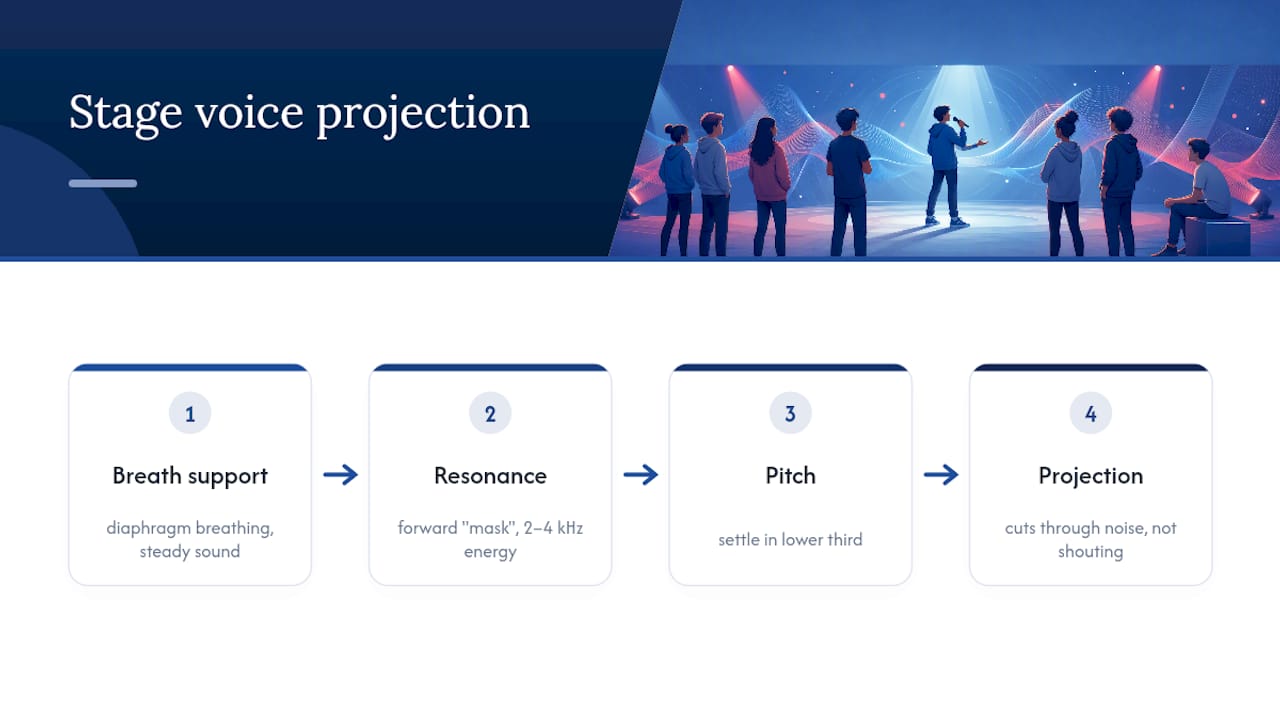
Diaphragmatic breathing is the foundation. Place a hand on your stomach, breathe in through your nose, and feel your belly expand rather than your shoulders rising. Then try the “ha” exhale: breathe in low, then push out five short, sharp “ha” sounds using only your stomach muscles, not your throat. You should feel your abdominal wall snap inward on each one.
Resonance and forward placement come next. When you hum, your voice can vibrate in your chest (a warm, low buzz) or in your “mask”, the bony area around your nose, cheeks and forehead (a brighter, more piercing buzz). Trained performers deliberately push sound into that mask area because it carries further with less effort.
There’s a specific acoustic reason for this. Skilled voices concentrate extra energy in a frequency band around 2 to 4 kilohertz, sometimes called the actor’s formant, which sits right where human hearing is most sensitive. This is why a trained actor’s voice cuts through an orchestra pit or a noisy hall while an untrained shout gets lost.
Voice projection statistic: the actor’s formant clusters around 2 to 4 kHz, a range that lets a voice cut through ambient noise without extra volume. It explains why a well placed whisper on stage can carry further than a badly placed shout.
Finding your optimum pitch matters too. Try a “swoop”: glide your voice from your lowest comfortable note to your highest, then settle somewhere in the lower third. Rest your fingers on your chest as you speak a sentence there. If you feel a gentle vibration, you have likely found a pitch that resonates rather than strains.
Shouting damages the voice because it forces the vocal folds to slam together under excess air pressure, causing swelling and hoarseness over time. Projection uses that same air more efficiently, so the sound travels without the wear.
Vocal warm-up exercises to build projection
Run this sequence in order, in a quiet space, for 15 to 20 minutes before rehearsal or a big speech.
Posture check. Stand with feet hip-width apart, knees soft, shoulders rolled back and down, chin level. Good alignment lets air move freely through your body.
Belly breaths. Ten slow breaths, hand on stomach, feeling it expand and release fully each time.
M-hum. Hum “mmmm” gently for five seconds, feeling the buzz in your lips and nose. Repeat five times, letting the hum climb slightly in pitch each round to find your forward resonance.
“Ha” bursts. Ten sharp “ha” sounds from the diaphragm, as described above, keeping your jaw loose.
Vowel intensity slides. Say “ah, eh, ee, oh, oo” at a comfortable volume, then repeat, gradually increasing intensity without tightening your throat. Notice where the sound feels easiest to push forward.
Tongue twisters. Run through a few at increasing speed, such as “red leather, yellow leather” or “unique New York”, to sharpen articulation.
Projection throws. Pick a spot on the far wall and deliver a short line, aiming your voice at that exact point, as though posting a letter through a slot rather than blasting it out.
Warm-ups built from postural stretches, sharp exhales, pitch slides and lip flutters prepare the voice for sustained work without unnecessary tension, according to Backstage’s guidance for actors. Practising with a visual target trains your brain to judge distance and adjust effort automatically, a technique also recommended in DEEPR’s projection guide.
Pro Tip: Keep your jaw hanging loose during every exercise, even the loud ones. A clenched jaw is the single most common reason young performers strain their voice while trying to project.
Safety comes first. If your voice feels hoarse, scratchy, or tired, stop immediately and rest. Breathe regularly between drills rather than holding your breath, and never push through pain. Track your progress by noting how long you can sustain a comfortable hum, and whether your throat feels relaxed afterwards rather than tight.
How do you project your voice in a real performance space?
Every room behaves differently, and reading it fast is a skill in itself. A carpeted, curtained hall absorbs sound and needs more forward energy; a bare, tiled hall or an outdoor space scatters sound and needs sharper consonants to stay clear. During a technical rehearsal, walk to the back row yourself and have a castmate speak a line at normal performance volume. If you cannot understand every word, the delivery needs more forward placement, not more volume.
Aim your voice at the back wall, not the front row, so the sound naturally carries the full length of the room.
Visualise the distance before you speak, the same way you did with the “throw” drill in your warm-up.
If a microphone is provided, speak slightly toward it rather than away, and keep your usual supported breathing. Microphones amplify what you give them, including strain, so still project as though it weren’t there.
Never rely on a mic to replace technique. Equipment fails, batteries die, and directors move blocking at the last minute.
Clear diction matters as much as raw loudness for audience comprehension. Crisp consonants at the start and end of words often carry information the audience needs more than the vowels do, so a diction drill focusing on final “t”, “d”, and “k” sounds can improve clarity more than simply speaking louder. Ocean Theatre’s own production pages show the scale of hall these skills need to fill during a live show.
A 6-week plan to build projection you can sustain
Consistency beats occasional marathon sessions. Short daily practice, even just 15 minutes, shows measurable gains within 4 to 8 weeks when it focuses on breath, resonance and placement, according to DEEPR’s research summary.
Weeks 1 to 2, foundation. Focus purely on diaphragmatic breathing and the M-hum. Ten minutes daily. Don’t chase volume yet.
Weeks 3 to 4, connection. Add “ha” bursts, vowel slides and pitch-finding. Practise linking breath support to actual sentences from a script.
Weeks 5 to 6, integration and stamina. Run the full warm-up sequence, then rehearse full scenes or speeches at performance volume, twice a week, alongside your daily ten-minute maintenance routine.
Track progress with three simple checks: a sustained hiss (time how many seconds you can hold a steady “ssss” and aim to increase it week on week), a projection distance test (have a friend stand progressively further away and tell you when your words stop being clear), and a recorded before-and-after comparison of the same short speech.
If hoarseness, pain, or a persistent rasp lasts more than a week despite rest, that’s a signal to see a vocal coach or speech therapist rather than push through it.
Who’s behind this advice?
This piece was written for Oceantheatre, a youth theatre company training performers aged 14 to 19 across Berkshire. Projection features constantly in rehearsal rooms for high-energy productions such as Guys & Dolls, We Will Rock You, and West Side Story, where young casts need to reach a full auditorium without body microphones on every scene.
Rehearsal activities that build these skills typically include:
Full-cast vocal warm-ups before every session, led by production staff.
Blocking rehearsals in the actual performance space, so young performers learn to judge and adjust for the room early.
Diction-focused notes during ensemble numbers, where clarity across a large group matters as much as individual volume.
A note from the rehearsal room
Nerves tighten the throat before they touch anything else, which is why a shaky first line so often comes out thin. A quick belly breath and picking a fixed spot at the back of the room before you speak settles most of that in seconds. It’s a small habit, but it works reliably enough that we teach it to every new performer. If you want proper feedback on your technique, guided sessions make the difference that self-practice alone rarely can.
— Andrew
Where Ocean Theatre fits into your training
Reading about breath support is one thing. Having a director actually listen to your line from the back of a real auditorium and tell you what’s landing and what isn’t, is another entirely. A youth theatre company builds projection into everyday rehearsal for performers aged 14 to 19, through professional-led sessions, full ensemble numbers, and two large-scale musical productions a year that put these techniques straight into practice on a real stage.
[

Whether you’re chasing a lead role or simply want to speak with more confidence and less strain, training alongside a supportive cast gives you the feedback that solo practice can’t. Explore current productions and enrolment details on the Ocean Theatre Company landing page to see when the next intake starts.
Sources
FAQ
How long does it take to improve stage voice projection?
Most young performers notice a clearer, more sustainable voice within 4 to 8 weeks of short daily practice, provided the work focuses on breath and resonance rather than volume alone.
Is shouting the same as projecting your voice?
No. Shouting forces the vocal folds together under excess pressure and causes strain, while projection uses diaphragmatic breath support and forward resonance to carry sound safely.
What’s the fastest exercise to warm up before going on stage?
A minute of belly breathing followed by a gentle “mmmm” hum is enough to loosen the throat and activate forward resonance before stepping on stage.
Should I still project my voice if I’m using a microphone?
Yes. Microphones amplify whatever you give them, including strain, so maintaining proper breath support and placement keeps your sound clear and protects your voice.
Where can young performers get hands-on projection coaching?
Structured rehearsal with professional direction, like the training Oceantheatre runs for performers aged 14 to 19 in Berkshire, gives far more consistent feedback than practising alone.
Recommended
Comments