

Performing Arts Bursaries in the UK: What Teens Can Apply For

If you are 14 to 19 and serious about drama, singing or dance, the most useful bursary to know first is the National Youth Arts Trust (NYAT) bursary: up to £1,000 for talented young people aged 12 to 25 who cannot afford arts opportunities, and it can pay for part-time drama classes. Bigger awards exist, but they usually start at 16 or 18 and are tied to a full-time course. This guide sorts the schemes by age and purpose, shows what a strong application contains, and explains where regular, affordable stage experience fits alongside funding. At Ocean Theatre Company in Berkshire, we train 14 to 19 year olds through weekly rehearsals and two large-scale musicals each year, and our Company (14-19) page shows what that looks like.
TL;DR
A bursary is money for a particular need or purpose, such as classes, travel or an audition. A scholarship is usually a fee reduction from a school or college, awarded for ability. The terms overlap, so read each scheme’s own rules.
For ages 14 to 19, NYAT bursaries of up to £1,000 are the most accessible national option. Trustees review applications several times a year.
Government-backed Dance and Drama Awards help with fees and living costs, but only from age 16 (18 for acting) and only at approved schools.
Strong applications combine proof of residency, evidence of dedication, a costed plan and a referee who knows your work.
Regular production experience builds the evidence every funder asks for. Ocean Theatre Company offers it to 14 to 19 year olds in Berkshire.
Table of Contents
Bursary or scholarship: what is the difference?
The two words get used loosely, which causes confusion. The House of Commons Library’s July 2026 briefing on funding for music, dance and drama explains the usual pattern. Scholarships are generally offered by performing arts schools, colleges and universities as fee reductions or waivers, sometimes with help towards living costs, and they are awarded for ability, for a specific discipline or to widen access. Bursaries target financial need, a particular background or a specific purpose such as travel or a project.
In practice that means:
Scholarship: you apply to a school or course, usually through an audition, and the institution reduces what you pay.
Bursary: you apply to a charity, trust or fund, explain what you need and why, and the money covers a named cost.
Most teenagers searching for drama scholarships in the UK are really looking for one of two things: help paying for ongoing classes now, or help paying for a vocational course later. Those are different pots of money with different age limits, so it helps to decide which you need before you start applying.
Funding you can apply for now, at 14 to 19
National Youth Arts Trust bursaries
NYAT grants music, dance and drama bursaries of up to £1,000 each to talented young people aged 12 to 25 who cannot afford to access opportunities in the arts. Applicants must have lived in the UK for more than three years and need a referee, such as a teacher or director, who can confirm their ability and dedication.
For drama, the NYAT drama bursaries page lists what an Access Bursary can fund:
audition recalls or tuition fees at eligible drama schools
drama lessons
travel
books and other educational materials
part-time drama classes
One limit matters: NYAT does not accept applications for first-time auditions, so it is for recalls and ongoing training rather than the very first audition fee.
Family Action educational grants
The Stage’s drama school funding guide describes Family Action’s Educational Grants Programme. It is open from age 14 to people on a low income or receiving benefits, and covers tuition, materials, equipment, travel or living costs for drama training. If your household income is limited, it is worth reading alongside the NYAT criteria, because the two cover similar costs for different applicants.
Your own school, college and local sources
The Commons Library advises checking a provider’s website under “fees and funding” or “scholarships and bursaries” and speaking to a financial support officer about what you might be eligible for. The same habit works for sixth forms and colleges that run performing arts courses: ask about their own bursary funds before you accept a place. In Berkshire, your school’s pastoral or finance team, and your local council’s youth and community pages, are the natural places to ask about smaller local grants, since these change from year to year.
Funding for full-time vocational training (16 and over)
If your goal is a full-time course at drama or dance school, the cost is the big question. The Council for Dance, Drama and Musical Theatre notes that a course at one of its accredited vocational schools can cost between £7,000 and £30,000 a year. Funding at this level works differently.
Dance and Drama Awards (DaDA)
GOV.UK explains that Dance and Drama Awards help with fees and living costs at 12 private dance and drama schools for 2026 to 27. Key points:
Applicants must be 16 to 23, or 18 to 23 for acting courses.
You must show talent and the likelihood of succeeding, and have lived in the UK, EU, Switzerland, Norway, Iceland, Liechtenstein, the Channel Islands, the Isle of Man or Gibraltar for the past three years.
The amount depends on household income and where you live and study.
The course must lead to a Trinity College London Diploma in Professional Acting, Professional Dance or Professional Musical Theatre.
You apply directly to the school, so the audition comes first.
The awards are available at schools such as Italia Conti Arts Centre, Laine Theatre Arts, The Oxford School of Drama and Tring Park School, among others on the GOV.UK list. Rules and participating schools are reviewed each academic year, so check the GOV.UK page for the year you plan to start.
Music and Dance Scheme
The CDMT page also describes the government’s Music and Dance Scheme, which provides grants and fee help at eight independent schools and 21 advanced training centres, with eligibility from age 8 to 19 for music schools and 11 to 19 for dance schools. It suits young people who are already on a specialist pathway at that age, rather than those starting out.
Charity access programmes
The Stage’s guide also describes Open Door, a UK charity offering free audition preparation, one-to-one tuition, travel expenses, theatre tickets, workshops and mentoring. For its 2025 acting programme, applicants had to be 18 or over, live in London, Essex or the South East, have a household income under £43,000, and plan to apply for a full-time BA (Hons) Acting degree. That makes it a Year 13 or gap-year route, and eligibility details are updated by the charity, so read its current page. The same article covers the Wayne Sleep Foundation, which helps with living and accommodation costs for full-time UK drama and dance students, with applications typically opening in March and closing in May.
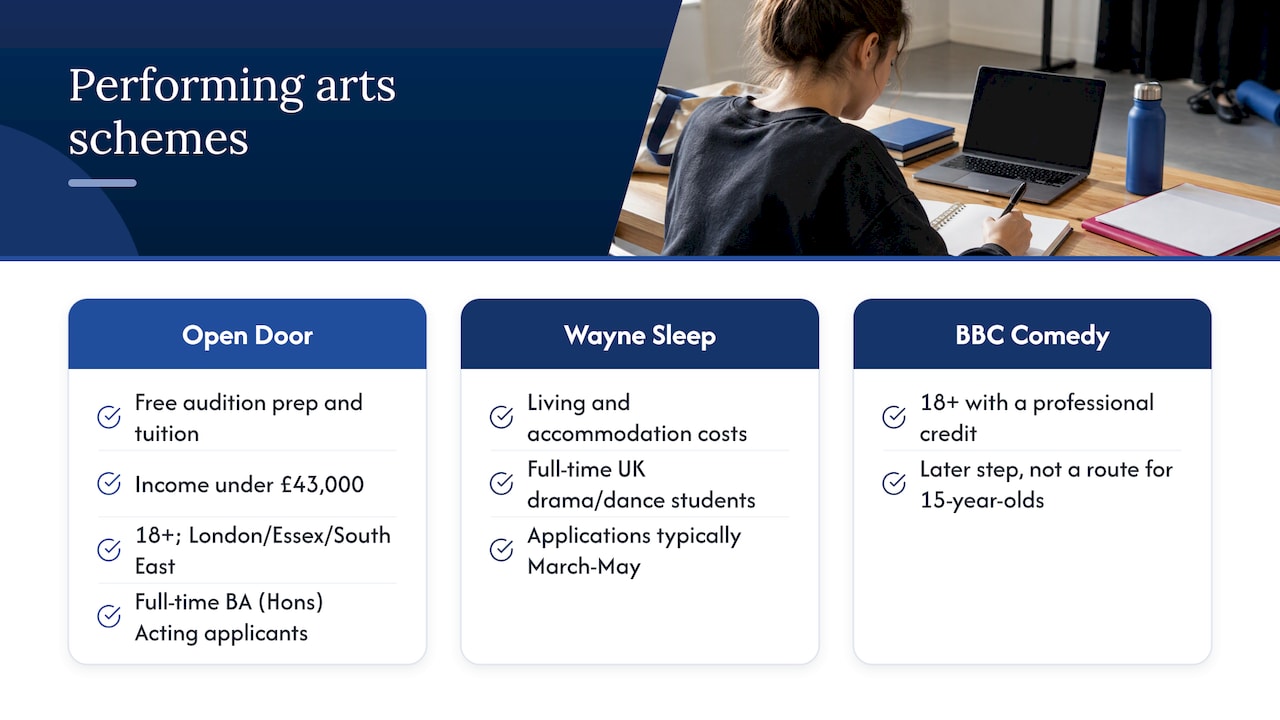
A word on screen and industry schemes. Some well-known bursaries, such as the BBC Comedy Collective, are for people aged 18 or over with a professional credit, so they are a later step, not a route for a 15 year old. Funders elsewhere in the world run similar selective programmes, and announcements like this arts scholarship programme’s finalist list show how competitive a shortlist can be, which is why a well-prepared application matters.
Which one fits you? A quick guide
Your situation | Where to look first | What it can pay for |
14 to 17, wants regular drama classes, limited household budget | NYAT drama bursary | Part-time drama classes, lessons, travel, materials (up to £1,000) |
14 or over, family on low income or benefits | Family Action educational grants | Tuition, materials, equipment, travel, living costs |
16 to 19, heading for a vocational course | DaDA, via the school you audition for | Fees and living costs, depending on household income |
18 or over, applying for a BA Acting | Charity access programmes | Audition preparation, tuition, travel, mentoring |
Already at a school or college | The provider’s own scholarships and bursaries page | Fee reductions, waivers, travel or project costs |
How to put together a strong application
Funders read many applications from talented young people. What separates the successful ones is clarity and evidence. Using NYAT’s published requirements as the model, prepare these items.
Proof of residency. NYAT asks for a bill or council tax letter, plus Home Office documents if relevant. Gather these early, because they are the most common reason for delay.
Evidence of ability and commitment. Upload up to four certificates, awards or academic transcripts, or a CV if that suits you better. Programme listings, show posters and references from a director count as evidence of sustained commitment.
An optional video. NYAT allows a video of your practice of no more than five minutes. Choose one piece you are proud of, filmed clearly, and let it speak for itself.
A costed plan. NYAT asks for a detailed breakdown of tuition, equipment and travel. Use real quotes from the provider, not estimates.
A referee. Pick someone who has watched you work over time: a drama teacher, a youth theatre director or a singing teacher. Tell them what you are applying for so they can be specific.
Free School Meals confirmation, where relevant. NYAT accepts a school letter confirming this.
Writing the statement of purpose
NYAT’s guidance suggests structuring your statement around six prompts, saying that this section helps inform its decision: the skills you have and want to learn, evidence of your dedication, what the art form means to you, your future goals, your reasons for applying, and any difficulties you have faced accessing training. Write in your own voice, give one concrete example under each prompt, and keep it honest. A short paragraph about a rehearsal period you stuck with, or a role you took on, is stronger than a list of adjectives.
Timing and what to expect
NYAT trustees usually review applications in April, July, September and November. Late applications roll over to the next meeting, and decisions normally arrive roughly six to eight weeks after the deadline, though they can take up to five months. Every applicant is written to with the committee’s decision. Because these meetings repeat each year, look at the NYAT page for the next deadline rather than relying on a date you saw last year, and apply well before the one you are aiming for.
Why production experience strengthens every application
Every scheme above asks some version of the same question: how do we know you are committed? Auditions for vocational schools ask it too. The best answer is a record of regular rehearsal, performance and responsibility over time, ideally with a director who can write a specific reference.
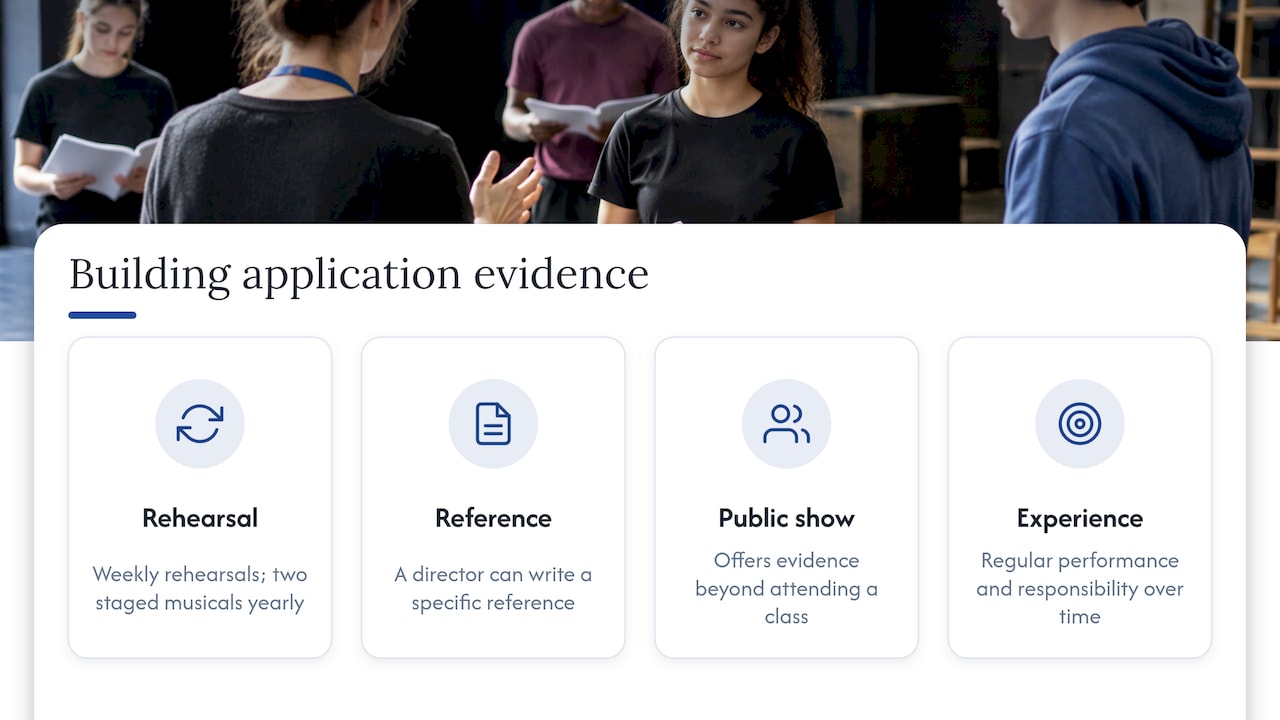
That is the strength of youth theatre built around real productions. Our guide on what youth theatre is for UK teens explains why a public show, not just a class, gives you something to point to. If you are heading towards drama school, our pieces on open auditions, callbacks for young actors and a six week musical theatre audition plan cover the practical side, and how to become a West End actor maps the longer route.
Parents often ask whether their child needs to be “good enough” before joining a youth company. We would say the opposite: the company is where confidence, teamwork and stagecraft are built, and that growth is exactly what a referee will describe.
Funding matters, and we are glad that schemes exist to open doors for talented young people. But in our experience of what young performers need, the foundation is the same whatever the application form says: regular, demanding, joyful work with professional direction, and a real audience at the end of it. At Ocean, we put 14 to 19 year olds into weekly rehearsals and two fully staged musicals every year, with room to grow in singing, acting, dancing and ensemble leadership. We welcome young people without an entry audition, because we believe confidence is something you build in the room, not something you must prove at the door. When a young person comes to us, we want them to leave each show prouder, braver and more connected to a team. That is the record that makes a statement of purpose sound like a real person, and it is the best launching pad we know. Andrew
Our view from the rehearsal room
Train and perform with Ocean Theatre Company
Ocean Theatre Company is a youth theatre for 14 to 19 year olds in Berkshire. Members take part in weekly rehearsals led by professionals and perform in two large-scale musical theatre productions each year, alongside opportunities in singing, acting, dancing and leadership roles in ensemble performances. Our current show, CRAZY FOR YOU, is a good place to see the standard of work, and you can find out how to join on the Ocean Theatre Co. Berkshire home page.
[

Past productions such as Anastasia, The Addams Family and Our House show the range of musicals our members have taken on.
Frequently asked questions
Are there performing arts bursaries in Berkshire specifically?
The national schemes above are open to Berkshire residents, and they are the best-documented source of drama funding for teenagers. Local grants change from year to year, so ask your school or college, and look at your local council’s youth and community pages for what is currently offered.
Can I get a drama scholarship at 14 or 15?
Drama school scholarships and Dance and Drama Awards generally start at 16, or 18 for acting courses. Under 16, the realistic options are bursaries such as NYAT’s, which accepts applicants from 12 and can fund part-time drama classes, and Family Action grants, which start at 14.
Does a bursary have to be paid back?
Bursaries are grants for a stated purpose, so they are not loans. You will normally need to spend them on the costs you listed in your application, which is why a clear cost breakdown matters.
How much does a bursary cover?
NYAT bursaries are up to £1,000. DaDA support depends on household income and where you live and study, and vocational courses at accredited schools can cost between £7,000 and £30,000 a year according to CDMT, so larger courses often need a combination of funding sources.
Sources
Recommended
Comments