

Stage Bow Etiquette: How to Take a Curtain Call with Confidence
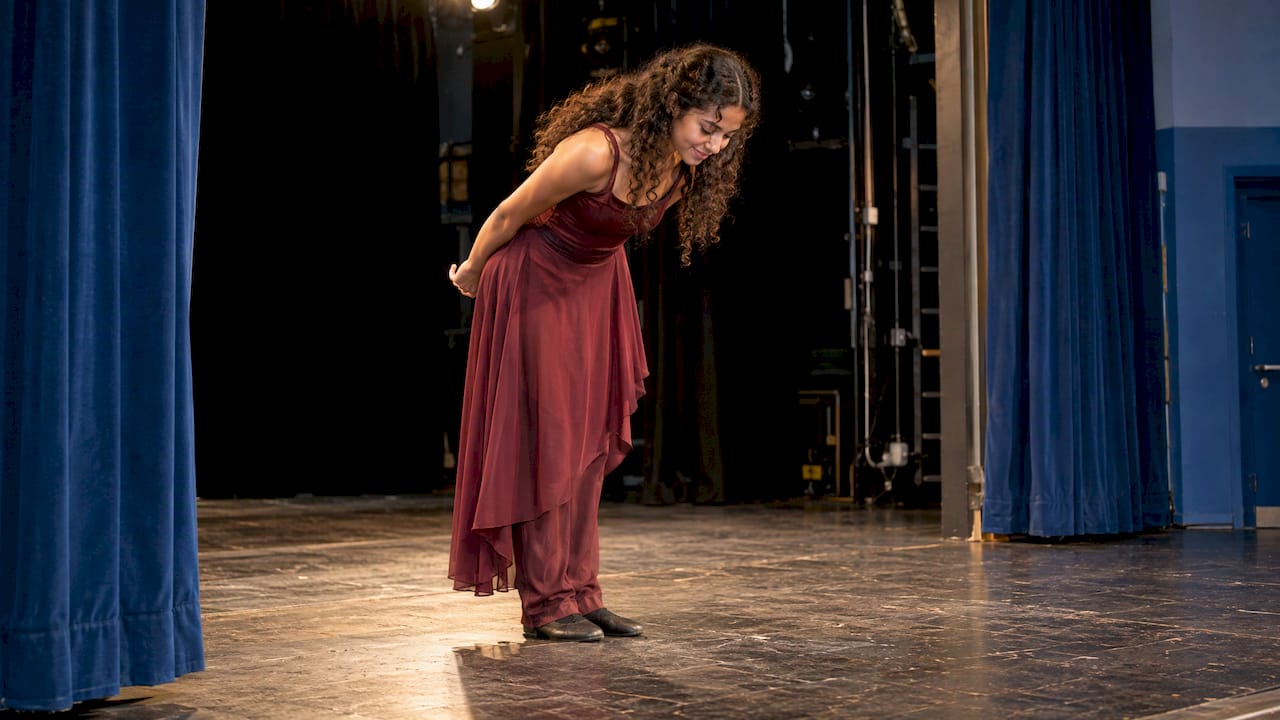
A good stage bow is simple: stop on your spot, look at the audience, bend from the waist with your eyes on the floor, hold for a count of three, then come up and look out again. The etiquette around it is just as straightforward. You bow when the audience applauds, you bow as yourself rather than your character, you follow the order and the leader your director has set, and you stay a performer until you are out of sight. This guide walks you through each part, so the final minute of the show feels as polished as the two hours before it.
The curtain call is the last thing an audience sees, so it is worth rehearsing properly. At Ocean Theatre Company, our 14 to 19-year-olds rehearse weekly towards two fully staged musicals a year, and the bow is part of the production from the start, not an afterthought.
TL;DR
Bow whenever the audience applauds: on entering if they clap, at the end, and even after a show that did not go the way you hoped.
The basic bow: feet together, bend from the waist with a straight back, look down, hold for three, rise fully and look up again.
In a group, follow the order the director sets and watch the bow leader, not the audience.
Take the call as yourself, keep smiling, acknowledge the orchestra or crew with an open hand, and keep moving.
Practise the bow in costume at rehearsal, so hats, wigs and long skirts hold no surprises on the night.
Table of Contents
Why we bow in the first place
A bow is half of a conversation. When the audience claps, they are saying thank you for the performance, and the performer’s bow is the reply: thank you for listening and for showing your appreciation. One piano teacher puts it as a small rudeness to walk away without answering that applause.
A stage-deportment teacher describes the same exchange from both sides: the audience claps to welcome you, you bow to say it is good to be here, and at the end the applause says that was great and the bow says thank you. Ignore it, and the clapping tends to fade, and some audience members may feel you are not interested in them.
If bowing feels showy to you, it helps to know that it is the opposite. A concert pianist points out that standing still while people clap can look smug, whereas a bow shows humility and appreciation. It is a gesture of thanks, not of pride.
The tradition is also younger than you might think. One theatre writer traces the curtain call to the 1820s, saying it was common practice by the 1826 season. And because social bowing has not survived in everyday life in Britain or the rest of Europe, a stage bow has to be learned and practised. Nobody is born knowing how to do it, so do not worry if it feels odd the first few times.
When to bow
The rule of thumb is that you bow whenever the audience applauds. That includes:
When you walk on. In some situations the audience claps as you appear, and a simple bow is the right answer.
At the end of a piece or a performance. Trinity College London describes the customary pattern: at the start you thank the audience for their welcome, and at the end you thank them for listening.
After a performance that went badly. The audience is still thanking you, so you still reply.
For musical theatre, the main moment is the curtain call, sometimes called the walkdown or the final bow, when the performers come back out to be recognised by the audience. In a musical, the cast usually also recognise the orchestra and its conductor at the end of the call.
If you are a soloist or a musician, acknowledge applause promptly. UK music teacher notes on stagecraft suggest a bow, or at least a definite nod of the head, at a classical concert, while a jazz or pop setting allows a more informal but still clear signal of thanks.
How to bow on stage, step by step
Here is the technique, built from the guidance of several stagecraft teachers.
Arrive and stop. Walk to your spot at a medium pace, calm and smiling. Do not start bending while you are still walking: this is known as the Premature Bow.
Look at the audience. Take a short beat to look out and take in the applause before you move.
Set your feet. Face the back of the room and put your feet together.
Bend from the waist. Keep your back straight and bring your chin towards your chest so your eyes fall on the floor. Looking down matters, because eye contact mid-bow can come across as disrespectful or even aggressive.
Hold for three. A flute teacher’s method, quoted in a curtain-call guide, is to hold for a count of three. It stops you rushing.
Come all the way up. The bow is not finished until you are upright. Look at the audience again, smile, then take another short beat before you move.
The pacing matters as much as the bend. A teacher of the curtain-call technique describes it as: walk on, short beat, bow, short beat, walk off at the same pace. Bowing again and again without looking up at the audience in between makes you look like a mechanical doll, so give people a moment to see your face.
How deep, how long, how sincere
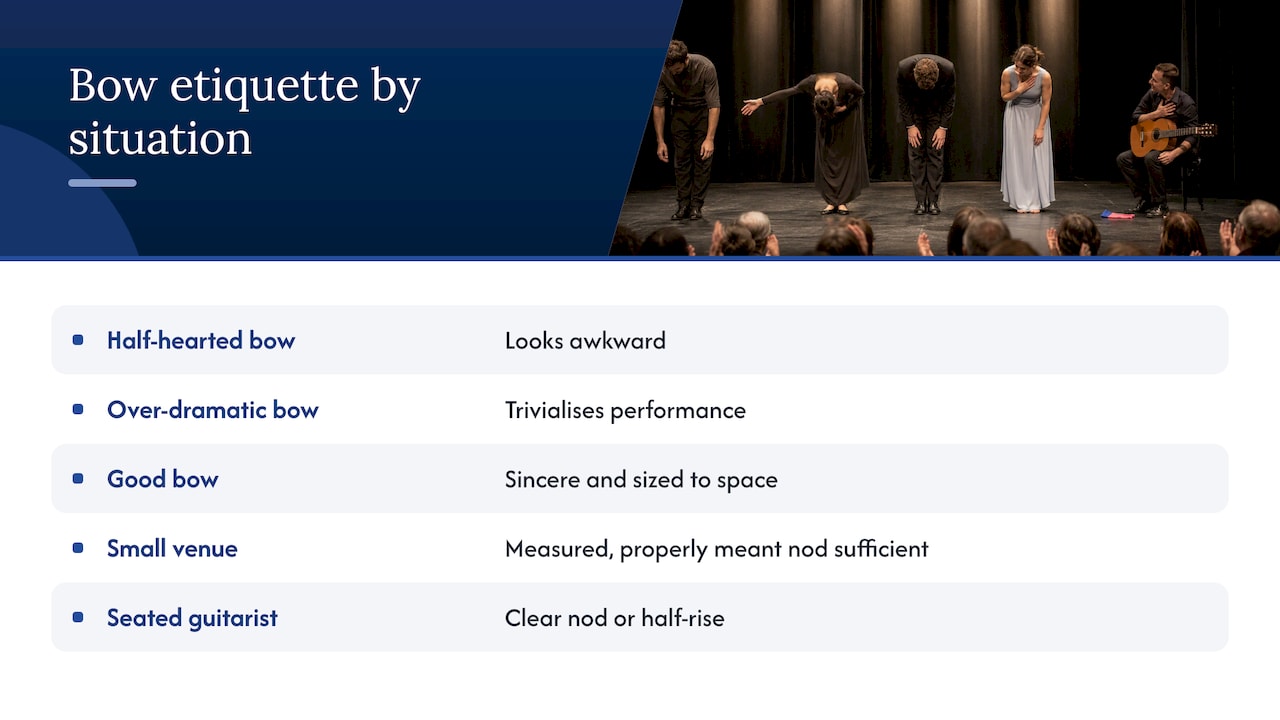
Sincerity is the real test. Trinity College London warns that a half-hearted bow looks awkward, while an over-dramatic one trivialises the performance. Aim for something in between: a bow you genuinely mean, sized to the space.
In a small or cramped venue where a full bow feels out of place, the same guidance says that a measured, properly meant nod of the head is perfectly sufficient. Matching the bow to the room and the style of the performance is part of good etiquette. If you play an instrument, the same thinking applies to how you stand and present yourself. A classical guitarist, for instance, will often be seated, so the acknowledgement may be a clear nod or a half-rise rather than a full bend. Knowing the types of classical guitar you might meet in a recital also helps you plan how to handle your instrument as you acknowledge applause.
Bows to avoid
One curtain-call guide, citing a flute teacher, names four common mistakes. They are easy to spot once you know them, and just as easy to fix in rehearsal:
Bow | What goes wrong | The fix |
The Sneak-a-Peek | Glancing up in the middle of the bow | Keep your eyes on the floor until you rise |
The Ballerina Bow | Flat back, bottom out, eyes on the audience | Bend from the waist with the chin towards the chest |
The Premature Bow | Bending while still walking on | Arrive, stop, look, then bow |
The Tripod Bow | Feet shoulder-width apart | Bring your feet together |
All four come from the same curtain-call guide. It also suggests testing long costumes, hats and wigs at the first dress rehearsal, since a headpiece that slides forward when you bend is much better discovered in rehearsal than in front of an audience.
Taking a curtain call as part of a cast
A solo bow is about you and the audience. An ensemble bow is about the whole company, and it works only when everyone follows the plan.
The usual order
The standard curtain call builds from least to most important:
Everyone with no lines or no distinguishing character, as one group.
Bit players, as a group.
Supporting players, in small groups of related characters.
The leads, each with a solo bow, working towards the central character.
The whole company together.
The order is set by the director, so your job is to know it. The advice is to write down your group, entrance side, spot and cue at the bow rehearsal. If you want to understand why the director makes these calls, our guide to the director’s role in theatre explains what directors and musical directors do.
Keep it moving
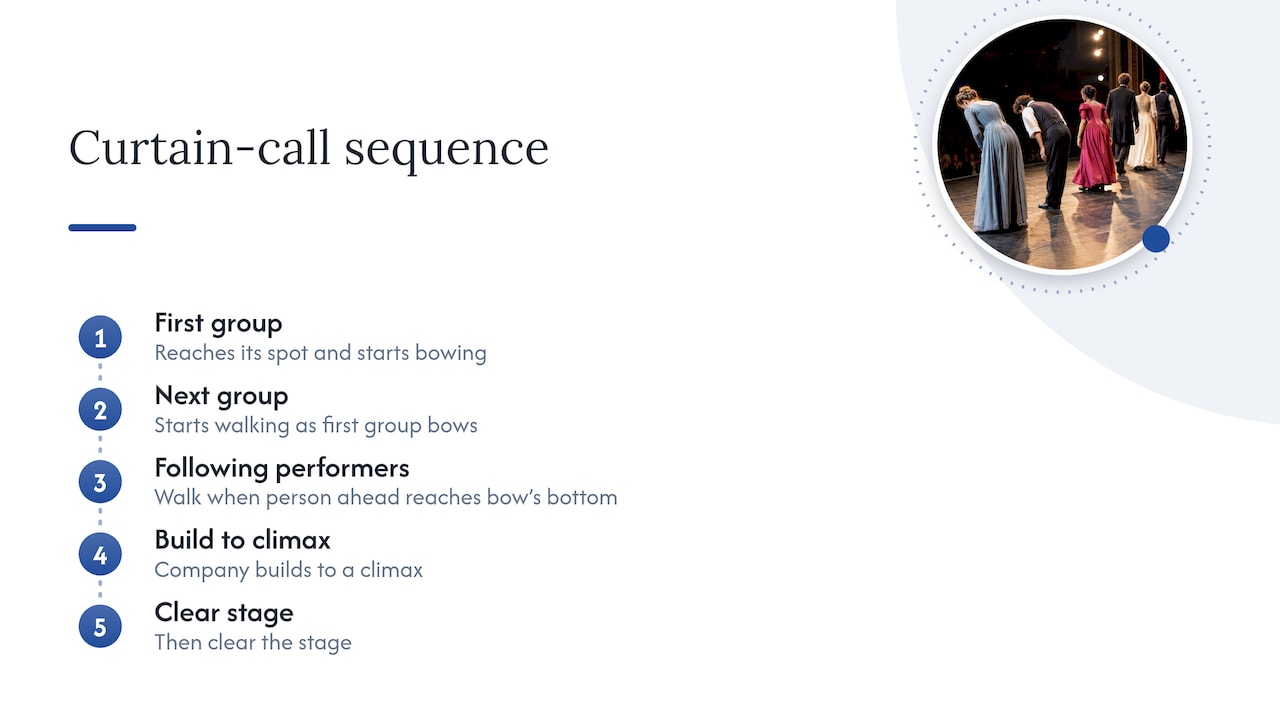
One rule from community-theatre guidance is that a curtain call should be brief, keep moving and build to a climax, then clear the stage. In practice, groups overlap. As soon as one group reaches its spot and starts to bow, the next group starts walking down. If you are not first out, start walking when you see the person ahead of you at the bottom of their bow.
The company bow
In the final group bow, the front-row leader tilts their head back slightly before bending, so everyone else goes down with them. In the company bow you watch the leader, not the audience. Bowing together is what makes a line of twenty or thirty teenagers look like one confident ensemble.
Acknowledging the orchestra and crew
In a musical, the cast turns to the band. Community-theatre guidance says the cast should acknowledge the conductor, who asks the orchestra to stand, with the cast joining in the applause for the musicians before a final group bow. One theatre’s production manual adds a useful house rule: performers receive applause from the audience only, and the pit and the light booth are thanked with an open-handed gesture, not by clapping them. Your own company may do things differently, so follow your director.
Smiles, character and the little details
Smile. Many performers forget to during a bow, out of modesty or tiredness. The audience wants to believe everyone on stage enjoyed it, and smiles invite more applause.
Bow as yourself. Performers usually bow as themselves, not as their character, unless the director asks otherwise. The play is over; this is you thanking the audience.
Plan the surprises. Presenting flowers or calling the director on stage is lovely, but it should be planned and rehearsed within the curtain-call time.
Be the same every night. Consistency at every performance is the performer’s job, whatever the company does.
Stay in performance mode when you leave. Exit calm and confident, neither rushing nor hanging about. You remain a performer until completely out of the audience’s sight.
The same habits run through everything backstage, too. If you want to build them into your routine, our 10 stage etiquette rules to practise in rehearsals and backstage etiquette checklist cover what directors notice most.
Nerves, and how to practise
Bowing is a small moment, but it can feel enormous when you are out of breath, buzzing and being applauded. Three habits help.
Practise it like a line of choreography. Run the bow at every rehearsal near the end of the show, with the real order and the real entrances, until it needs no thought.
Be your own audience. Trinity College London suggests that performers imagine how they look, both when playing and when not. Try recording a bow on your phone and watching it back. You will see straight away whether your feet are together and whether you looked up too soon.
Remember the point. The same guidance says that, above all, stagecraft is about learning to enjoy performing. The bow is your chance to enjoy the moment you have earned. If a calm reset helps before you go on, try our three-minute mindfulness routine for rehearsals.
Bow etiquette for the audience
If you are watching rather than performing, the etiquette is easy. It is normal to clap during the show where it feels natural, and many people also clap at the very end when the cast comes out to take their bows. Keep phones away, wait for the cast to finish, and stay seated or stand as the mood of the room suggests. Applause is how you answer the bow, and it is what makes the exchange work.
Our view on the bow
We think the curtain call is one of the best teaching moments in youth theatre. Nobody learns to bow at school or at home, so a young performer meets it for the first time in front of an audience unless somebody has rehearsed it with them. That is why we treat the bow as part of the production. Our company rehearses weekly under professional direction towards two fully staged musicals a year, and the final picture of the show gets the same care as the opening number. A confident, grateful bow is a small act of public speaking: you stand in front of a room, receive attention, and respond with warmth. We welcome young people aged 14 to 19 without an entry audition, because we believe the confidence to bow, to be seen and to say thank you grows in a supportive, friendly group. Our performers learn it alongside people who are learning the same thing. Andrew
Take your bow with us
If you would like to practise bowing where it counts, with a live audience and a full cast, The Company at Ocean Theatre is for young people aged 14 to 19 in Berkshire. You rehearse weekly with professional direction, take part in two large-scale musical theatre productions a year and join without an entry audition. Find out about The Company or see our current production, CRAZY FOR YOU.
[

If you are curious about how this kind of training helps beyond the stage, our piece on musical theatre and public speaking for 14 to 19s is written for parents.
FAQ
Do you have to bow if the show did not go well?
Yes. The applause is the audience’s thank-you, and you should always bow when the audience claps, including after a performance that did not go the way you wanted. The audience is thanking you for the effort, so reply with a sincere bow and a smile.
Should you look at the audience when you bow?
Look at them before and after, not during. Bend from the waist with your eyes on the floor, hold, then come all the way up and look at the audience again. Looking up in the middle of the bow is known as the Sneak-a-Peek and is best avoided.
Do you bow as your character?
Usually not. Performers normally bow as themselves unless the director asks for something different. Your director will tell you if a particular production does it another way.
Who decides the order of the curtain call?
The director. The usual pattern runs from ensemble groups up to the leads and then to the whole company together, but the order is set by the director of the show. Write down your group, entrance side, spot and cue at the bow rehearsal.
What if the venue is too small for a full bow?
A measured nod of the head is enough. Trinity College London says that where bowing feels inappropriate in a less spacious venue, a genuinely meant nod is perfectly sufficient.
Sources
Recommended
Comments