

Equity vs Spotlight: What Young Performers Need

Equity and Spotlight are not rivals you pick between. Equity is the trade union for performers, and Spotlight is the casting directory where agents and casting directors search for actors. If you are 14 to 19 and want to act, you do not need either one to be doing the thing that matters most right now: building stagecraft, confidence and a record of real performances. Both become useful later, and this guide explains when, what they cost and where Mandy fits in.
We run a youth theatre in Berkshire, so we are asked about this regularly by teenagers and parents who have seen the headlines about the two organisations going to court. Here is the plain version.
TL;DR
Equity is a trade union (pay, conditions, insurance, legal advice). Spotlight is a paid directory that casting professionals search. Mandy is a jobs board. They do different jobs.
Young performers can join both: Spotlight has a under-18 tier at £136.50 a year, and Equity offers half-price membership for eligible performers aged 10 to 17.
A court case over Spotlight’s fees is going to the Court of Appeal, listed for 24 November 2026. It affects how the industry works, not whether a teenager can start acting.
Before paying for any directory, collect stage experience, a good photo and a few credits. A full-scale musical every year is the best place to start.
Table of Contents
What Equity, Spotlight and Mandy each do
Equity is the performing arts and entertainment trade union. It says it represents 50,000 performers and creative practitioners and offers support on pay and conditions, plus insurance, legal advice, pension, tax and social-security guidance, and discounts. Think of it as the body that stands up for you at work.
Spotlight has connected performers with agents and casting professionals since 1927. It began as a printed book of photographs and now offers digital profiles, self-tape tools and performer events. According to the Guardian, it is the biggest database for agents, producers and casting directors in the UK and Ireland, with about 100,000 actors and performers signed up. Its managing director describes it as an advertising service, not an agency, and says it does not procure work for you.
Mandy is a jobs platform for cast, crew and creative professionals. Its UK site says it was founded in 2003, lists casting calls and crew jobs across film, TV, theatre, commercials and voiceover, and offers profiles, job alerts and messaging.
So the shortest summary is this: a union protects you, a directory helps you be found, and a jobs board lets you apply to listed work.
Equity vs Spotlight at a glance
Equity | Spotlight | Mandy | |
What it is | Trade union | Casting directory | Jobs and casting platform |
Main purpose | Pay, conditions, advice, insurance | Being found by agents and casting directors | Applying for listed jobs |
Does it find you work? | No, it supports you in work | No, it advertises you | You apply to posted roles |
Young performer option | Subsidised rate for ages 10 to 17 | Young Performer tier, under 18 | Check its UK site |
Typical user | Working or emerging professionals | Performers seeking agents and castings | Performers, crew and creatives |
The important point for a teenager is the second row. Neither organisation hands you a part. They are tools you use once you have something to show.
What they cost in 2026
Prices move, so always check the official page before you pay, but here is where the published figures stood in 2026.
Spotlight. Its billing support page, updated on 22 May 2026, lists a Young Performer (under 18) membership at £136.50 a year or £12.48 a month. The adult Performer rate is £210 a year (£175 plus VAT) or £19.20 a month. It also lists discounts for deaf, disabled and neurodivergent performers and a bursary scheme.
Equity. Its 2026 subscription fees are based on earnings: £198 a year, or £16 a month by Direct Debit, for gross annual income under £40,000, rising in bands above that. Eligible performers aged 10 to 17 can join at 50% off the lowest band. Equity also lists an Education and Training membership at £49.20 a year or £3.60 a month by Direct Debit.

Mandy. Its UK site describes unlimited applications for members; look at the current membership page for the price when you are ready.
For a family, that adds up quickly. Joining both Equity and Spotlight could cost a few hundred pounds a year before a teenager has had a single paid job. That is why the order of your steps matters.
Who is allowed to join
This is where many teenagers get stuck, so it helps to know the entry rules.
Spotlight has entry requirements. You need at least one featured role with an Equity or equivalent union contract, or two professional performance credits, or at least a year of full-time professional training at RQF level 5 (two years part-time), or a recommendation from a Spotlight-registered agent or a member of a recognised casting directors’ body. RQF is the national framework that grades the level of a qualification.
Equity full membership requires you to show £750 or more earned from professional entertainment and performing-arts work, membership of an affiliated union abroad, or work on an Equity contract. Student contracts do not count. Younger performers who qualify can use the subsidised route.
In plain terms: both organisations are built around professional credits or training. A teenager who has only done school plays will find the doors easier to open after they have built a performance history, and that is exactly what a serious youth theatre can give you.
The Equity and Spotlight court case, explained
You may have seen headlines. Here is what happened, in short.
Equity argued that Spotlight acts like an employment agency, and that fees charged to actors for being listed should therefore be restricted. In September 2025 the High Court disagreed. The judge found that Spotlight does not provide services for finding people employment or supplying employers with people to employ, so it is not an employment agency under those rules. The details are on Equity’s own news page.
Equity was then given permission to appeal on the basis that there was a real prospect of success. The Court of Appeal hearing is listed for 24 November 2026, with judgment expected later. Equity is also asking members to write to their MPs about changing the law, which currently lets performing arts be charged upfront fees that other job-finding services cannot charge. It calls this a ‘tax on hope’, and its campaign also names other casting directories, including Mandy.
Spotlight’s side, in the Guardian’s interview, is that it has offered the same kind of service for almost a century and that its fees pay for an advertising service for self-employed performers. The two sides also held monthly meetings before the case began.
What does it mean for you? Nothing changes overnight for a young performer. Check Equity’s news page and Spotlight’s site for the outcome after the hearing, because prices and rules could shift. The core advice is the same either way: get experience first, then pick tools.

Where Mandy fits in
Mandy sits at the other end of the market. It is a jobs board covering film, TV, theatre, commercials, voiceover and more, and it also lists crew roles. That makes it a place where people build credits on smaller projects.
For young people, take extra care. Anyone under 18 should involve a parent or guardian before replying to any casting call, and should never share personal details, travel alone or sign anything without an adult reading it. Real auditions should not ask you for money. Talk through every listing with a parent first.
What a 14 to 19-year-old actually needs first
Neither a union card nor a directory profile makes you a better performer. Directors and agents want to see that you can hold a stage, take direction, sing, move and work in a company. Here is a sensible order.
Train and perform regularly. Weekly rehearsal and a staged show every year teach you more than a profile ever will. Our guide to youth theatre as a public show, not just a class explains why performing in front of an audience changes everything.
Learn how auditions work. Know the difference between open and closed auditions and what to expect at a callback.
Build real credits. Ensemble work counts. Ensemble roles in musicals teach timing, harmony and stage discipline that directors notice.
Widen your skills. Singing, acting and dance are all part of a musical theatre career. See our look at dancing for actors.
Think about the longer route. If the West End is your goal, our UK guide to becoming a West End actor maps out training, agents and when professional tools come in.
Then consider Spotlight and Equity. When you have credits, a decent photograph and ideally an agent’s interest, a directory profile and a union membership start to make sense.
Parents often ask whether it is too early. For most teenagers the honest answer is that the membership fees are better spent on training and productions first. There is no rush, and nobody is judged for waiting.
A worked example
Imagine a 15-year-old who joins a youth theatre in September. By the next summer she has been in one full musical and has started on a second. By 17 she has sung in the ensemble, taken a small named role, attended callbacks and learned to prepare a monologue. That is a body of work. At that point a young-performer profile or a subsidised union membership has real material behind it. If she had joined a directory at 14 with no credits, she would have paid the fee for a profile with almost nothing in it.
Our perspective
We meet young people every week who want to know how the industry works, and the honest answer is that the industry rewards people who can really perform. Equity and Spotlight are important institutions, and we hope every one of our members who goes on to work professionally finds them useful. But at 14, 15 or 16, the thing that moves a young performer forward is time on stage with good direction. That is what we built Ocean Theatre Company around: weekly rehearsals, professional direction, and two large-scale musical productions each year, with extra opportunities in singing, acting, dancing and leadership roles in ensemble performances. We also do not ask anyone to audition to join, because confidence grows in a supportive company. Our parents tell us about the change they see in their children, and that is the part we are proudest of. Come and be part of a company that gets you ready for whatever comes next, whether that is a directory profile, a union card, drama school or simply the joy of bringing down the house. Andrew
Join the company at Ocean Theatre
If you are 14 to 19 and live in or near Berkshire, The Company is where you can start. We offer intensive performing arts training with weekly rehearsals, professional direction and two fully staged musicals every year, and there is no entry audition.
[
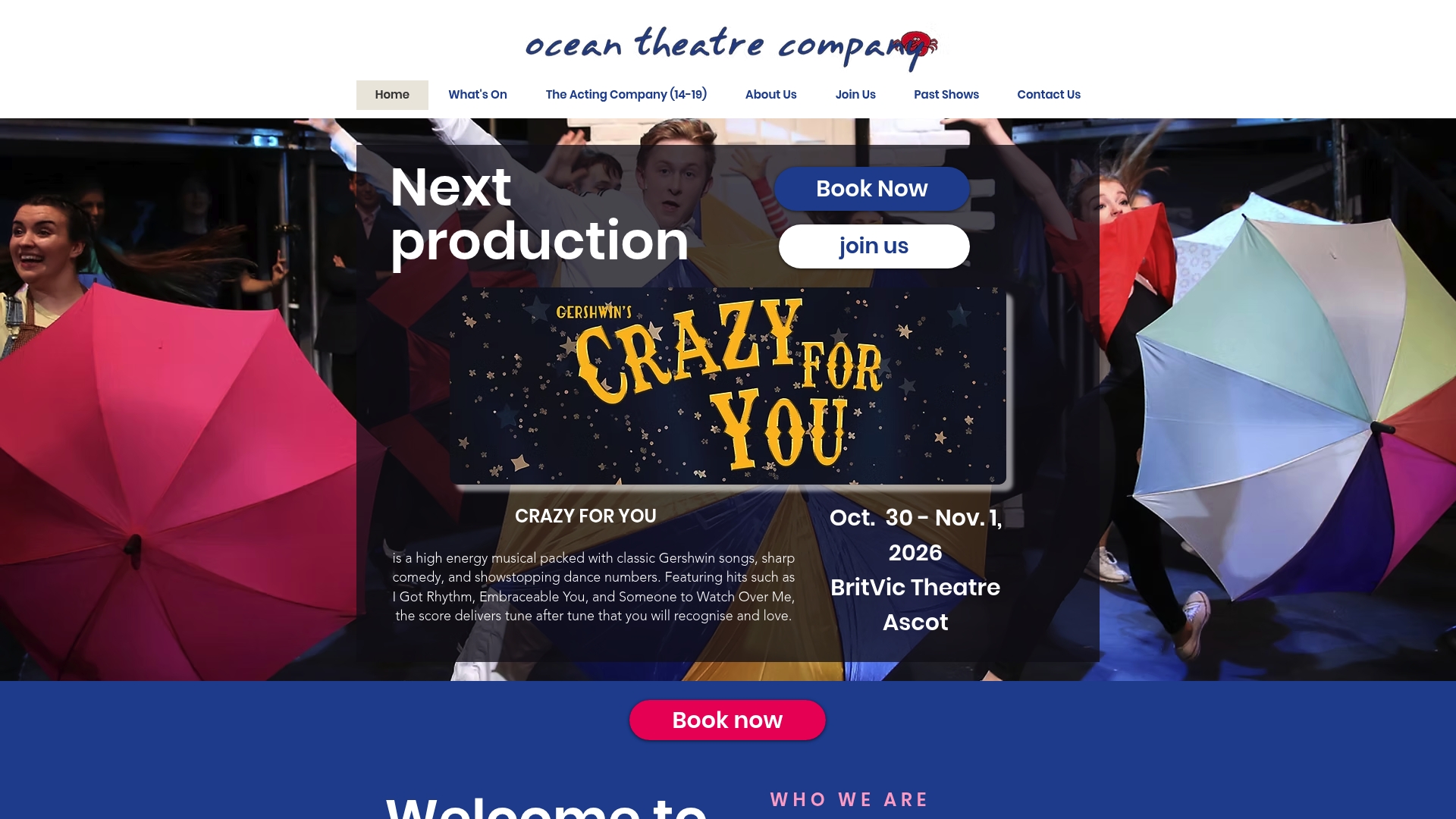
You can see our current production on the What’s On page, or visit Ocean Theatre Co. in Berkshire to find out more about joining. Whatever you decide about Equity and Spotlight later, you will arrive with real credits and the confidence to use them.
FAQ
Is Equity or Spotlight better for a young actor?
They do different jobs, so it is not a straight choice. Equity is a union that supports you at work, and Spotlight is a directory that casting professionals search. Most young performers benefit from building experience first and then adding either one when they have credits to show.
Can I join Equity and Spotlight at the same time?
Yes, many professional performers hold both. Equity offers subsidised membership for eligible performers aged 10 to 17, and Spotlight has an under-18 tier at £136.50 a year, according to its 2026 support page. Check each organisation’s entry rules first, because both ask for professional credits or training.
What is the difference between Spotlight and Mandy?
Spotlight is a directory where agents and casting directors look for performers. Mandy is a jobs platform where you apply to posted casting calls and crew roles. Spotlight has stricter entry requirements, while Mandy is open to a wider range of creatives, so young people should always have a parent check any listing.
Does the court case affect me as a teenager?
Not directly. The Court of Appeal hearing is listed for 24 November 2026 and could change how directories are regulated, but it will not stop you training or performing. Look at Equity’s news page for the outcome and any change to fees.
Do I need an agent before joining Spotlight?
No. Spotlight lists several routes in, including professional credits, qualifying training or a recommendation from a registered agent or casting director. An agent is one route, not a requirement.
Sources
Recommended
Comments