

Nail a 32 Bar Cut in 60–90 Seconds With Hands On Rehearsal

A 32-bar cut is shorthand for roughly 60 to 90 seconds of music, not a literal count of measures. What matters far more than counting bars is choosing a complete dramatic moment, a setup, a turn, and an aftermath, that shows the panel who you are within seconds. Get that shape right and the length looks after itself.
TL;DR:
A 32-bar audition cut typically lasts between 60 and 90 seconds, but slow ballads may extend beyond that, making timing more important than measure count.
Choose a cut centered on a clear dramatic turn, ensuring it includes a full phrase at the start and end, with a natural shift in emotion.
Mark your sheet music precisely, confirm a comfortable key, and test tempo with your accompanist or backing track before the audition.
Select songs with obvious or story-driven turns that allow you to demonstrate character and emotional arc within the time frame.
Rehearse cold, record your performance, and practice with live and recorded accompaniment to build confidence and consistency under pressure.
Table of Contents
What does “32 bars” actually mean in practice?
The phrase comes from classic musical theatre songwriting, where the 32-bar AABA form (verse, verse, bridge, final verse) was the standard architecture for a show tune. Modern songs rarely follow that structure so neatly, which is exactly why “32 bars” has drifted from a literal measure count into a rough time window.
StageAgent recommends treating a 32-bar cut as under two minutes and a 16-bar cut as under a minute, with storytelling taking priority over the arithmetic. Audition coach Kyle Branzel makes a similar point: slow ballads with long, sustained bars can turn a “technically correct” 32 bars into something well over two minutes, which is why casting teams care about the clock far more than the score.
32-bar cut: roughly 60 to 90 seconds
16-bar cut: roughly 45 to 60 seconds
Exception: ballads with extended note values need trimming even when the bar count looks right
Rule of thumb: if in doubt, time it, don’t count it
How do you choose the exact bars to cut?
Vocal coach Topher Keene built his reputation on one idea: a strong cut behaves like a self-contained scene, with a setup, a turn, and an aftermath, rather than a highlight reel stitched together for maximum vocal show-off. That structure gives the panel a beginning, a shift, and a resolution, even in under a minute.
Here’s a repeatable process:
Find the dramatic moment. Read the lyric like a monologue and locate the line where the character’s feeling changes.
Centre your cut on that turn. Build backwards and forwards from it so the turn sits naturally in the middle third of the excerpt.
Check your bookends. Start on a full musical phrase and end on one too, never mid-line, never on an unresolved chord.
Test vocal security. Sing it cold, first thing in the morning, with no warm-up. If it holds up, it’s audition-ready.
Check accompanist-friendliness. Make sure the cut starts and ends where a pianist could realistically pick it up from sheet music.
Pro Tip: If you’re torn between two potential cuts, sing both for a friend who doesn’t know the show. Whichever one they understand emotionally without context is the stronger choice.
How do you prepare the sheet music, key, and backing track?
A great cut can still fall apart in the room if the accompanist can’t follow it. Preparation is where most of the actual audition is won or lost, long before you sing a note.
Mark your copy clearly: highlight the start bar, note whether there’s a bell tone or spoken intro, and flag any tricky page turns so the pianist never has to guess. Yale’s own audition packet confirms this is standard expectation, most panels assume you’ll arrive with clean, marked sheet music and treat that as basic professionalism.
On key and tempo:
Choose a key that sits comfortably in your voice on a tired day, not just your best day
Test the opening phrase as a genuine cold start, not after humming it through twice backstage
If you’re transposing, get it printed properly rather than scribbled by hand
Confirm tempo with your accompanist in advance if you’re not using a backing track
If you’re using a backing track instead of live accompaniment, check the licensing terms of wherever you source it, and always carry printed sheet music as backup even when a track is provided.
Which songs make good 16 or 32-bar cuts?
Some songs are audition workhorses because they offer a clean, obvious turn. Others get overused precisely because that turn is so easy to find, so a slightly less obvious moment can actually help you stand out.
For female-identifying voices:
A driving uptempo number with a clear button ending
A contemporary ballad with an unresolved final line that still lands emotionally
For male-identifying voices:
A comic uptempo cut that shows timing as much as tone
A legit ballad with a mid-song realisation rather than the obvious final climax
Gender-neutral and contemporary options:
Story-driven pop/rock musical theatre numbers with a spoken-word or rubato opening
Ensemble numbers with a strong solo break, useful for character-type auditions
Whatever you pick, map it onto the same shape: find where the character learns or decides something (the turn), give it a few bars of context beforehand (the setup), and let the last few bars show the consequence (the aftermath). Musicnotes publishes curated lists with suggested cut points if you want a starting shortlist rather than a blank page.
How should you rehearse and perform your cut?
Casting decisions form fast. Research from the Royal College of Music notes that panels often form an impression within the first eight bars, which means your entrance carries more weight than almost anything else in the cut.
Pick a cut you can sing well on a bad day, not just a good one. A cut built entirely around one spectacular high note is a gamble; if your voice is even slightly tired, the whole piece can collapse around that one moment. Build your rehearsal around three drills:
Cold starts. Sing the cut first thing, with zero warm-up, to simulate walking into a room unprepared.
Record yourself. Watch it back for posture, focus, and whether the turn actually reads.
Rehearse with both. Practise once with a live accompanist and once with your backing track, since the feel differs more than people expect.
Pro Tip: Enter the room already “in” the first line. If you’re still settling your breath or thinking about the setup as you begin, the panel will feel that hesitation before you sing a word.
Where can you find ready-made cuts and backing tracks?
You don’t have to build every cut from scratch. The Audition Cut offers karaoke-style videos with pre-marked 16 and 32-bar sections, useful for hearing how a cut sounds once trimmed. Musicnotes sells purchasable sheet music with suggested cut points built in, which saves time if you’re not confident marking your own.
When evaluating any backing track, listen for three things:
Does the arrangement match the tempo you’d actually sing at, or has it been sped up for the video?
Are there audible guide vocals or cues that might clash with your own performance?
Does the track start and end cleanly on your chosen bars, or will you need to edit it?
Whichever resource you use, StageAgent is worth checking too, since it catalogues suggested cuts by show and character type. And whatever track you bring, print the sheet music as well; most accompanists expect it regardless of format, and copyright terms on backing tracks rarely cover printed reproduction.
How does hands-on training help you nail your cut?
Reading about setup, turn, and aftermath only gets you so far. Building genuine confidence with a 32-bar cut takes repetition in front of real people, ideally with a working accompanist and honest feedback.
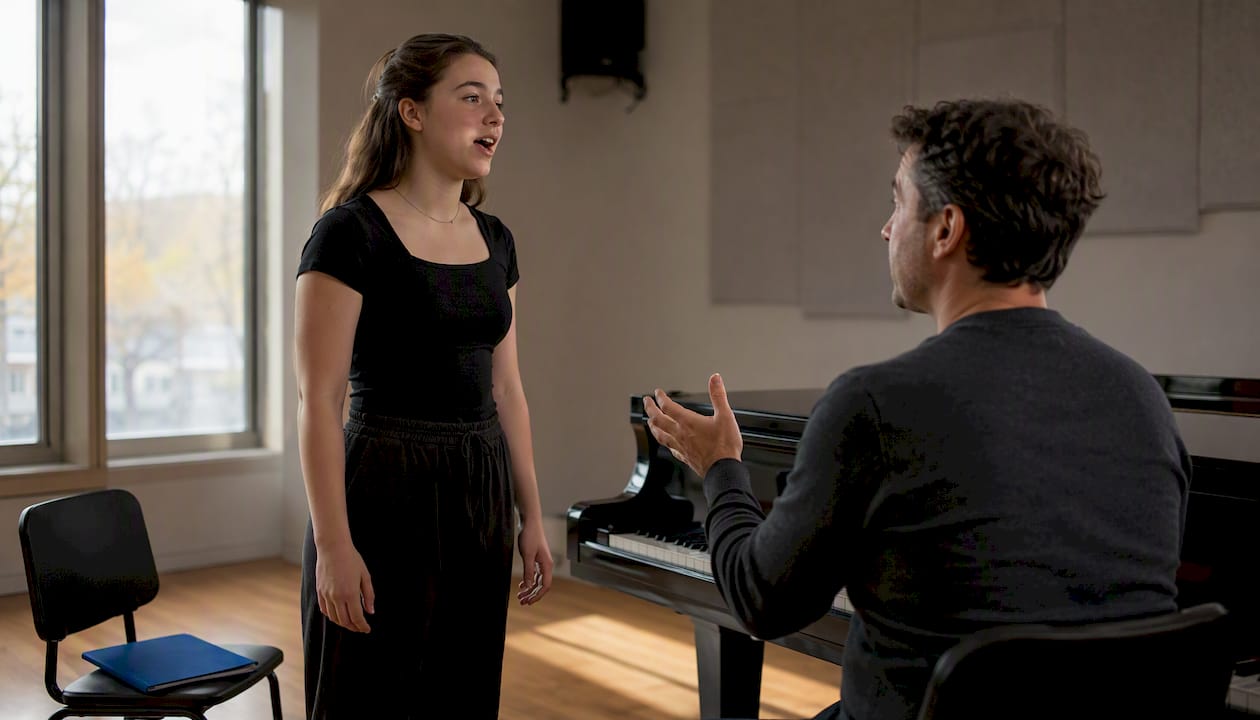
At The Company (14 to 19), our weekly rehearsals and professional-led direction give young performers exactly that kind of practice, cold starts, accompanist timing, and the discipline of committing to a moment from bar one. Participants preparing for their own auditions often find that the habits built rehearsing for our biannual productions transfer directly: strong entrances, secure keys, and the confidence to perform under pressure.
An honest note on preparation, and your one-page checklist
The temptation is always to chase the flashiest cut in the room, the biggest note, the loudest button. In practice, the performers who book work tend to be the ones who chose something they could sing convincingly on a Tuesday morning with no notice, not just on their best night.
Before your next audition, run through this: pick your dramatic moment, mark your music clearly, rehearse it cold at least once, confirm your key and tempo work under pressure, and practise presenting it from bar one, not from a warmed-up mid-song entry. Our production pages show the kind of repertoire choices that reward exactly this approach.
— Andrew
Ready to put your cut to the test?
Reading about the setup, turn, and aftermath framework is useful, but nothing replaces rehearsing your cut with a real accompanist and an honest room of peers watching you commit to that opening line. We offer hands-on practice, weekly rehearsals with professional direction, biannual productions, and no entry audition required, so you’re building genuine audition muscle memory rather than just theory.
[

If you’re aged 14 to 19 and based in Berkshire, The Company (14 to 19) gives you regular stage time, cold-start rehearsal habits, and feedback from professional-led direction, the same conditions that make a 32-bar cut feel second nature rather than nerve-racking. You can also see what’s currently in production, including CRAZY FOR YOU, to get a feel for the kind of high-energy, classic repertoire we work with. Enquire through the main programme page to find out how to join.
Sources
FAQ
Is a 32-bar cut about a minute long?
Not exactly, it’s usually longer than a minute. Most guidance, including the Yale School of Music’s audition packet, treats a 32-bar cut as around one minute, while StageAgent recommends aiming for under two minutes.
How long is a 32-bar cut roughly?
Roughly 60 to 90 seconds is the practical target for most songs. Tempo changes this considerably, a slow ballad with long note values can push a technically accurate 32 bars well past two minutes, which is why timing your cut with a stopwatch matters more than counting measures.
Can you give an example of a 32-bar song form?
The classic AABA structure, verse, verse, bridge, final verse, is the traditional 32-bar form found in many golden-age musical theatre standards. Modern musical theatre songs often abandon this structure, which is part of why “32 bars” now functions as a time-based term rather than a literal form.
What are some good 32-bar songs for an audition?
Strong choices usually have a clear emotional turn you can isolate cleanly, ballads and uptempo numbers alike. Musicnotes publishes curated lists with suggested cut points if you want a starting shortlist, and rehearsing your chosen cut with real accompanist time, the kind offered through The Company (14 to 19), helps you confirm it actually works under pressure.
Recommended
Comments