

Actors: What a Table Read Means, What Happens in 1–3 Hours

A table read is a full read-through of a script, done aloud, by the cast and key creative team, usually seated around a table rather than on their feet. Its purpose is twofold: it lets everyone hear whether the dialogue works, and it brings the whole team together, often for the first time. You’ll find the format used across film, television, and theatre alike.
TL;DR:
A table read typically reveals dialogue and pacing issues that are difficult to detect on paper, enabling timely script adjustments.
Attendance includes cast, director, writers, producers, and department heads, each focusing on performance, script integrity, or practical concerns.
The session usually lasts one to three hours for film or TV, with longer theatre reads combining rehearsal and script review.
Preparation involves actors annotating scripts beforehand, organizers providing printed materials, and recording sessions for review.
Feedback should be brief, specific, and collected after scenes without improvising or overacting, maintaining the session’s rhythm.
Table of Contents
What a table read is and why productions hold one
The industry also calls it a read-through, or sometimes “table work”, and it sits near the very end of pre-production, just before rehearsals or filming properly begin. That timing matters. Everything up to this point has been paper and plans; the table read is the first moment the script becomes sound in the room.
Hearing lines spoken aloud does something a script on the page cannot. Wooden dialogue suddenly sounds wooden. A joke that read well falls flat. A scene that felt tight on paper drags when an actor has to actually say the words. This is why a table read functions as a genuine diagnostic tool, not a formality.
What tends to surface at this stage:
Clunky or over-written lines that nobody caught on the page
Pacing problems, especially scenes that run too long once spoken
Plot holes or continuity gaps between scenes written weeks apart
Chemistry issues or mismatches between actors and characters
Practical snags, such as a line that’s simply too tricky to deliver naturally
Beyond the script itself, a table read is also where a company starts to feel like a company. Everyone in the room, whether they’re playing the lead or running the schedule, gets a shared understanding of the whole story for the first time.
Who attends a table read, and what they’re listening for
Attendance is wider than most newcomers expect. It isn’t just the actors reading their parts; a read-through typically draws together principal cast, director, writers, producers, and heads of department, each listening for something different.
Principal cast and director — focused on performance clarity: does the character sound right, does the relationship between two characters land?
Writers and producers — taking script notes on pacing, tone, and whether scenes still serve the story now that the whole thing is assembled.
Department heads — design, camera, and scheduling staff listening for practical red flags, like a scene that will be far harder to shoot or stage than the page suggested.
A designated reader or stage manager — often reads scene headings and action description in shorthand, keeping the session moving without pulling focus from the dialogue.
That last role matters more than it sounds. Without someone managing the non-dialogue parts, a read-through grinds to a halt every few lines.
What actually happens during a table read
The shape of a table read is fairly consistent, whether you’re in a rehearsal room in Berkshire or a studio soundstage. It usually runs in this order:
Introductions and framing. The director or a producer opens the session, sets expectations, and often reminds the room this is a working read, not a performance; this step is crucial as directors often use aspect ratio changes to evaluate interpretations and technical approaches during early script readings.
The read itself. Actors read their own dialogue; a stage manager or spare reader handles scene headings and action lines in an abridged form, keeping pace without slowing the room down.
Pauses for notes. After a scene, or sometimes after an act, there’s a short pause for discussion. Notes are kept brief and specific.
Capture and follow-up. Sessions are frequently recorded, and notes are logged for the writer or director to work through afterwards.
Expect scripts to shift even during the session itself. It’s common for pages to be handed out with last-minute changes right before or during the reading, which is exactly why nobody treats a table read as a finished product.
Pro Tip: If you’re organising one, appoint your non-dialogue reader in advance and give them a marked-up script. A confident reader keeps the whole room’s energy up, while a hesitant one can make even a strong script sound flat.
When it happens and how long it actually takes
A table read typically lands right at the boundary between pre-production and rehearsal, often signalling that pre-production is almost complete. In theatre, it frequently doubles as day one of rehearsals; in film and television, it can happen slightly earlier, once casting is locked but before the crew moves into full production mode.
Most table reads for a feature film or an hour-long television episode run between one and three hours, depending on script length and how much the director wants to stop and discuss along the way.
Theatre productions sometimes stretch this further, since a first rehearsal often folds in company introductions, a read of the whole script, and initial blocking conversations in one extended session. Film and television reads tend to be tighter and more clipped, partly because schedules are less forgiving and partly because the goal is diagnosis, not discussion.
How to prepare for a table read
Preparation looks different depending on which side of the table you’re sitting on, but the goal is the same for everyone: make the hour or two genuinely useful.
For actors:
Read the script through fully beforehand and annotate it, rather than arriving cold.
Know your character’s arc and intentions, but don’t feel you need lines memorised.
Read with clarity and intent, not full performance energy. Over-projecting or acting the socks off a scene can mask genuine problems rather than reveal them.
For organisers:
Provide printed scripts and a simple call sheet with timings, so nobody is squinting at a phone screen.
Have a designated non-dialogue reader briefed and ready to go.
Set out refreshments and factor in short breaks for longer scripts.
Record the session; it’s far easier to review pacing problems afterwards than to remember them accurately.
For writers and directors: the hardest job is often listening rather than talking. Take notes, resist the urge to explain or defend a line the moment it lands awkwardly, and save the real conversation for after the read.
Pro Tip: Keep a single shared notes document open during the session. It stops feedback getting lost between five different notebooks and gives the writer one clean list to work from afterwards.
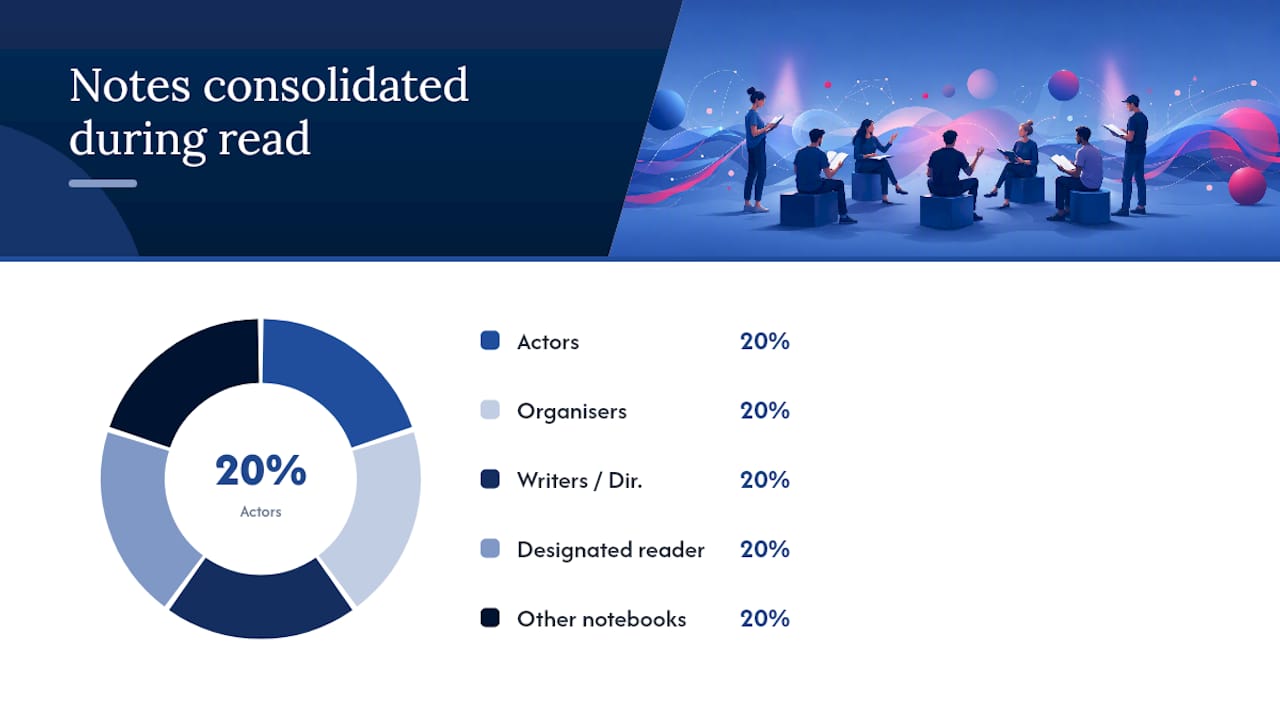
Table read etiquette and the misconceptions that trip people up
The most common misunderstanding is treating a table read as an audition, or a performance to be judged. It’s neither. Nobody is being cast off the back of it, and nobody should be trying to steal the scene.
Over-acting is a real problem here, not just an awkward habit. If an actor performs a line with heavy inflection or invented business, it can mask a line that’s genuinely not working, which defeats the entire purpose of the exercise. The same goes for improvising extra dialogue on the spot. The read is there to reveal what’s actually on the page, not what a talented actor can make of it.
Notes etiquette follows naturally from this:
Keep feedback brief, specific, and tied to a moment, not a general critique of a character.
Offer notes after a scene, not mid-line, so the read keeps its rhythm.
Write notes down rather than debating them live. Most genuine problems need a rewrite, not a conversation in the room.
How Ocean Theatre Company puts table reads to work
A table read is often treated as both a rehearsal milestone and a confidence-building moment for young performers. For company members, it’s often the first time the full cast hears a script together, and casting decisions feel confirmed in the room rather than just on a list pinned to a noticeboard.
Productions such as The Addams Family and Our House are built on exactly this kind of early, collaborative groundwork, where hearing the script aloud sets the tone for weeks of rehearsal ahead.
A short checklist for approaching this stage includes:
Everyone gets a printed, annotated script before the first read.
The read is framed clearly as a team moment, not a test.
Notes are gathered constructively and fed straight into rehearsal planning.
Why table reads still earn their place in modern production
Some assume table reads are an old-fashioned ritual, a holdover from an era before rehearsal software and pre-visualisation tools took over. That’s a mistake. What a table read does, which no amount of digital planning replicates, is put a script’s actual sound and rhythm to the test in front of the exact people who’ll have to make it work on stage or in front of a camera.
A brief run-through can substitute when a scene is minor or a schedule is genuinely tight. But for a full script, particularly one with an ensemble cast, skipping the table read tends to store up problems that surface far more expensively later, mid-shoot or mid-rehearsal, when changes cost time nobody has. The collaborative value isn’t sentimental. It’s that a room full of people catches what one writer alone, however good, cannot.
— Andrew
Sources
The core definitions and practical guidance behind this article draw on the NFI’s table read overview for timing and purpose, Wikipedia’s read-through entry for attendance and production context, StudioBinder’s hosting guide for practical steps, NoFilmSchool’s explainer on diagnostic use, and the Cambridge Dictionary entry for the plain-language definition.
If you’d like to see what comes after the table read stage, Oceantheatre’s main company page for ages 14 to 19 explains how rehearsals and casting develop through to full staged productions.
FAQ
Why do actors do a table read?
Actors take part in a table read so the whole team can hear the script spoken aloud before rehearsals or filming begin. It reveals problems with dialogue, pacing, or character chemistry that are hard to spot on the page alone, and it’s usually the first time the full cast and crew are in a room together.
What should you expect at a table read?
Expect a read-through of the entire script, with actors voicing their own dialogue and a designated reader covering scene headings and action lines. There are short pauses for notes after scenes, and it’s common for pages to change on the day itself, so treat it as a working session rather than a finished performance.
Do productions still hold table reads?
Yes. Table reads remain standard practice across film, television, and theatre, typically sitting at the end of pre-production or the start of rehearsals. They’re valued precisely because no amount of digital planning replaces hearing a script spoken by the people who’ll actually perform it.
How long does a table read take?
Most table reads for a feature film or an hour-long television episode last between one and three hours, depending on script length and how much discussion the director wants along the way. Theatre reads can run longer where they double as the first full rehearsal.
Recommended
Comments