

Four Week Off Book Plan for 14–19 Actors: What Off Book Means

Off book means an actor has fully memorised their lines and no longer needs the script during rehearsal or performance. For young performers, this is the moment rehearsals shift from learning words to building a real performance, and it’s a milestone every director in youth theatre watches for closely. It applies to anyone stepping into a role, whether you’re 14 and playing your first ensemble part or 19 and carrying a lead.
TL;DR:
Actors should aim to be fully off book before blocking rehearsals to enable natural reactions and allow directors to add movement and stage business.
The recommended schedule involves starting memorization at least four weeks before opening, with gradual, spaced practice and testing on separate days.
Falling behind on off-book deadlines can slow rehearsal progress and lead to rushed, superficial memorization that impacts performance quality.
Stricter stage expectations require actors to produce lines solely from cues, without scripts, once the deadline approaches, unlike screen work where sides or cue cards are common.
The key to lasting memorization involves consistent testing, focus on cue-based recall, and maintaining flexibility for creative choices after becoming fully off book.
Table of Contents
Off book meaning in practice: what changes when the script disappears
How to build an off-book rehearsal schedule that actually works
What directors expect, and how to behave when you’re not quite off book yet
Off book beyond the stage: the same phrase, a different world
How Ocean Theatre supports young performers on the road to off book
Why the “off book” deadline gets more attention than it deserves, and less than it needs
Off book meaning in practice: what changes when the script disappears
Once you’re off book, your hands are free, your eyes are up, and your attention moves from the page to the person opposite you. That shift sounds small. It changes everything about how a scene plays. Being off book frees an actor to focus on blocking, listening, and emotional choices rather than line recall, which is exactly why being off book improves naturalness and physical engagement so noticeably once the script is gone.
Picture a rehearsal room where half the cast is still glancing down mid-sentence. The scene stutters. Cues get missed. Now picture the same scene two weeks later, once everyone’s off book: eye contact holds, reactions land in real time, and the stage manager can finally block movement without someone bumping into furniture because their nose was in a script.
A few practical differences show up straight away once a scene goes off book:
You can react to what your scene partner actually does, not just what you expect them to say.
Directors can add blocking, choreography, and stage business without a script getting in the way.
Mistakes become more obvious, which is uncomfortable but useful, because it’s how you fix them before opening night.
Your performance starts to feel like you, rather than a recitation.
It’s worth noting that theatre’s off-book culture is stricter than most screen work, where actors often work from sides or cue cards between takes. On stage, there’s no second take, so the deadline for going off book carries far more weight.
When should a cast be off book? A phase-by-phase timeline
There’s no single universal date, but there is a sensible sequence most rehearsal processes follow, and knowing it helps you plan rather than panic.
Rehearsals typically move through three broad phases:
Table work and read-throughs. Scripts are expected here. This is where you’re working out character, intention, and the shape of scenes, so the book stays in hand.
Blocking rehearsals. This is the real turning point. You should be off book before blocking rehearsals lock in for a scene, so you can focus on where you’re moving and why, not on reading lines while walking into a mark. HitCue’s guidance on off-book timing puts it plainly: the target window is to be off book by the start of blocking for that specific scene, not the whole show at once.
Run-throughs and polish. By this stage, off book is the assumed baseline for everyone, every scene, no exceptions.
Directors and stage managers set these deadlines deliberately. Being off book enables more fluid, engaged performances, and a firm deadline is really a production control tool: it drags rehearsal time away from recall and toward the ensemble work that actually makes a show land.
A few baseline deadlines worth holding yourself to:
Off book for a scene before its first blocking session.
Off book for the full show before opening is generally expected in most youth and community productions, often with some reasonable lead time set by the director.
No scripts allowed in run-throughs once the polish phase begins.
How to build an off-book rehearsal schedule that actually works
The biggest mistake young actors make isn’t laziness. It’s leaving memorisation until the week before it’s due and hoping panic will do the work. A rehearsal plan that counts back from the off-book deadline and sets per-scene gates removes that risk, because a countback plan distributes memorisation sensibly rather than dumping it all into one frantic week.
Here’s a four-week countdown structure that works well for most youth theatre roles:
Week 1: Read and map. Read the whole script, highlight your lines, and sort your scenes into heavy, medium, and light by how much text you carry in each. Give the heaviest scenes the most days on your calendar.
Week 2: Cue-first drills. For each scene, cover the script and try to produce your line from your scene partner’s cue alone, not from memory of “roughly what comes next”. This is harder than it sounds and far more useful than reading the page repeatedly.
Week 3: Blackout and cover-and-recall. Use the blackout test, covering the page entirely and performing without peeking. If you hesitate or glance down, that line isn’t secure yet, full stop. Mix in cover-and-recall (read a line, cover it, say it back) and short spaced repetition sessions rather than one long cram.
Week 4: Consolidation only. No new memorising. Run scenes with a partner, run the full show in your head during downtime, and test yourself on two separate days to check the lines hold up when you’re not thinking hard about them.
If you’re down to three days before an off-book deadline, don’t try to relearn everything at once. Split the show into thirds, drill each third with a partner using cue-first runs, then do one full blackout run-through the night before. It won’t feel comfortable, but it works far better than re-reading the whole script from the top.
Pro Tip: Test yourself on two different days, not just twice in one sitting. Testing on separate days is a stronger signal that a line is genuinely locked in, because your brain has had time to forget the surface details and you’re checking real recall, not short-term echo.
Weekly and daily targets help too. Aim to nail one scene fully off book every few days rather than trying to hold the whole script loosely in your head at once. Little and often beats one exhausting cram session, every time.
What directors expect, and how to behave when you’re not quite off book yet
Directors set off-book deadlines for a reason, and it’s rarely about being strict for its own sake. Many directors won’t allow scripts in hand once the deadline passes, because a script in someone’s hand during a run-through slows down everyone else’s work too, not just yours.
If you’re not quite there yet, there’s a right way to handle it:
Call “line” clearly and calmly rather than mumbling or trailing off, so the prompt can respond quickly and the scene keeps moving.
Keep your script closed unless you genuinely need it. Holding it open “just in case” during blocking rehearsals slows the whole room down.
Don’t apologise repeatedly or make a big performance of forgetting. Take the line, reset, and carry on.
If you’re consistently behind, talk to your director privately rather than letting it become obvious mid-rehearsal.
One caution worth taking seriously: don’t lock in your delivery too early. Some practitioners warn that memorising too rigidly, too soon, can flatten a performance before you’ve had the chance to discover better choices through rehearsal. Know your lines cold, but stay open to a director asking you to try a moment differently, even in week four.
For parents, the most useful support isn’t drilling lines nightly, though that helps. It’s helping your young performer build a realistic schedule and sticking to short, regular practice sessions rather than one long panicked session the weekend before.
Off book beyond the stage: the same phrase, a different world
The phrase “off book” turns up outside theatre too, and it’s worth knowing that so you’re not confused when you spot it elsewhere. In business and finance, “off the books” describes transactions or arrangements kept outside official financial records, an entirely different and unrelated use of similar wording.
That’s a completely separate context with its own rules and implications, and it has nothing to do with what happens in a rehearsal room. If you search “off book meaning” and land on an article about accounting or unrecorded trades, you’ve found the wrong sense of the phrase entirely.
In theatre, the meaning is fixed and specific: memorised lines, no script in hand. It’s used the same way whether you’re rehearsing a school play, a community panto, or a professional production. The consistency actually helps. Once you understand what off book means on stage, that meaning holds everywhere in the performing arts, from am-dram halls to West End rehearsal rooms.
Knowing this distinction matters mostly so you can talk about your rehearsal process clearly with people outside theatre, parents included, without anyone assuming you’re discussing something financial when you mention being “off book” for a show.
Common misconceptions about being off book
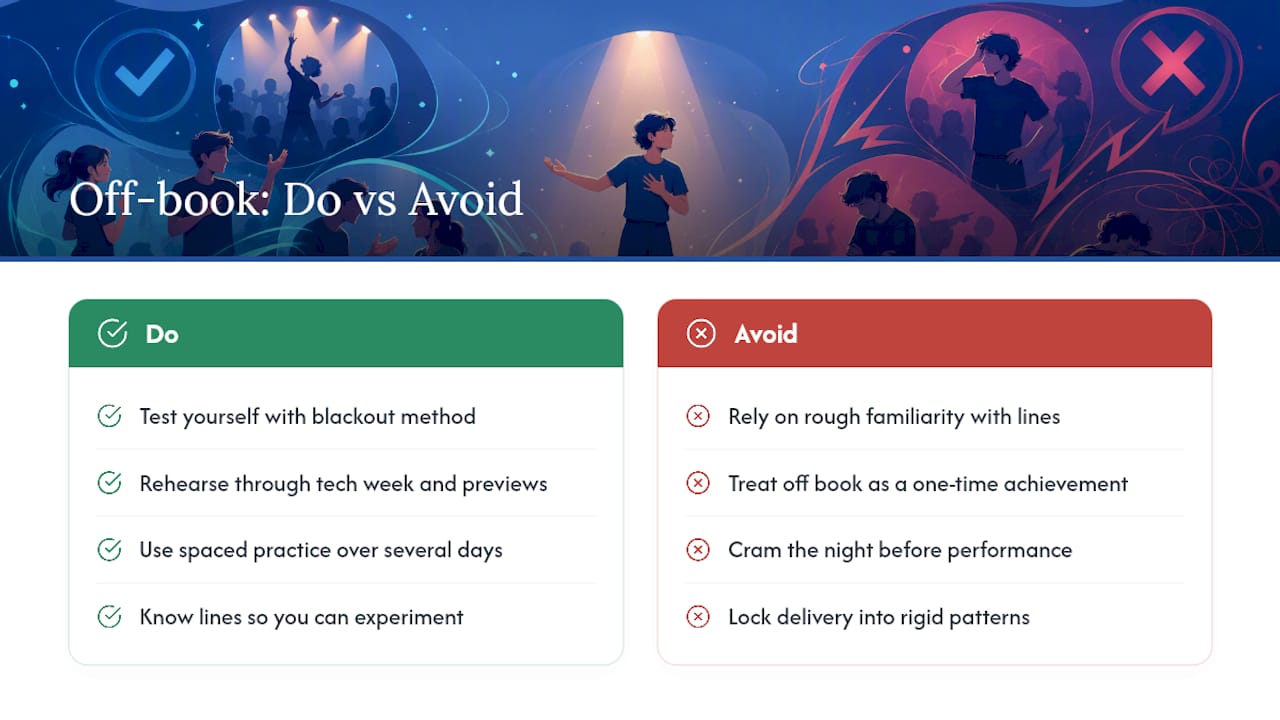
The biggest myth is that off book means “roughly knows the lines.” It doesn’t. Off-book is not simply being able to read lines correctly with the script nearby for backup; real off-book means producing the next line from your scene partner’s cue alone, with no visual prompt, and holding that recall steady across separate days, not just in one good run.
A second misconception: that being off book is a one-time achievement you tick off and forget. Lines can slip, especially under the added pressure of costumes, lights, or an audience for the first time. Staying off book means maintaining the work through tech week and previews, not just hitting the deadline once and coasting.
Third, some young actors assume memorising fast is memorising well. Speed-reading a script the night before a deadline might get you through a single run, but it rarely survives the following week. Slower, spaced practice across several days produces far more reliable recall than one long cram, even if the cram feels productive at the time.
Finally, there’s a myth that off book means rigid and unchangeable. Being secure in your lines shouldn’t mean locking your delivery in stone. The best off-book performers know their words so thoroughly that they can experiment freely with tone, timing, and reactions, because the words themselves are no longer a worry.
Avoiding these traps comes down to one habit: test yourself properly, with the blackout method, on more than one day, rather than assuming familiarity equals readiness.
How Ocean Theatre supports young performers on the road to off book
We’ve built our rehearsal process around helping young performers reach off book with confidence, not panic. Our structured, professionally led rehearsals give every cast member a clear sense of what’s expected and when, because we know that vague deadlines are how young actors end up cramming the week before opening.
Across two large-scale musical productions each year, from big ensemble shows like Our House to demanding book-heavy pieces like Sweeney Todd, our directors set per-scene expectations early and offer extra coaching to performers who need more support with memorisation. Nobody gets left to work it out alone.
What makes this work isn’t pressure, it’s structure paired with genuine encouragement. Parents regularly share how much confidence young performers gain once they’ve experienced holding a scene off book for the first time, script down, eyes up, fully present in rehearsal. That moment, more than any note or deadline, is where the real growth happens. It’s one of the reasons families choose Ocean Theatre as a genuinely supportive standard of youth theatre training.
Ready to see what off-book confidence looks like on stage?
If you’ve read this far, you already understand more about off-book readiness than most first-time cast members do walking into rehearsal one. That’s the kind of preparation built into these productions, with structured rehearsal schedules, professional direction, and support for young performers working towards their own off-book moment.
Whether your teenager is drawn to big ensemble energy or a meatier character role, our productions, from Legally Blonde to upcoming shows, are built to stretch young performers while keeping the process encouraging rather than overwhelming. Explore Ocean Theatre Company’s current programmes and see how we help young actors turn memorised lines into performances worth remembering.
Why the “off book” deadline gets more attention than it deserves, and less than it needs
Most rehearsal advice treats the off-book deadline like a hard cliff edge: hit it or fail. That framing misses what’s actually going on. The deadline isn’t the goal. It’s a proxy for something harder to measure, whether an actor has internalised the material enough to stop performing recall and start performing character.
I’d argue the more useful mental model for young actors is to treat “off book” as a floor, not a ceiling. Getting the words out without the script is the minimum bar, not the finish line. The real work, the work that makes an audience believe you, happens in the weeks after you’re technically off book, when you’re free to actually listen to your scene partner instead of waiting for your cue.
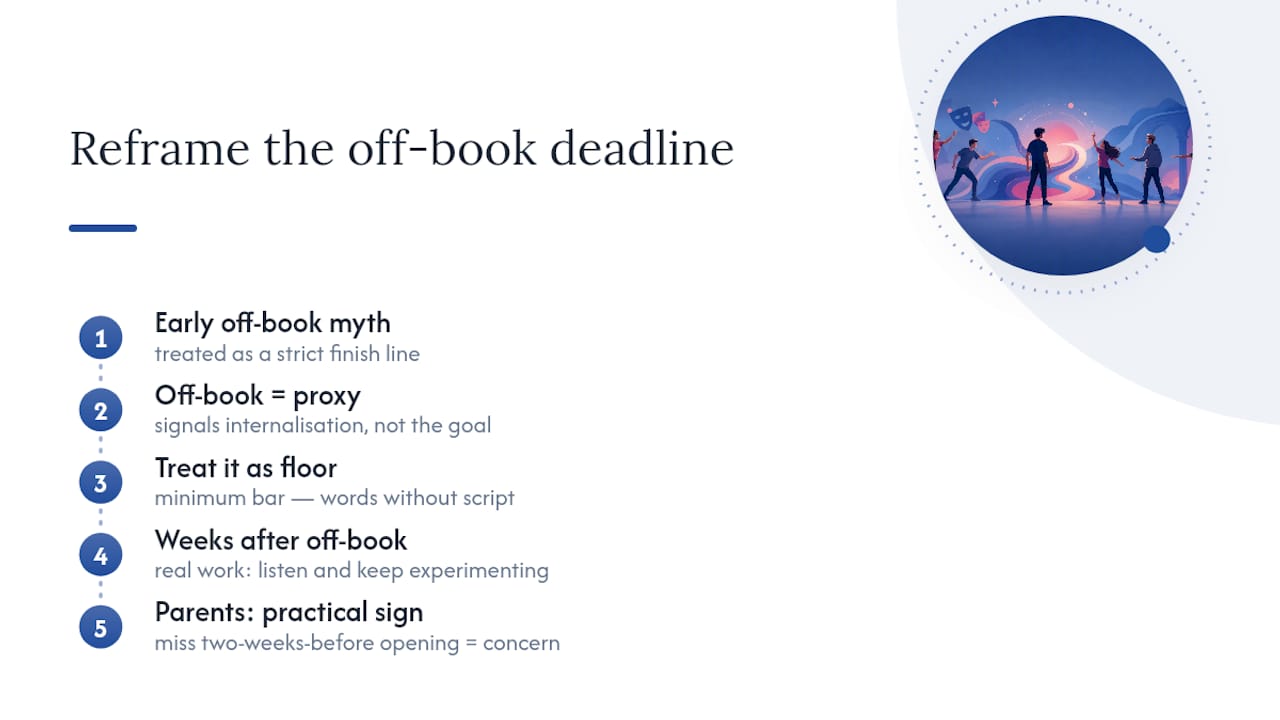
Where I think a lot of well-meaning advice goes wrong is in treating early memorisation as an unqualified virtue. It isn’t. An actor who locks in every inflection and pause by week two often gives a flatter performance by opening night than one who reaches off book slightly later but keeps experimenting. Security in the words matters enormously, but security shouldn’t calcify into a fixed performance before a director has had the chance to shape it.
For parents watching this process from the sidelines, the most useful thing you can do isn’t quiz your teenager nightly, though that helps, it’s understanding that missing an early off-book target isn’t a crisis. Missing the two-week-before-opening deadline consistently, on the other hand, is a genuine signal worth a calm conversation about workload and practice habits.
— Andrew
Sources
Recommended
Comments